Done well, this move unlocks real operational and financial advantages. Done poorly — or at the wrong time — it creates compliance gaps, strained vendor relationships, and costs that exceed what you were trying to save.
According to Deloitte's 2024 Global Outsourcing Survey, 80% of executives planned to maintain or increase third-party outsourcing investment — yet 70% reported their vendor management office was not fully mature. That gap between outsourcing volume and oversight capacity is exactly where things go wrong.
This article covers which business scenarios make outsourcing the right call, the warning signs that it's time to act, when to hold off, and how to make the transition work.
Key Takeaways
- Outsourcing vendor management makes sense when capacity is stretched, expertise is thin, or vendor portfolios outpace team bandwidth
- Company size, growth stage, regulatory complexity, and contract timing all influence the decision
- Declining vendor performance, rising management costs, and upcoming contract renegotiations are the clearest signals to act
- Strong internal teams may benefit more from refining existing processes before outsourcing
- In regulated industries, HIPAA and PCI compliance expertise are non-negotiable criteria for any outsourcing partner
Why the Timing of Vendor Management Outsourcing Matters
Outsourcing vendor management is not a one-size-fits-all decision. The same move that rescues one organization can create disruption for another, depending entirely on when and how it's executed.
Two timing mistakes consistently drive poor outcomes:
- Too early: Outsourcing before vendor requirements and performance expectations are clearly defined leaves the incoming partner without enough context. The result is poor oversight, strained relationships, and cost overruns.
- Too late: Waiting until vendor relationships are in crisis compounds every problem. Missed contract windows, unmonitored SLA drift, and accumulated compliance exposure are all harder to address once things have already broken down.
The governance gap makes this worse. Deloitte's 2023 Global Third-Party Risk Management Survey of more than 1,300 leaders across 40 countries found that only 27% said their budgets had increased to match rising third-party management complexity. Organizations are managing more vendor relationships with proportionally less oversight — and that gap grows every year.
That's the core timing argument: outsourcing works best when it's a deliberate operational choice, not a last resort after vendor relationships have already frayed.
When Outsourcing Vendor Management Makes Sense: Key Scenarios
Not every business needs to outsource vendor management. But certain conditions make the case hard to argue against. Here are four of them.
Company Size and Internal Capacity
Small and mid-sized businesses rarely have the headcount to manage multiple BPO or contact center vendors effectively. Building an internal team with the right mix of contract, compliance, and performance expertise takes time and money most growing companies don't have. Outsourcing fills that gap without the lead time of hiring.
Enterprises face a different version of the same problem. Even dedicated internal teams hit capacity ceilings when managing dozens of vendor relationships simultaneously. At that scale, partial or full outsourcing becomes a practical pressure valve — not a fallback.
Expertise Gaps on Your Team
Effective vendor management across contact center and BPO relationships requires multi-disciplinary knowledge that few internal teams possess in full:
- Contract negotiation and benchmarking
- Performance management and SLA enforcement
- Compliance review — HIPAA, PCI DSS
- RFP/RFI design and vendor evaluation
- SOC report analysis and security due diligence
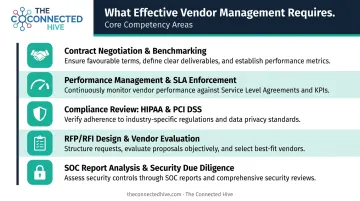
When any of these competencies are missing internally, the gap shows up in delayed audits, missed contract issues, and regulatory exposure. Outsourcing to a specialist who handles these tasks daily — rather than quarterly or reactively — closes that gap directly.
That's the kind of expertise The Connected Hive brings to each engagement. Tim Austrums has over 20 years of executive BPO and contact center experience, including working knowledge of HIPAA and PCI compliance requirements — depth that's genuinely difficult to replicate in a single internal hire.
During Rapid Growth or Scaling Cycles
Rapid growth — entering new markets, launching new products, or scaling customer service operations — is a high-risk window for vendor management breakdowns. Internal resources get pulled toward growth priorities, and vendor oversight quietly degrades.
Outsourcing during these phases maintains the oversight function while your team focuses on what matters most. The Connected Hive has helped eCommerce clients navigate unexpected demand surges and seasonal scaling challenges because an outside partner could absorb the vendor coordination complexity while the business scaled.
Ahead of a Major Contract Renewal
One of the highest-leverage moments to bring in an outsourcing partner is ahead of a major vendor contract renewal. An experienced partner can:
- Identify unfavorable terms before you're locked in
- Benchmark your current costs against the market
- Negotiate more favorable agreements from a position of knowledge
Tim Austrums has closed $5–6 million dollar contracts and negotiated multi-million dollar vendor relationships throughout his career. That experience frequently delivers savings that more than offset the outsourcing cost — making the renewal cycle one of the clearest ROI moments for bringing in outside help.
Signs It's the Right Time to Outsource Vendor Management
Think of the following as a practical checklist — the more boxes you check, the stronger the case for outsourcing.
Capacity and expertise signal:
- Internal vendor management staff are consistently overwhelmed
- Performance reviews, compliance audits, or SLA checks are being delayed or skipped
- No single team member has full competency across all vendor management disciplines
Performance signal:
- One or more key vendors are underperforming
- The internal team lacks the bandwidth or data infrastructure to identify root causes
- Corrective action plans exist on paper but aren't being enforced
Cost signal:
- Vendor management costs are rising without a clear explanation
- Contract terms are not being actively monitored for compliance or value
- There's no mechanism for validating whether vendors are delivering ROI against what's been paid
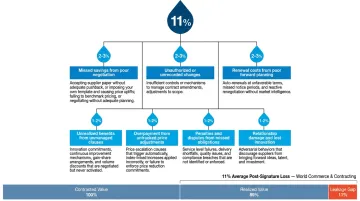
Cross-sector research from World Commerce & Contracting shows average post-signature value leakage of 11% across enterprises, driven by missed savings, unmanaged contract clauses, and unauthorized changes. That number reflects what passive contract oversight consistently costs organizations.
Upcoming high-stakes contract signal:
- A major vendor contract is approaching renewal
- A new vendor selection process is underway and requires independent expertise
- The organization has no internal capacity to run a competitive benchmarking exercise
When several of these signals converge, particularly around a contract milestone, the cost of inaction tends to outpace the cost of bringing in outside expertise.
When Outsourcing Vendor Management Isn't the Answer
Outsourcing isn't always the right move. Three situations where it's likely the wrong call:
When your internal team is already well-resourced. If you have a clearly defined vendor management function operating at high capacity, adding an external layer creates duplication, confusion in vendor relationships, and unnecessary cost. Refine internal processes first.
When the partner lacks compliance expertise. In healthcare or financial services, a vendor management partner without genuine HIPAA or PCI knowledge creates more risk than they resolve. Regulatory fines, data exposure, and reputational harm don't disappear because oversight was outsourced — PCI DSS v4.0.1 (Requirement 12.8) makes clear that outsourcing activities doesn't transfer compliance accountability. The organization retains ultimate responsibility.
When the scope isn't defined. Without a clear internal understanding of vendor requirements and performance expectations, an outsourcing partner doesn't have sufficient context to manage relationships effectively. The result: poor outcomes, strained vendor partnerships, and cost overruns that defeat the purpose entirely.
Outsourcing works when internal capacity, genuine expertise gaps, and business complexity align to make the case. If those conditions aren't present, start by clarifying your internal requirements before bringing in an external partner.
Best Practices for Making Vendor Management Outsourcing Work
Define Scope Before You Engage
Organizations that clearly articulate their needs before outreach consistently achieve better outsourcing outcomes. Before contacting any partner, document:
- Which vendor relationships need active management
- What compliance requirements apply (HIPAA, PCI, GDPR, CCPA)
- What performance outcomes you expect and over what timeframe
- Your current contract status and upcoming renewal dates
- Budget parameters and internal escalation thresholds
The Connected Hive's intake process asks prospective clients to provide industry classification, monthly call volume, current outsourcing status, and preferred start timeline before a consultation begins — a model worth emulating regardless of which partner you engage.
Vet Your Partner as Rigorously as Your Vendors
The evaluation criteria that apply to your BPO vendors apply equally to the firm you hire to manage them. Look for:
- Sector-specific experience in your industry, not just general outsourcing or procurement consulting
- Proven compliance expertise across the frameworks that govern your business (HIPAA, PCI, GDPR)
- Client references from organizations with comparable size, complexity, and regulatory profile
- A partner network with genuine relationship depth, not just directory access
- Communication practices and escalation protocols defined in writing before engagement begins
ISO 18295-2:2017 (which covers clients using outsourced customer contact centers) and COPC's CX Standard for VMOs are the strongest independent frameworks for evaluating partner qualifications. Both provide structured evaluation criteria worth applying during your due diligence process.
Retain Internal Oversight — Don't Fully Cede Control
Outsourcing vendor management complexity makes sense. Outsourcing your accountability does not, and regulators are clear on this point: using a third party doesn't reduce your organization's responsibility to operate safely, comply with law, and protect customers. Retain:
- Strategic decision-making authority
- Audit and escalation rights
- Compliance accountability
- Visibility through regular reporting and scheduled performance reviews
The outsourcing partner manages day-to-day complexity. You retain governance.
Establish KPIs and Communication Cadence From Day One
Performance drift almost always starts with ambiguity. Set clear expectations at the start of the engagement:
- Defined KPIs and SLA thresholds specific to your program
- A regular reporting rhythm — weekly, monthly, or tied to contract milestones
- Escalation procedures for missed benchmarks
- Structured feedback mechanisms and quality review schedules
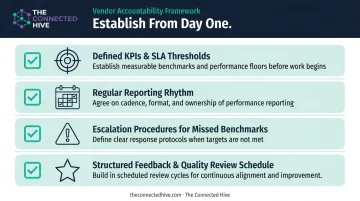
The Connected Hive's approach to client engagements centers on holistic business assessment and full transparency — establishing joint KPIs, clear communication protocols, and regular performance reviews as foundational elements, not afterthoughts. Any partner you consider should be able to demonstrate the same discipline before the engagement starts, not after problems surface.
Conclusion
There's no universal right time to outsource vendor management. The decision depends on company size, internal capacity, expertise gaps, growth stage, and contract timing, all of which shift as the business evolves.
What separates successful outsourcing decisions from costly ones is timing. Companies that engage a partner before vendor relationships deteriorate or compliance gaps surface spend far less on recovery than those who wait until the damage is done.
With a clearly defined scope and the right partner in place, vendor management stops being a drain on internal resources. It becomes a function that protects contract value, keeps vendors accountable, and frees your team to focus on work that actually moves the business forward.
Frequently Asked Questions
Is vendor management the same as outsourcing?
No. Vendor management is the internal process of overseeing third-party relationships — monitoring performance, managing contracts, and ensuring compliance. Outsourcing refers to delegating a business function to an external party. Vendor management outsourcing is when the oversight function itself is handed to a specialist firm.
What are the clearest signs a company needs to outsource vendor management?
The clearest signals: internal team consistently overwhelmed, compliance reviews being skipped, one or more vendors underperforming without corrective action, and a major contract renewal approaching without internal capacity to manage it effectively.
How much can outsourcing vendor management save compared to keeping it in-house?
Savings vary by portfolio size and current staffing costs. Cost advantages come from eliminating recruitment, training, benefits, and tooling overhead for internal staff. The Connected Hive's outsourcing engagements have achieved 20–30% cost reductions for clients, though your results depend on scope.
Can small businesses benefit from outsourcing vendor management?
SMBs are often the strongest candidates. Building an internal team with multi-disciplinary expertise — contract negotiation, compliance, performance benchmarking — is cost-prohibitive at smaller scale. Outsourcing provides immediate access to that expertise without the overhead of building it from scratch.
What should you look for when choosing a vendor management outsourcing partner?
Prioritize verified industry experience, compliance expertise relevant to your sector (HIPAA, PCI where applicable), client references from comparable organizations, a vetted partner network, and clear communication protocols established before the engagement begins.
What risks come with outsourcing vendor management?
Key risks include reduced internal visibility, potential misalignment with business-specific needs, and data security exposure. These are mitigated by retaining strategic oversight and audit rights internally, selecting a partner with strong compliance credentials, and establishing clear reporting and escalation protocols from the start.