
This article covers what nearshore outsourcing actually is, the concrete benefits it offers, how it compares to offshore and onshore models, which industries are best positioned to use it, the risks worth understanding, and how to build a partnership that holds up over time.
Key Takeaways
- Nearshore outsourcing places BPO teams in neighboring countries — for U.S. companies, typically Latin America — within 1–2 hours of Eastern Time
- Latin American hubs like Bogotá, Mexico City, and San José operate on fixed UTC offsets, keeping scheduling predictable year-round
- Nearshore models deliver 20–30% cost savings vs. in-house teams without sacrificing oversight or quality
- Healthcare, financial services, insurance, and government are the strongest fits due to compliance and bilingual requirements
- Successful partnerships require structured vendor vetting, clear SLAs, and defined KPIs set before work begins
What Is Nearshore Outsourcing?
Nearshore outsourcing is the practice of contracting business functions to a third-party provider in a geographically close, neighboring country rather than domestically or in a distant region. For U.S. companies, this almost always means Latin America — Mexico, Colombia, Costa Rica, and similar markets.
Three sourcing models define the landscape:
- Onshore — same country, highest cost, maximum oversight
- Nearshore — neighboring country, moderate cost, strong time zone and cultural alignment
- Offshore — distant country (India, Philippines), lowest cost, significant coordination challenges
How It Works in Practice
A U.S. business partners with a contact center or BPO provider in a nearby country to handle defined functions: customer service, technical support, back-office processing, or healthcare enrollment support. The nearshore team operates during overlapping business hours, communicates in English (and often Spanish), and works within regulatory frameworks familiar to U.S. buyers.
Consider a U.S. healthcare insurance company outsourcing its member enrollment call center to a provider in Colombia or Costa Rica. Agents in Bogotá operate just one hour behind New York (UTC-5, no daylight saving time), while teams in San José and Mexico City run two hours behind. That's a full shared workday, real-time supervisor access, and same-day escalation — without waiting on a next-morning email.
Key Benefits of Nearshore Outsourcing
Meaningful Cost Savings Without Sacrificing Quality
The loaded cost of a U.S. customer service rep extends well beyond that $20.59 hourly wage. Add employer benefits, recruiting costs, training infrastructure, facilities, and contact center technology, and the true per-agent cost climbs substantially. Nearshore outsourcing sidesteps most of that capital outlay.
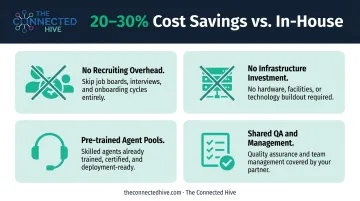
The Connected Hive consistently cites 20–30% cost savings compared to maintaining an equivalent in-house domestic team — and that figure holds across nearshore, offshore, and hybrid models. Nearshore may not match the deepest offshore price points, but it preserves something offshore often sacrifices: the ability to actually manage the program in real time.
Cost efficiency in nearshore extends across multiple dimensions:
- No recruiting overhead for individual agent hires
- No upfront investment in contact center infrastructure or technology
- Access to trained, managed agent pools without the attrition risk of building from scratch
- Shared management and QA infrastructure already in place at the provider
Real-Time Collaboration Through Time Zone Alignment
Bogotá runs at UTC-5 year-round — one hour behind New York. Mexico City and San José sit at UTC-6, two hours behind. None of these cities observe daylight saving time, so the gap shifts slightly when U.S. clocks change, but the working-hours overlap stays substantial throughout the year.
What that overlap actually buys you in a contact center context:
- Live supervisor monitoring and real-time agent coaching
- Same-day QA review and issue escalation
- Rapid response to campaign changes, service updates, or volume spikes
- Daily standups and weekly governance calls within normal business hours for both sides
The "relay race" dynamic common in offshore engagements largely disappears: a U.S. manager no longer sends instructions at end-of-day and waits until morning for a response.
Cultural Compatibility and Access to Bilingual Talent
Many Latin American markets offer a strong pipeline of bilingual English/Spanish agents who bring cultural familiarity to customer interactions. This matters more than it sounds, particularly for healthcare, insurance, and financial services — industries where conversations require empathy, precision, and trust.
The EF English Proficiency Index 2025 provides useful country-level benchmarks: Costa Rica scored 516 overall, with a customer-service function score of 574. Colombia scored 480 overall, 570 in customer service. Mexico scored 440 overall, with a notably strong customer-service function score of 599. These numbers vary by city and applicant cohort, so agent-level assessments still matter — but the talent pool is real.
For U.S. companies serving Spanish-speaking customers, bilingual capability is a direct business requirement. Nearshore Latin American markets meet that requirement with agent pools large enough to staff dedicated Spanish-language queues without compromising English-channel coverage.
Nearshore vs. Offshore vs. Onshore Outsourcing
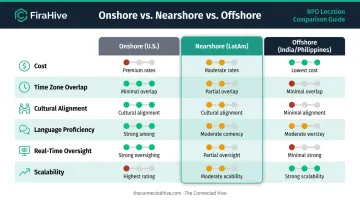
The decision between models comes down to a handful of dimensions that directly affect contact center performance.
| Dimension | Onshore (U.S.) | Nearshore (LatAm) | Offshore (India/Philippines) |
|---|---|---|---|
| Cost | Highest — $20.59+/hr median wage, fully loaded higher | Moderate — 20–30% savings vs. in-house | Lowest hourly rates, but total cost model varies |
| Time Zone Overlap | Full overlap | 1–2 hrs behind (fixed UTC) | 9–13 hrs difference |
| Cultural Alignment | Native | Strong regional affinity | Variable |
| Language Proficiency | Native English | Bilingual EN/ES; varies by city | Strong English in major markets |
| Real-Time Oversight | Full | Strong | Limited during U.S. hours |
| Scalability | Constrained by U.S. labor market | Flexible multi-country footprint | Large agent pools available |
When Each Model Makes Sense
Offshore fits price-led programs built around highly scripted, repeatable tasks where real-time collaboration isn't critical. Back-office data processing, overnight transaction handling, and large-volume outbound campaigns with minimal judgment calls are typical fits.
Onshore is typically reserved for the highest-sensitivity work: programs requiring domestic presence for legal or compliance reasons, complex escalations, or situations where data sovereignty rules out international delivery entirely.
Nearshore is where most U.S. companies with customer-facing BPO needs land. It captures the majority of offshore's cost advantage while maintaining the real-time oversight, cultural fit, and language quality that customer experience programs demand — without the coordination friction that comes with a 10-hour time gap.
Which Industries Benefit Most from Nearshore Outsourcing?
Healthcare and Insurance
Healthcare and insurance are the strongest vertical fits. Member enrollment, claims support, benefits inquiries, and care coordination all require bilingual agents who can handle sensitive conversations with accuracy and empathy.
HIPAA compliance is non-negotiable here — and the rule is clear: HIPAA follows the data and the contracted service, not the country. Compliance must be verified at the provider, site, subcontractor, and control level. Country location alone establishes nothing.
Tim Austrums, Founder and CEO of The Connected Hive, built his career in this space — leading enrollment and member experience programs for Humana, Blue Cross/Blue Shield, and other major healthcare organizations. That domain knowledge is directly relevant when evaluating nearshore partners for regulated healthcare programs.
Financial Services and Government
Financial services companies need agents who handle sensitive account inquiries with precision and PCI-DSS awareness. PCI DSS explicitly covers call-center and customer-contact entities — third-party service providers must be vetted, documented, and monitored for compliance, not assumed to be covered by a country's reputation.
Government agencies present a different challenge: urgent, high-volume programs that demand rapid ramp-up without sacrificing quality controls. Tim's work with FEMA, the State of Louisiana Office of Group Benefits, and the Louisiana Department of Children and Family Services reflects exactly this pattern — programs requiring fast mobilization, bilingual capacity, and structured oversight.
Retail, E-Commerce, and Technology
Retail and e-commerce companies use nearshore outsourcing primarily for customer care, order support, and seasonal surge management — situations where scalability matters more than deep domain expertise. Tech startups and SaaS companies use it for technical help desk and first-tier support. Common use cases across both verticals include:
- Customer care and order management during peak seasons
- First-tier technical support and troubleshooting
- Bilingual service for Spanish-speaking U.S. consumer segments
- Overflow handling during product launches or promotional events
Risks of Nearshore Outsourcing and How to Address Them
No outsourcing model is risk-free. Nearshore is no exception — but most risks are manageable with the right contract structure and governance.
Communication and cultural misalignment: Even with linguistic proximity, differences in communication styles or documentation practices create friction. Standardized protocols, onboarding alignment sessions, and regular governance cadences address most of them before they compound.
Data security and IP exposure: A 2021 cyberattack on one major Latin American BPO provider resulted in $34.8M in lost revenue and $11.3M in remediation costs in a single quarter. The risk is real. Contracts should cover:
- HIPAA Business Associate Agreements (for healthcare programs)
- PCI-DSS responsibility matrices (for financial services)
- Incident notification windows and audit access rights
- Subcontractor compliance obligations
- Data return and deletion on contract termination
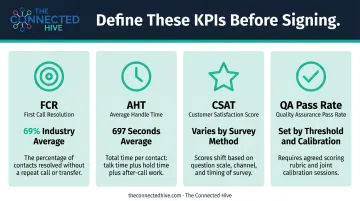
Vague SLAs and undefined KPIs: Undefined success criteria are the most common cause of nearshore partnership failure. Establish these metrics before signing — not after the first quality review:
- FCR (First-Contact Resolution) — 2024 industry average: 69%; define your queue-specific target and resolution methodology
- AHT (Average Handle Time) — industry average 697 seconds; baseline by queue type
- CSAT — define survey method, sample size, and attribution before launch
- QA pass rate — set thresholds, scoring rubrics, and calibration cadences
Vendor lock-in: Single-provider dependence without an exit plan is a structural risk that's easy to avoid — if you address it upfront. Negotiate IP ownership, documentation SLAs, and structured transition assistance into the contract from day one.
Working with an experienced advisor during contract negotiation is where this protection gets built in. At The Connected Hive, Tim Austrums' 20+ years negotiating multi-million dollar client/vendor relationships means exit provisions and compliance requirements are standard inclusions — not something clients have to ask for.
Best Practices for Building a Successful Nearshore Partnership
Vet Partners Rigorously Before Committing
Partner selection is the most consequential decision in nearshore outsourcing. Evaluate candidates across:
- Time zone coverage and operating schedule confirmations
- Bilingual agent proficiency — require role-specific assessments, not country averages
- Compliance certifications relevant to your industry (HIPAA BAA, PCI-DSS documentation)
- Reference checks from clients in similar verticals
- Attrition management processes and agent tenure data
- Pilot terms and ramp-down provisions

Run a structured pilot before committing to full-scale rollout. The goal is to establish program-specific performance baselines and surface issues before they affect your customers at volume.
A consultant with direct industry relationships can compress this process considerably. The Connected Hive's network spans 8,000+ global contact centers, and Tim Austrums' 20+ years of executive relationships with contact center owners give clients faster access to vetted candidates than any RFP process alone can deliver.
Establish Clear Governance and Communication Standards
Define the operating structure before the engagement goes live:
- Daily standups during ramp-up and for high-volume programs
- Weekly performance reviews with shared dashboards
- Monthly governance calls covering trend analysis and scope adjustments
- Documented escalation paths with named contacts and response SLAs
Set a Statement of Work that defines scope, deliverables, quality thresholds, and change control processes explicitly. Assume nothing is understood unless it's written down.
Measure Performance and Continuously Optimize
Successful nearshore partnerships aren't set-and-forget arrangements. Monitor KPIs consistently, use governance reviews to identify process gaps, and treat the partner as a strategic relationship rather than a transactional vendor. KPMG research shows 81% of organizations want providers to act as strategic collaborators — that expectation has to be established and reinforced through regular engagement, not assumed.
Frequently Asked Questions
What is nearshore outsourcing?
Nearshore outsourcing is contracting business functions to a third-party provider in a geographically close, neighboring country. For U.S. companies, this typically means Latin America. It combines cost efficiency with time zone alignment and cultural compatibility, making it distinct from offshore (distant country) or onshore (same country) models.
What is an example of nearshore outsourcing?
A U.S. healthcare insurance company outsourcing its member services call center to a provider in Colombia or Costa Rica. Bilingual agents operate within 1–2 hours of Eastern Time, under HIPAA-compliant processes, handling enrollment and member experience calls during normal U.S. business hours.
What is the difference between nearshore and offshore outsourcing?
Nearshore involves neighboring countries with significant time zone overlap — typically 1–2 hours for LatAm hubs — and strong cultural alignment. Offshore involves distant countries like India or the Philippines, with 9–13 hour time differences, lower hourly rates, but greater coordination complexity and reduced real-time oversight.
What are the main benefits of nearshore outsourcing for contact centers?
Key benefits include:
- Real-time collaboration during shared U.S. business hours
- Access to bilingual, culturally aligned agents
- 20–30% cost savings versus an in-house domestic team
- Compliance-ready partners for regulated industries like healthcare and financial services
Which industries benefit most from nearshore outsourcing?
Healthcare, insurance, financial services, and government are the strongest fits due to their need for bilingual, compliance-aware, customer-facing support. Retail, e-commerce, and technology companies also benefit, particularly for seasonal surge management and scalable customer care.
How do I choose the right nearshore outsourcing partner?
Evaluate compliance certifications, bilingual agent quality, industry experience, and performance in similar programs. Run a structured pilot before full commitment. A BPO consultant like The Connected Hive can accelerate the selection process — at no cost to the buyer — by matching you with vetted partners based on your program, compliance needs, and budget.