Outbound call centers flip the contact center model on its head — instead of waiting for customers to call in, agents pick up the phone and initiate the conversation. The applications go far beyond cold sales calls. From patient reminders to contract renewals to lead qualification, outbound programs touch nearly every stage of the customer lifecycle.
This guide covers what an outbound call center is, how it differs from inbound, the specific services it provides, the technology and metrics that drive performance, and how to find the right partner for your business.
Key Takeaways
- Outbound call centers proactively initiate calls for sales, lead generation, appointment setting, market research, and customer retention
- Federal regulations — including the TCPA and the FTC's Do Not Call Registry — set strict rules on who can be called, when, and by what method
- The global outsourced outbound services market was valued at $39.4 billion in 2024 and is growing at 10.8% annually
- Dialer type (predictive, progressive, or preview) directly affects both campaign performance and compliance risk
- Choosing the right outbound partner requires navigating vendor complexity — a process where a specialized advisor can save significant time and cost
What Is an Outbound Call Center?
An outbound call center is a business operation — either in-house or outsourced — where agents initiate contact with customers or prospects. Unlike inbound centers that wait for calls to arrive, outbound centers are proactive by design.
Every campaign starts with a defined goal: close a sale, qualify a lead, schedule an appointment, collect survey data, or retain a customer who's at risk of churning.
How Outbound Centers Operate Day-to-Day
Agents work from curated contact lists and follow campaign-specific scripts or call guides. Dialer technology automates the connection process to maximize time spent in live conversations rather than manually dialing. After each call, outcomes are logged back into a CRM — tracking dispositions, follow-up requirements, and conversion data.
The contacts themselves fall into two broad categories:
- Existing customers — retention outreach, renewal reminders, proactive service alerts, upsells
- New prospects — cold or warm outreach, lead qualification, telemarketing, appointment setting
That distinction matters. Outbound centers serve far more than just sales functions. A healthcare system using outbound calls for appointment reminders is running an outbound program, even if no transaction ever occurs.
Compliance Is Non-Negotiable
US outbound call centers must operate within a specific federal regulatory framework:
- FTC Do Not Call (DNC) Registry — Contact lists must be checked against the National DNC Registry, using a version downloaded no more than 31 days before calling. Most B2B sales calls are exempt, but consumer-directed campaigns are fully covered.
- Telephone Consumer Protection Act (TCPA) — Governs dialing methods, calling hours, and pre-recorded messages. Violations can result in $500 per violation in private actions, tripling to $1,500 for willful or knowing violations.
- FTC Telemarketing Sales Rule (TSR) — TSR violations carry civil penalties of up to $53,088 per violation, according to current FTC guidance. The FTC's 2024 rule also extended material misrepresentation prohibitions to B2B telemarketing.
- Calling hours — Covered residential telemarketing calls are restricted to 8 a.m.–9 p.m. local time at the called party's location.
The financial exposure is significant, but the reputational damage and class-action litigation risk make non-compliance even more costly in the long run.
Delivery Models
Outbound call center operations can be structured three ways:
- In-house — Full control, higher fixed overhead, significant hiring and training burden
- Outsourced BPO — Variable costs, access to specialized expertise and technology, faster scalability
- Blended model — Internal team handles core functions; BPO partner handles overflow or specialized campaigns
Choosing between these models is rarely straightforward — regulated industries like healthcare and financial services face compliance requirements that can significantly narrow the field of viable BPO partners.
Outbound vs. Inbound Call Centers
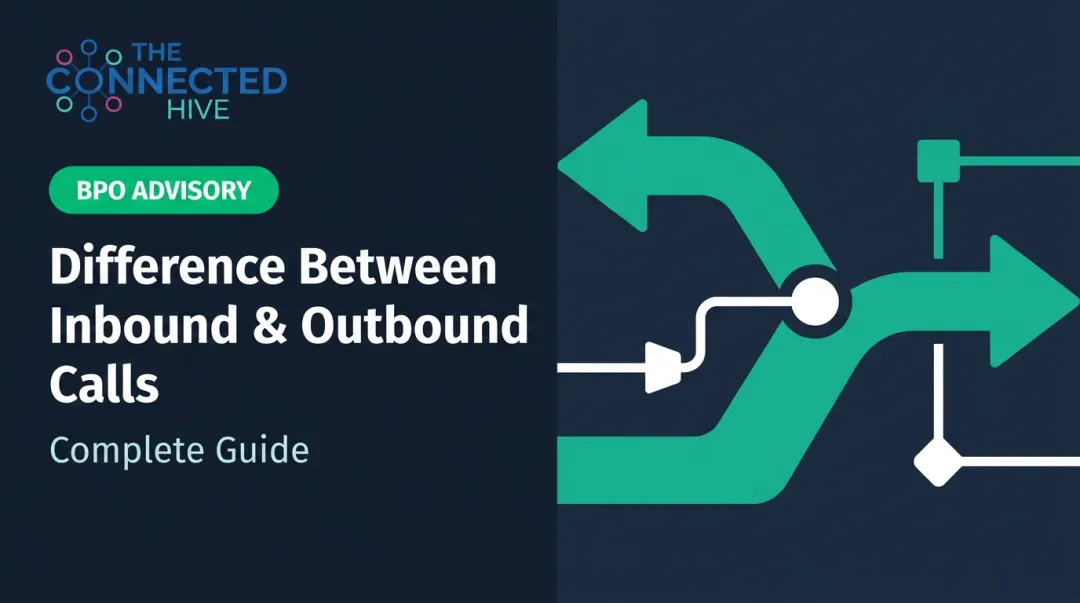
The core difference is directional. Inbound centers receive calls initiated by customers — support inquiries, billing questions, complaints. Outbound centers place calls to customers or prospects. Neither is superior; they serve different strategic purposes and often complement each other.
Side-by-Side Comparison
| Dimension | Outbound | Inbound |
|---|---|---|
| Who initiates contact | Agent | Customer |
| Primary purpose | Sales, lead gen, retention, research | Support, service, information |
| Key technology | Dialers (predictive, progressive, preview) | ACD, IVR, ticketing systems |
| Primary KPIs | Contact rate, conversion rate, cost per acquisition | FCR, CSAT, average handle time |
| Typical use cases | Telemarketing, appointment setting, surveys | Customer service, tech support, billing |
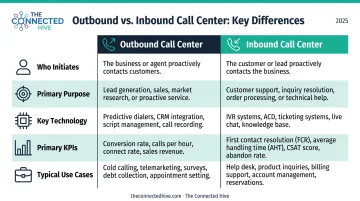
Many organizations run a blended contact center where the same agents handle both inbound and outbound interactions depending on call volume. When evaluating outsourcing, knowing which model (or combination) fits your operation determines which vendor capabilities to prioritize and which KPIs to hold them accountable to.
Types of Outbound Call Center Services
Sales and Telemarketing
Outbound sales agents contact prospects with the goal of closing a deal or booking a sales meeting. Cold calls reach prospects with no prior relationship; warm calls follow up on leads who have already expressed interest in some way.
According to HubSpot's 2025 State of Cold Calling report, 34% of sales professionals reported slightly higher cold-call volume in 2025 compared to 2024 — suggesting phone outreach remains an active channel, not a dying one.
Lead Generation and Qualification
Lead gen teams focus on identifying and qualifying prospects, then passing only well-vetted opportunities to a sales team. The value isn't in closing deals — it's in pipeline efficiency. Sales reps spend their time on high-likelihood opportunities instead of unqualified contacts.
Appointment Setting
Outbound agents schedule meetings between prospects and sales reps, clinicians, or service professionals. This is especially prevalent in:
- Healthcare — patient appointment reminders and rescheduling (a 2023 randomized study found that targeted live reminder calls reduced no-show rates among at-risk patients)
- Financial services — advisory consultations, product review meetings
- Field services — technician scheduling, installation coordination
Missed appointments and scheduling gaps cost money and, in healthcare, affect care outcomes. The difference between a well-run appointment-setting program and a poor one shows up directly in revenue and patient retention.
Market Research and Surveys
Some outbound teams exist purely to gather data: customer satisfaction scores, product feedback, competitive intelligence. These insights feed directly into product development, marketing strategy, and service improvements. There's no sales pitch involved. The entire purpose is structured listening at scale.
Customer Retention and Proactive Service
Outbound centers serve a customer success function. Agents reach out before a contract renews, follow up after a negative experience, or alert customers to product changes before they become problems.
McKinsey research on next-best-experience programs found that coordinated proactive engagement approaches can improve customer satisfaction by 15–20% and revenue by 5–8% (that evidence covers multichannel programs, not outbound phone calls in isolation). The directional signal still holds: proactive outreach reduces inbound complaint volume and builds loyalty when executed well.
How Outbound Call Centers Operate: Technology and Key Metrics
Dialer Technology
Dialer selection shapes both efficiency and compliance exposure. Three main types are used:
Predictive dialers use algorithms to anticipate agent availability and auto-dial ahead of current calls ending. They maximize call volume but require careful configuration — FCC rules cap abandoned live-answered telemarketing calls at 3% per campaign over 30 days, and calls must ring at least 15 seconds or four rings before disconnecting.
Preview dialers show agents customer information before connecting the call. Agents choose when to dial, which improves quality on complex or high-value calls. Best suited for sensitive interactions — healthcare, financial services, high-ticket sales.
Progressive dialers dial one number at a time per available agent. They reduce abandoned calls compared to predictive dialers while maintaining more efficiency than purely manual dialing. A middle ground for teams that need balance between volume and quality.
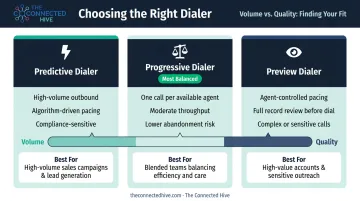
Dialer choice is a compliance decision as much as a technology one. Predictive dialers misconfigured for volume can generate abandoned call rates that trigger regulatory violations.
Key Metrics to Track
The right dialer gets calls connected — the right metrics tell you whether those calls are working. Performance measurement should match the campaign goal:
| Metric | What It Measures | Poor Result Signals |
|---|---|---|
| Contact rate | % of dial attempts reaching a live person | Bad list quality or wrong calling hours |
| Conversion rate | % of contacts achieving the campaign goal | Script issues, agent skill gaps, poor targeting |
| Cost per acquisition (CPA) | Total spend ÷ successful outcomes | Inefficient dialing or high handle times |
| Average handle time (AHT) | Average call duration from start to disposition | Over-scripting or agent knowledge gaps |
| Calls per agent per hour | Agent productivity across a session | Dialer inefficiency or high post-call work |
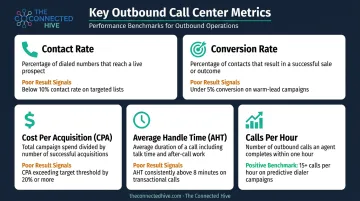
Most modern outbound centers layer CRM integration and conversation intelligence tools on top of these KPIs. Real-time transcription and sentiment analysis, for example, let managers catch script problems within days rather than discovering them in a month-end report — which is where campaigns quietly bleed budget before anyone notices.
How to Find the Right Outbound Call Center Partner
Selecting an outbound call center partner is more complex than reviewing a vendor's website. The criteria that matter most:
- Industry experience — A partner that has worked in healthcare, financial services, or insurance understands the nuance those sectors require. Domain knowledge isn't optional in regulated industries.
- Compliance capabilities — HIPAA, PCI-DSS, TCPA, and DNC adherence must be verifiable — not just claimed.
- Technology infrastructure — Can their systems integrate with your CRM? Do they use the right dialer type for your campaign goals?
- Scalability — Can they ramp up for seasonal campaigns and scale back without disruption?
- Cultural alignment — Outbound agents represent your brand in direct conversation. How they speak, handle objections, and treat prospects reflects on you.
Why Many Businesses Work with an Advisory Firm
Vetting contact center providers is time-consuming and technically demanding, particularly for organizations without prior outsourcing experience. The Connected Hive, a Minneapolis-based contact center consultancy founded by Tim Austrums, serves as a strategic intermediary for businesses navigating this process.
The firm starts with a detailed needs assessment covering business goals, culture, budget, and compliance requirements. From there, they match clients with vetted partners from a network spanning 3,500+ domestic US contact centers and 8,000+ globally.
The process includes RFP/RFI creation, site visit audits, proposal evaluation, and negotiation support. In most cases, this comes at no cost to the client, as the fee is paid by the placed partner.
In one documented case, a leading insurance company connected through The Connected Hive achieved a 30% increase in customer retention over six months after being matched with a specialized outbound contact center focused on customer engagement.

What to Demand from Any Partner
Whether you use an advisory firm or vet partners independently, hold every candidate to the same standard before signing:
- Request references from current clients in your industry — not a curated shortlist the vendor controls
- Listen to actual call recordings before committing; agent quality is impossible to assess on paper
- Tie SLAs directly to your campaign KPIs, not generic industry benchmarks
- Establish clear escalation paths so you know exactly who to contact when performance slips or a compliance issue surfaces
- Expect ongoing communication from your partner, not just monthly report drops
Frequently Asked Questions
What is outbound in a call center?
"Outbound" refers to calls initiated by call center agents rather than received from customers. Outbound activity supports sales, lead generation, market research, appointment setting, and proactive customer service — any function where the agent makes the first contact.
What is inbound vs. outbound call center?
Inbound centers receive calls from customers seeking help or information. Outbound centers place calls to reach prospects or existing customers. Most businesses run both functions together, or use a blended model where agents handle either call type based on volume and priority.
What are the main types of outbound call center services?
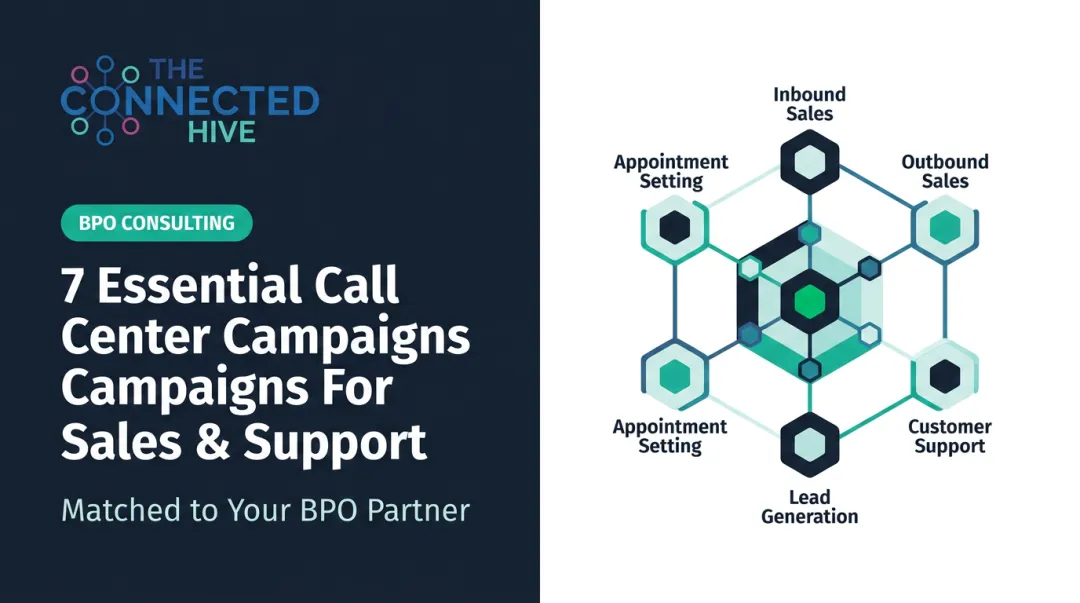
The five primary categories are:
- Sales and telemarketing
- Lead generation and qualification
- Appointment setting
- Market research and surveys
- Proactive customer retention outreach
Most outbound programs focus on one or two of these, though blended campaigns are common.
What US regulations apply to outbound call centers?
Outbound centers must comply with the FTC's Do Not Call Registry and Telemarketing Sales Rule, as well as the TCPA. These rules govern who can be called, which dialing methods are permitted, and during which hours. Violations carry substantial penalties — up to $53,088 per TSR violation and $500–$1,500 per TCPA violation.
What metrics should I track to measure outbound call center performance?
The core outbound KPIs are contact rate, conversion rate, cost per acquisition, average handle time, and calls per agent per hour. Which metrics matter most depends on your campaign goal — volume-driven programs like lead generation prioritize different measures than quality-driven ones like complex sales or retention.
When should a business outsource its outbound call center operations?
Outsourcing is a strong fit when:
- You need to scale quickly without hiring permanent staff
- Your team lacks in-house outbound strategy or compliance expertise
- Your industry requires specialized regulatory knowledge (healthcare, financial services)
- You want to convert fixed overhead into variable costs
If any of these apply, outsourcing typically delivers faster results than building an internal team from scratch.