Introduction
Picture this: a customer calls to dispute a charge, insisting your agent promised a full refund. Your agent says otherwise. Without a recording, you're stuck in a he-said-she-said situation that costs time, money, and a long-term customer relationship.
That scenario plays out across contact centers every day. It's also why call recording has become standard practice — not a nice-to-have, but a core operational requirement.
This guide covers everything decision-makers need to know: what call recording is, the types available, key benefits, legal obligations across jurisdictions, must-have system features, and how to evaluate whether an outsourced call center partner has the recording infrastructure your business requires.
Key Takeaways
- Call recording captures every agent-customer interaction — making it essential for quality assurance, compliance, agent training, and dispute resolution.
- Recording laws vary by state and country, with one-party vs. all-party consent rules requiring legal review before recording any call.
- Healthcare and financial services face additional requirements under HIPAA and PCI-DSS governing how calls are recorded, stored, and deleted.
- When outsourcing, your partner's recording infrastructure is an extension of your compliance obligations — vet it with the same rigor you apply internally.
What Is Call Center Call Recording?
Call center call recording is the process of capturing and storing audio from interactions between agents and customers for playback, review, and analysis. Modern systems also capture screen activity in sync with voice, and extend that coverage to digital channels like chat and email.
Voice Recording vs. Screen Recording
These are two distinct capabilities, and conflating them creates blind spots:
- Voice recording captures what was said — the words, tone, and commitments made during the call.
- Screen recording captures what the agent was doing in the system simultaneously — which account they pulled up, what data they entered, which scripts they followed.
Together, they give supervisors and QA teams full context — not just what was said, but how the agent handled the system in real time. Voice recording alone won't show whether an agent pulled the right account, entered data correctly, or followed required scripts.
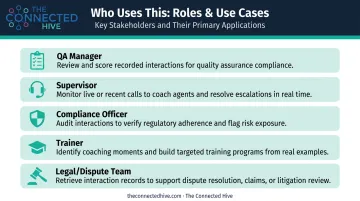
Who Uses Call Recordings — and Why
| Role | Primary Use |
|---|---|
| QA Managers | Scoring agent performance against defined criteria |
| Supervisors | Real-time monitoring and live coaching |
| Compliance Officers | Verifying regulatory adherence and consent disclosures |
| Trainers | Building onboarding libraries from real customer interactions |
| Legal/Dispute Teams | Retrieving time-stamped records for escalated complaints |
Types of Call Center Call Recording
Automatic vs. On-Demand Recording
Automatic (passive) recording captures every inbound and outbound call without requiring any agent action. Policy-based rules can filter by channel, call direction, skill group, or business criteria. For organizations with compliance obligations, this is the baseline requirement — gaps in coverage create audit exposure.
On-demand (active) recording requires a supervisor or agent to manually start and stop capture. It's useful for selective interaction capture or reducing storage costs, but carries an inherent risk: mandatory calls can be missed through human error.
ContactBabel's 2024 contact center survey found that ContactBabel's 2024 contact center survey found that 82% of contact centers used call recording, and among those, 65% recorded all calls while 35% could only capture part of an interaction. That 35% gap matters if your industry requires full coverage.
Cloud-Based vs. On-Premise Systems
- Cloud recording offers faster deployment, remote access, and straightforward scalability — 67% of contact centers surveyed by ContactBabel were already cloud-based, with another 25% planning to move within two years.
- On-premise recording gives organizations direct control over data storage and security infrastructure, which some regulated industries prefer.
- Hybrid models are increasingly common for organizations that need cloud flexibility alongside on-site control for sensitive data.
Where your recordings live shapes what you can do with them. Cloud-based platforms, in particular, have made AI-powered analysis far more accessible for mid-sized operations.
AI-Enhanced Recording
AI adds an analytical layer on top of recorded calls, turning audio files into structured, actionable data:
- Automatic transcription converts audio to full-text, making every call searchable
- Keyword spotting surfaces calls containing specific phrases — complaints, competitor mentions, compliance triggers
- Sentiment analysis identifies calls where customer frustration spiked, so supervisors can intervene before the issue escalates
Key Benefits of Call Center Call Recording
Call recording delivers value well beyond compliance. Here's where organizations see the clearest return:
- Quality assurance: Objective performance evidence speeds up QA review and coaching sessions
- Agent training: Real call libraries prepare new hires faster than scripts or hypotheticals
- Dispute resolution: Time-stamped recordings settle "what was said" disagreements quickly
- Business intelligence: Recurring complaints and product questions surface before they hit formal feedback channels
- Agent accountability: Awareness of recording keeps scripts and policies applied consistently
Quality Assurance and Agent Coaching
Recordings give supervisors concrete, objective evidence of performance rather than relying on memory or secondhand reports. A supervisor can pull the exact call where an agent missed a compliance disclosure or handled an escalation particularly well — and use it directly in a coaching session.
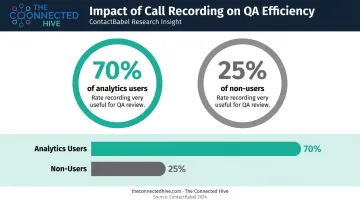
The impact on QA teams is measurable: according to the ContactBabel survey, 70% of analytics users considered recording "very useful" for speeding up QA review, compared to just 25% of non-users. That gap reflects how much time recordings save when supervisors don't have to reconstruct what happened from notes alone.
Accelerating New Agent Training
Those same recordings also accelerate onboarding. New hires learn faster from real calls than from scripts — a library of interactions, including strong examples and calls that went sideways, prepares agents for the range of situations they'll face before going live independently. Trainers work from specific, contextualized examples rather than hypotheticals, which shortens ramp time.
Dispute Resolution and Customer Protection
A time-stamped recording is the most direct way to resolve "what was actually said" disputes. Rather than extended back-and-forth with a customer — or expensive legal escalation — teams can retrieve the call, review it, and reach a fair resolution quickly.
Surfacing Broader Business Intelligence
Call recordings contain information that rarely makes it out of the contact center. Recurring complaints, common product questions, and persistent confusion around policies all show up in calls before they appear in formal feedback channels. Sharing these patterns with product, marketing, and operations teams turns the contact center from a cost center into a source of organizational insight.
Agent Accountability and Brand Protection
Agents who know calls are recorded consistently apply scripts and policies more carefully. Recording creates a deterrent against inappropriate behavior and gives compliance teams a way to monitor for tone-of-voice issues, script deviations, and policy violations — catching problems before they become reputation incidents.
Legal and Compliance Requirements for Call Recording
One-Party vs. All-Party Consent
Under U.S. federal law (18 U.S.C. § 2511), recording a call is lawful when one party to the conversation consents — in practice, the business doing the recording. However, multiple states impose stricter requirements.
Core all-party consent states (where all parties must be informed):
- California, Florida, Illinois, Maryland, Massachusetts, New Hampshire, Pennsylvania, and Washington
Conditional or mixed jurisdictions (requiring careful review):
- Connecticut, Delaware, Michigan, Montana, Nevada, and Oregon each have varying rules that depend on whether the call is criminal, civil, in-person, or telephone-specific
For interstate calls, follow the most restrictive rule that could plausibly apply. For international calls, GDPR requires a lawful basis under Article 6 — consent is one option, but legitimate interests or contractual necessity may also apply depending on the purpose.
Practical rule: Never assume implied consent. If you're unsure which jurisdiction applies, default to all-party disclosure.
The "This Call May Be Recorded" Announcement
The standard disclosure message serves a concrete legal function. It must play before the conversation begins (not mid-call) and must be audible and clear. In many jurisdictions, this announcement satisfies consent requirements. Businesses that skip it or bury it at the end of a long IVR sequence are taking on avoidable legal risk.
Industry-Specific Requirements — HIPAA and PCI-DSS
HIPAA: Any call recording that captures protected health information (PHI) is treated as electronic PHI (ePHI) and requires administrative, physical, and technical safeguards. Healthcare contact centers must also execute a Business Associate Agreement (BAA) with any BPO partner handling those recordings.
Covered entities that fail to secure ePHI face civil and potentially criminal penalties. HHS OCR enforcement actions have resulted in settlements ranging from tens of thousands to millions of dollars.
PCI-DSS: PCI Security Standards Council guidance is explicit: storing CVV/CVC/CID or other sensitive authentication data after authorization violates Requirement 3.2, even if encrypted. Any contact center processing payment card data must ensure those data points are never captured in recordings.
FINRA Rule 3170: Brokerage firms meeting specific conditions must record broker-customer conversations and retain them for a minimum of three years, with the first two years readily accessible. This applies to "taping firms" as defined by the rule — not every financial services call center.
Data Retention Policies
Retention requirements vary significantly:
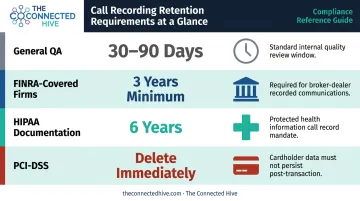
- General QA purposes: 30–90 days is common practice
- FINRA-covered firms: Three years minimum
- HIPAA documentation: Required compliance documentation is kept six years; call recordings containing ePHI follow security rule requirements
- PCI-DSS: Minimize stored cardholder data; delete sensitive authentication data immediately after authorization
Every organization should maintain a written, purpose-based retention policy. Storing recordings longer than necessary increases both storage costs and regulatory exposure. The right tools make staying within those limits — and proving it — significantly more manageable.
Consent Management and Redaction Tools
Pause-and-resume functionality allows agents to pause recording before a customer reads out card details or sensitive personal information. Automated redaction tools scrub PII from transcripts and audio after the fact.
PCI SSC notes that manual pause-and-resume depends entirely on agents executing it correctly : a single missed step can capture card data in a recording. Automated redaction reduces that human error risk, but neither tool alone constitutes full PCI compliance. Both require monitoring and verification.
Must-Have Features in Call Recording Systems
Core Recording and Storage
- Automatic and on-demand recording modes
- Encrypted storage (cloud, on-premise, or hybrid)
- Configurable retention rules by queue, channel, or regulation type
- Role-based access controls limiting who can retrieve, download, or delete recordings
- Failure alerts when recording policies aren't executing as expected
AI-Powered Transcription and Analytics
Searchable transcripts, keyword spotting, sentiment analysis, and AI-generated summaries turn your recording archive into a searchable, actionable knowledge base. A supervisor who once manually reviewed 40 calls per week can let AI flag the 5 that actually need attention — freeing up time for targeted coaching instead of exhaustive auditing.
System Integration
A recording system that doesn't connect to your existing tools loses most of its operational value. Key integrations that multiply impact include:
- CRM linkage — every recording surfaces alongside the customer's history, open tickets, and prior escalations
- Workforce management platforms — ties call data to scheduling, staffing, and performance trends
- Quality scorecards — auto-populates evaluation forms so reviewers spend less time on logistics and more on feedback
How to Evaluate a Call Center Partner's Recording Capabilities
When you outsource customer interactions, your partner's recording infrastructure becomes part of your compliance picture. Both FINRA and the FCA are explicit that outsourcing does not transfer compliance accountability — the regulated firm retains ultimate responsibility. Under HIPAA, the covered entity must obtain satisfactory assurances from business associates through a BAA, even though BAs can also be held directly liable.
Key Due-Diligence Questions to Ask
Before committing to a contact center partner, ask:
- Do you record 100% of calls automatically, or only on demand?
- How are recordings stored — what encryption standards apply?
- What is your documented data retention policy, and can it be configured by queue or regulation type?
- Are your systems HIPAA and/or PCI-DSS certified? Can you provide documentation?
- Who has access to recordings, and how is access logged and audited?
- Do you have pause-and-resume functionality and/or automated PII redaction?
- What happens to recordings at contract termination — can data be exported or is it deleted?
- How quickly can you provide a specific recording in response to a compliance audit or legal request?
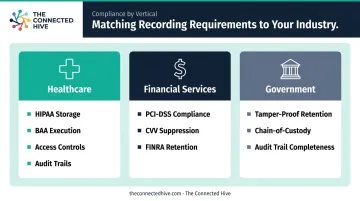
Matching Requirements to Your Industry
- Healthcare: HIPAA-compliant storage, BAA execution, access controls, audit trails
- Financial services: PCI-DSS compliance, CVV suppression or redaction, FINRA-applicable retention where required
- Government agencies: Tamper-proof retention, chain-of-custody documentation, audit trail completeness
Generic recording software is not the same as industry-specific compliance infrastructure. The right partner will have operational experience in your sector — not just a checkbox that says "HIPAA compliant" without the processes to back it up.
Working With a Consultant to Vet Partners
Evaluating a prospective partner's recording capabilities, compliance certifications, and data governance practices takes time and requires knowing what to look for — especially if your business is new to outsourcing.
The Connected Hive helps businesses navigate exactly this process. With a network of 3,500+ domestic and 8,000+ global contact centers, the firm brings 20+ years of executive experience in regulated industries — including healthcare (Humana, Blue Cross/Blue Shield) and financial services (Discover, Ameriprise). Partner vetting covers certification review, BAA execution confirmation, access control audits, and PCI-DSS compliance checks as standard steps, not afterthoughts.
There's no cost to the client. The Connected Hive is compensated by the placed partner once a match is confirmed.
Frequently Asked Questions
Is it illegal to record a call with customer service?
Recording is generally legal but jurisdiction-dependent. U.S. federal law requires only one-party consent, while certain states — including California, Florida, and Illinois — require all parties to be informed. GDPR imposes additional lawful-basis requirements for calls involving EU residents. Disclosing recording at the start of every call eliminates ambiguity across all jurisdictions.
Is it possible to record landline calls?
Yes. Landline calls can be recorded using dedicated hardware, a VoIP recording system connected to the phone network, or through a contact center platform that integrates with landline infrastructure. Federal and state consent rules apply regardless of whether the call travels over landline, VoIP, or cellular.
What is the difference between automatic and on-demand call recording?
Automatic recording captures every call without agent action — essential for full compliance coverage. On-demand recording requires a supervisor or agent to manually start and stop capture, which is useful for selective review but risks missing mandatory recordings through human error.
How long should call recordings be stored?
Retention periods vary by purpose: general QA typically requires 30–90 days, FINRA-covered firms must keep recordings for at least three years, and HIPAA documentation extends to six years. A written, purpose-based retention policy prevents applying a single timeframe where multiple obligations apply.
What is the difference between one-party and all-party consent?
One-party consent means only one person on the call needs to agree to recording — in practice, the business initiating the recording. All-party (two-party) consent requires every participant to be informed and agree, as required in states like California, Florida, and several others. Interstate calls should follow the most restrictive rule that applies.
What should I look for when evaluating a call center partner's recording capabilities?
Ask these questions before committing to any partner:
- Does the platform automatically record 100% of calls?
- How are recordings stored, encrypted, and accessed?
- What compliance certifications does the partner hold (HIPAA, PCI-DSS)?
- Is pause-and-resume or automated redaction available for sensitive data?
- Can recordings be exported if you switch vendors at contract end?