Introduction
AI is handling more customer interactions every year. According to Salesforce's 2025 State of Service report, AI resolved an estimated 30% of service cases in 2025 — with respondents projecting that figure to reach 50% by 2027. That shift isn't shrinking the importance of human agents. It's raising the bar for what they need to deliver.
When routine inquiries get filtered out, the calls that reach a human agent are the hard ones — emotionally charged, ambiguous, or high-stakes. Scripts don't cut it. Agents need real judgment and the ability to read a situation fast.
This guide covers the soft and hard skills that define high-performing agents in 2026. It's also a practical reference for businesses evaluating call center quality or vetting an outsourcing partner.
Key Takeaways
- Call center skills split into soft skills (empathy, active listening, communication) and hard skills (CRM proficiency, product knowledge, AI tool use) — both are required.
- Agents now need AI literacy to work effectively alongside AI copilots — it's no longer optional.
- Soft skills remain irreplaceable — AI cannot fully handle the emotional dimension of customer interactions.
- Evaluate BPO partners on agent skill benchmarks, training structures, and QA practices — not just pricing.
What Makes a Call Center Skill "Essential" in 2026
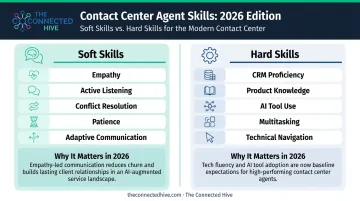
Call center skills fall into two broad categories. Soft skills are interpersonal — how an agent listens, communicates, and responds emotionally. Hard skills are technical — how an agent navigates systems, applies product knowledge, and uses digital tools. In practice, strong agents need both working together.
What's changed in 2026 is the context in which these skills get used. With 69% of service organizations now using at least one form of AI, AI handles the straightforward stuff — balance inquiries, order status checks, password resets. Human agents are left with what AI can't handle: escalations, emotionally charged situations, and nuanced judgment calls.
That raises the skill floor across the board. An agent who struggles with empathy or can't navigate a CRM under pressure is now handling the exact interactions where weak performance is most costly — and most visible.
Two skill types every agent needs:
| Skill Type | Examples | Why It Matters in 2026 |
|---|---|---|
| Soft Skills | Empathy, active listening, conflict resolution | AI can't replicate emotional nuance or judgment |
| Hard Skills | CRM use, product knowledge, AI tool proficiency | Agents work alongside AI tools daily |
Essential Soft Skills Every Call Center Agent Must Have
Active Listening
Active listening means capturing sentiment, tone, and the unstated need beneath what a caller actually says. An agent who listens actively gives tailored answers instead of scripted ones. That reduces repeat calls and builds customer trust faster than any efficiency metric.
The practical test: can the agent accurately summarize a caller's issue back to them before responding? That one behavior separates reactive agents from effective ones.
Empathy
Empathy is the single most effective de-escalation tool available to an agent. When a caller is frustrated or distressed, acknowledging their emotion without judgment changes the entire dynamic of the conversation, often before any solution is even offered.
In high-stakes industries like healthcare and financial services, this skill isn't optional. A member calling about a denied insurance claim or a patient navigating billing confusion needs to feel heard. Empathy doesn't slow calls down; it prevents them from spiraling.
Clear, Adaptive Communication
Agents interact with people across every background, technical level, and emotional state. The best ones shift their vocabulary, pace, and tone to match each caller: precise with technical users, plain-spoken with general customers, calm and measured with distressed ones.
Written communication follows the same logic. As omnichannel support grows, agents handle email, chat, and messaging alongside voice, each channel requiring a different register and style.
Patience and Resilience
Call center work is structurally high-pressure. Agents field emotionally charged calls back-to-back with minimal recovery time. ICMI reports that 54% of US contact centers see annual attrition between 21% and more than 50% — a figure that reflects how difficult the work genuinely is.
Agents with real resilience maintain service quality late in a shift or after a difficult interaction. Without it, quality erodes exactly when consistency matters most.
Conflict Resolution
Skilled agents defuse tension by expressing understanding, validating concerns, and redirecting toward solutions — without escalating the situation or abandoning brand standards. This requires composure, not just script compliance.
In regulated industries like insurance and government services, conflict resolution must operate within strict guardrails. Agents must resolve situations in a way that's both accurate and compliant, not simply whatever calms the caller in the moment.
Practically, that means agents need to know:
- Which escalation paths are available and when to use them
- What language is off-limits under compliance guidelines
- How to close a difficult call in a way that satisfies the caller without creating liability
Hard Skills That Drive Call Center Performance
Technical Proficiency
Agents navigate CRM systems, ticketing platforms, call management tools, and knowledge bases — often simultaneously while speaking with a customer. Competence here directly affects handle time, record accuracy, and first-call resolution rates.
An agent who fumbles through a system forces customers to wait, repeat themselves, and lose confidence. Technical fluency isn't a bonus skill — it's a baseline requirement for every role.
Product and Service Knowledge
Deep product familiarity lets agents give confident, accurate answers without putting customers on hold. Beyond feature knowledge, agents need to understand common failure modes, workarounds, and edge cases — so they act as advisors, not just information relays.
That depth matters most in complex-purchase categories like insurance, SaaS, or healthcare benefits, where customers typically call because they're confused or something has gone wrong.
AI Literacy and Tool Use
In 2026, agents work alongside AI copilots, interpret auto-generated summaries, act on suggested responses, and flag when AI outputs are inaccurate. McKinsey research on AI agent-assist tools indicates well-deployed implementations can reduce average handle time by up to 40% — but only when agents know how to use them correctly.
This isn't about programming. It's about knowing when to trust an AI recommendation and when to override it. An agent who blindly follows AI suggestions in an emotionally complex call — exactly the situation Forrester warns against over-automating — can damage customer relationships faster than no AI at all.
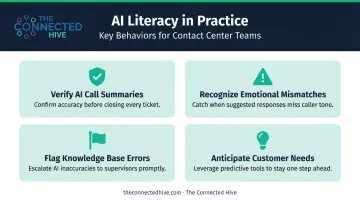
What AI literacy looks like in practice:
- Using AI-generated call summaries to confirm accuracy before closing tickets
- Recognizing when a suggested response doesn't fit the caller's emotional state
- Flagging AI knowledge base errors to supervisors for correction
- Using predictive tools to anticipate customer needs during a call
Multitasking and Organization
Agents toggle between live conversations, real-time note-taking, CRM updates, and queue management — all at once. Organizational discipline determines whether follow-ups happen, whether records are accurate, and whether details get dropped between channels.
This skill is harder to build than it looks. Structured habits — consistent note formats, defined wrap-up routines, clear queue protocols — are what separate agents who stay on top of complexity from those who fall behind it.
Strong multitaskers in practice:
- Follow a consistent call wrap-up sequence to prevent missed follow-ups
- Use CRM shortcuts and templates to cut documentation time
- Maintain focus during high-volume periods without sacrificing record accuracy
How to Train and Develop Call Center Agent Skills
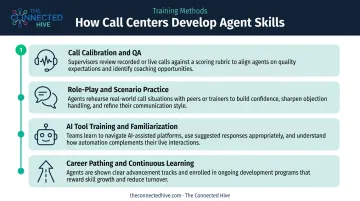
Strong skills don't appear at hire — they're built through deliberate, ongoing development. These are the training approaches that consistently produce better agents:
Call Calibration and Quality Assurance
Recorded call reviews and peer calibration sessions identify where agents excel and where they need coaching. AI-assisted QA tools can now flag tone, sentiment, and compliance issues automatically. That said, only 35.7% of contact centers currently use interaction or speech analytics, versus 89.9% with some form of quality monitoring — meaning many QA programs still rely on manual review.
Role-Play and Scenario Practice
Structured role-play simulates difficult or off-script customer situations before they happen in real calls. Agents who have practiced conflict resolution under pressure handle live escalations with more composure and less escalation.
AI Tool Training and Familiarization
Agents who understand how to use AI-powered assist tools, auto-transcription, and surfaced knowledge bases perform faster and more accurately. Because AI platforms update on a rolling basis, regular refreshers matter as much as initial onboarding.
Career Pathing and Continuous Learning
Agents who see a development roadmap are more engaged and more motivated to improve. Structured programs reinforce that skill-building is ongoing — not a one-time event at hire. Effective approaches include:
- Mentorship programs pairing new agents with senior staff
- Shadow sessions with high-performing agents on live calls
- Defined promotion criteria tied to measurable skill milestones
Why Agent Skills Matter When Choosing a BPO Partner
When businesses outsource customer interactions, they're delegating brand representation — not just call volume. The skill level of agents determines whether customers feel valued or dismissed, and PwC's 2025 Customer Experience Survey found that 29% of US consumers stopped using or buying from a brand because of poor customer experience.
That's a direct revenue risk tied to agent quality. Pricing and headcount matter in BPO selection — but they don't tell you whether agents can handle a distressed healthcare caller, navigate a compliance-sensitive financial services inquiry, or use AI tools accurately under pressure.
Questions to ask prospective call center partners:
- What are your hiring benchmarks for communication skills and technical aptitude?
- How long does initial training run, and what does ongoing development look like?
- How do you conduct QA — manual review, AI-assisted, or both?
- How do you track agent performance improvement over time?
- What does your attrition rate look like, and how do you address it?
The answers reveal whether a partner builds agent quality or just fills seats.
That's where The Connected Hive comes in. The firm helps businesses identify and vet BPO partners whose agent quality, training standards, and operational practices align with their brand and customer experience goals. Drawing on 20+ years of executive experience across healthcare, financial services, insurance, and government sectors, the firm evaluates each partner against your specific requirements before making a match.
The vetting process includes site visit audits, QA review, and direct evaluation of training program structure — across a network of 3,500+ domestic and 8,000+ global contact centers. There's no cost to the client.

Frequently Asked Questions
What skills do you need for a call center?
Agents need a mix of soft skills — active listening, empathy, clear communication, and patience — alongside hard skills like CRM proficiency, product knowledge, and AI tool proficiency. The right balance depends on industry and call type, but high performers in 2026 need both.
What is the difference between hard skills and soft skills in a call center?
Soft skills are interpersonal traits — empathy, adaptability, active listening — that shape how an agent connects with customers. Hard skills are learned technical capabilities — CRM navigation, product knowledge, AI tool proficiency. Strong agents develop both; a gap in either one shows up quickly in customer interactions.
Why is AI literacy becoming a critical call center skill in 2026?
As AI tools handle routine inquiries, human agents increasingly use AI copilots, auto-summaries, and predictive assists in real time. Knowing how to interpret, apply, and when to override AI outputs is now a standard job requirement across most contact center roles.
How do you evaluate call center agent skills when choosing a BPO partner?
Ask about hiring standards and skill benchmarks, training program length and structure, QA scoring methods (manual vs. AI-assisted), and how agent performance is tracked over time. Firms like The Connected Hive conduct this assessment as part of the vendor vetting process.
How long does it take to train a call center agent?
Initial training typically runs 4–10 weeks depending on product complexity, industry, and required systems. Ongoing development through QA, coaching, and AI tool training continues throughout an agent's tenure — especially in regulated industries where compliance requirements evolve.
Do call center skills differ by industry?
Yes. Healthcare and financial services layer on compliance requirements — HIPAA for PHI handling, PCI DSS for cardholder data — that most industries don't face. Agents in these sectors also handle more sensitive, high-stakes conversations, which demands greater precision and emotional discipline.