Performance disputes, missed response targets, and unclear accountability follow — and they're expensive to resolve after the fact.
This guide breaks down what an SLA is, the three primary types, the components every agreement should include, and the metrics that matter most when you're outsourcing contact center operations.
Key Takeaways
- SLAs define exactly what's promised, how performance is measured, and what happens when standards aren't met
- Three SLA types exist: customer-based, service-based, and multi-level — each suited to different contract structures
- Effective SLAs specify measurable metrics, clear responsibilities, penalties, and a built-in review process
- Contact center SLAs hinge on FCR, AHT, abandonment rate, and CSAT as the highest-weight performance indicators
- Healthcare and financial services SLAs must include HIPAA and PCI DSS compliance metrics — these aren't optional
What Is an SLA?
A Service Level Agreement (SLA) is a formal, often legally binding contract between a service provider and a customer that defines what services will be delivered, how performance will be measured, and what happens when commitments aren't met.
As IBM describes it, an SLA specifies the service, expected performance, measurement and approval method, and the consequences of missing the agreed level.
SLAs exist in two primary contexts:
- External agreements — between a business and an outside vendor, such as a company and its BPO partner
- Internal agreements — between departments within the same organization, such as IT and operations
Why SLAs Matter in BPO Relationships
Without an SLA, performance expectations exist only as verbal commitments — with no agreed standard for what "good" looks like or what happens when it falls short. With one, expectations are documented, measurable, and enforceable from day one.
A practical example: a contact center vendor commits to two specific benchmarks:
- Answering 80% of inbound calls within 20 seconds
- Resolving 75% of issues on first contact
If either benchmark is missed, the SLA defines exactly what happens next — whether that's a service credit, a performance review, or escalation.
That level of specificity shifts the relationship from trust-based to evidence-based — which matters most when performance actually slips.
Three Types of SLAs
Not all SLAs are structured the same way. The right format depends on the complexity of the relationship, the number of services involved, and how many parties are covered.
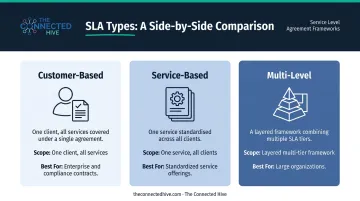
Customer-Based SLA
A customer-based SLA is tailored to the specific needs of a single client, covering all services they receive under one agreement. This format is common in complex enterprise contracts or when a client has unique compliance requirements.
A healthcare company contracting a HIPAA-compliant contact center is a clear example — the SLA would address data handling protocols, breach notification timelines, and member experience standards specific to that client, not a generic template applied across all customers.
Service-Based SLA
A service-based SLA applies one standard agreement to a specific service, covering all customers who use it. Every client receives the same defined terms for that service regardless of their size or industry.
A BPO provider might offer identical email response time commitments to all clients using their customer support tier, with the same terms applied consistently across accounts.
Multi-Level SLA
A multi-level SLA combines three layers into a single framework — corporate-level terms, customer-specific terms, and service-specific terms — each governing a different scope of the relationship.
This structure suits large organizations managing multiple vendors or service tiers simultaneously. It eliminates redundant contracts while still letting individual business units or client segments operate under tailored conditions.
Quick comparison:
| SLA Type | Scope | Best For |
|---|---|---|
| Customer-Based | One client, all services | Complex enterprise or compliance-driven contracts |
| Service-Based | One service, all clients | Standardized offerings with consistent delivery |
| Multi-Level | Multiple layers in one framework | Large organizations managing varied vendors or tiers |
Key Components Every SLA Should Include
A well-structured SLA is more than a performance checklist. It's a comprehensive document that defines the full scope of the working relationship — including what happens when things go wrong.
Services Covered and Exclusions
The SLA must explicitly state what services are included and, equally, what is excluded. Scheduled maintenance windows, force majeure events, and issues caused by the client's own systems or third-party tools should all be addressed. Any exclusion left undocumented is an exclusion that will be disputed.
Performance Metrics and Service Level Objectives
ICMI identifies measurable objectives — such as response times, abandonment targets, and FCR rates — as foundational SLA components. These are often captured as Service Level Objectives (SLOs): specific, quantifiable benchmarks the vendor is held to.
Vague targets like "timely response" or "high quality" are unenforceable. Every metric in the SLA needs a number attached to it.
Roles, Responsibilities, and Escalation Procedures
The SLA should:
- Assign ownership of each service component to a named party
- Designate primary contacts on both sides
- Outline a clear escalation path when issues arise
- Define escalation tiers with response time expectations at each level
Without clear ownership, a service disruption becomes a back-and-forth about whose problem it is — not a path to resolution.
Penalties, Remedies, and Service Credits
When an SLA is breached, service credits — amounts deducted from vendor payments — are the most common remedy. Some agreements also include earn-back provisions, allowing vendors to offset accumulated credits by exceeding targets in subsequent periods.
A well-designed penalty structure creates a financial incentive for consistent performance — without turning every missed metric into a legal event.
Review, Revision, and Termination Processes
An SLA that can't be updated will become irrelevant. Business needs change, technology evolves, and vendor capabilities shift. The agreement should include:
- A defined review cadence (quarterly is a reasonable minimum)
- A formal amendment process and clear termination rights, including provisions for material breach
Termination language deserves particular attention for regulated industries. HHS explicitly requires that HIPAA business associate contracts authorize termination when a material term is violated — so for healthcare entities, this isn't optional contract hygiene; it's a compliance requirement.
SLA Metrics That Matter in Contact Center Outsourcing
Technical uptime matters, but in contact center outsourcing, the metrics that most directly reflect value are the ones tied to customer experience and operational efficiency.
First Call Resolution and Abandonment Rate
First Call Resolution (FCR) measures the percentage of customer issues resolved on the first interaction, without requiring a follow-up. High FCR correlates directly with lower repeat contact rates and stronger customer retention.
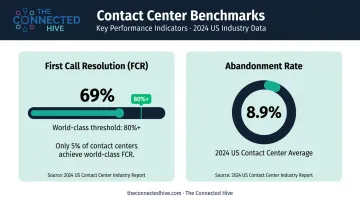
SQM Group's 2024 benchmarking data — drawn from more than 500 North American contact centers — puts the industry average FCR at 69%. Only 5% of centers achieve the "world class" threshold of 80% or higher. Building an FCR target into your SLA gives the vendor a clear quality bar to aim for, not just a volume target.
Abandonment rate measures the percentage of callers who hang up before reaching an agent. A high rate typically signals understaffing, poor call routing, or excessive queue times. ContactBabel's 2025 US Contact Center Decision-Makers' Guide reports a 2024 US average abandonment rate of 8.9%.
Average Handle Time and Response Time
Average Handle Time (AHT) covers the full duration of a customer interaction, including hold time and post-call wrap-up. Response time measures how quickly an agent picks up or acknowledges an inquiry.
Both metrics need context. An AHT target set too low pushes agents to rush calls, which drives down quality and increases repeat contacts. The right SLA balances speed with resolution quality — not one at the expense of the other.
CSAT and Quality Assurance Standards
Once speed and resolution targets are set, SLAs should also address the qualitative side of performance:
- CSAT targets — SQM reports a 78% industry average (top-box "very satisfied" measure)
- Quality monitoring standards — call recording review, scripted compliance, tone and accuracy scoring
- Sampling frequency — how many interactions are evaluated per agent, per period
For regulated industries like healthcare and financial services, quality monitoring serves a dual purpose: it tracks performance and supports compliance documentation.
Compliance Metrics: HIPAA and PCI DSS
For healthcare and financial services companies, compliance performance is an SLA category in its own right. Key requirements include:
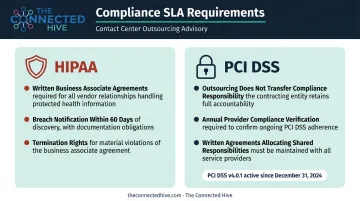
- HIPAA: Vendors handling protected health information (PHI) must have written business associate agreements in place. HHS requires breach notification within 60 days of discovery, and covered entities must retain termination rights for material violations.
- PCI DSS: Outsourcing payment processing doesn't transfer compliance responsibility. Merchants must verify provider compliance at least annually and maintain written agreements that clearly allocate shared responsibilities. PCI DSS v4.0.1 became the only active standard after December 31, 2024.
These aren't ordinary performance KPIs — they're regulatory obligations. Failing to address them in the SLA creates legal and reputational exposure that no service credit will cover.
Working with an advisor who understands these requirements before a contract is signed — rather than discovering gaps during an audit — can prevent the kind of exposure that retroactive remediation rarely fixes.
Best Practices for Structuring and Managing SLAs
A few principles that separate functional SLAs from ones that generate disputes:
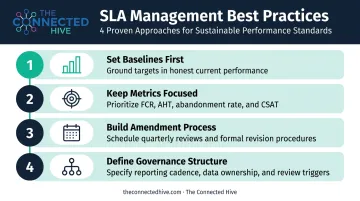
1. Set baselines before the contract is signed. As ICMI notes, there is no universal contact center service-level standard — the right targets depend on labor cost, call value, and caller tolerance. SLAs grounded in honest assessments of current performance are far more enforceable than aspirational numbers imposed without vendor input.
2. Keep the metric list focused. BenchmarkPortal recommends evaluating the 80/20 answer-time target alongside abandonment rate, AHT, and caller satisfaction together — not in isolation. The same logic applies to SLA design. A long list of tracked metrics dilutes accountability and makes reporting burdensome. Limit the SLA to what most directly reflects service quality.
3. Build in a formal amendment process. Business needs shift, technology changes, and vendor capabilities evolve. Schedule reviews at minimum quarterly to assess whether targets still reflect what good performance looks like. The Connected Hive includes ongoing SLA review support in its advisory engagements, helping clients keep BPO agreements aligned as their operations grow.
4. Define your own governance structure. Specify how performance data is reported, who generates it, how often, and what triggers a formal review. Passive monitoring of a vendor's own reporting is not a governance strategy — and most disputes stem from exactly that gap.
Frequently Asked Questions
What is SLA in simple words?
An SLA (Service Level Agreement) is a formal contract between a service provider and a customer spelling out what services will be delivered, how performance will be measured, and what happens if those commitments aren't met.
What does SLA and KPI mean?
An SLA is the agreement that sets performance expectations. A KPI (Key Performance Indicator) is the specific metric used to measure whether those expectations are being met. The SLA defines the standard; the KPI tracks progress against it.
What are three types of SLAs?
The three primary types are:
- Customer-based — tailored to one specific client's requirements
- Service-based — one standard agreement applied to all users of a given service
- Multi-level — a layered structure combining corporate, customer, and service-level agreements for complex relationships
What is a 4-hour SLA?
A 4-hour SLA is a resolution time commitment — the provider agrees to resolve a reported issue within four hours of it being logged. The exact meaning depends on how the agreement defines priority levels, coverage hours, and when the clock starts.
What happens when a vendor fails to meet SLA requirements?
The agreed-upon remedies apply — typically service credits (deductions from fees owed). In cases of repeated or severe breaches, the SLA may also allow for financial penalties or contract termination as outlined in the agreement.
What SLA metrics matter most in contact center outsourcing?
The most critical metrics are FCR, abandonment rate, AHT, response time, and CSAT. For healthcare and financial services clients, HIPAA and PCI DSS compliance metrics are equally important and should be treated as mandatory SLA components — not optional add-ons.