Business leaders in healthcare, insurance, and financial services face this decision regularly: do you hand off a specific task to a vendor, or bring in a partner to manage the entire function? The answer depends on which model you're actually choosing between — because outsourcing and managed services are not the same thing, even though the industry often treats them as interchangeable.
Understanding the distinction has real operational consequences. Scope, accountability, cost structure, and provider involvement differ significantly between the two models — and getting clear on those differences before you sign a contract is far less costly than course-correcting afterward.
Key Takeaways
- Outsourcing handles defined, time-bound tasks; managed services provide continuous operational support
- Key differences come down to scope, duration, and provider accountability
- Outsourcing fits short-term or campaign-based needs; managed services suit complex, ongoing functions
- Healthcare and financial services face compliance considerations that directly affect which model fits
- A hybrid approach — using both simultaneously — works well when structured thoughtfully
Outsourcing vs. Managed Services at a Glance
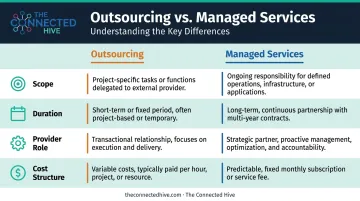
Before going deeper, here's how the two models compare across four dimensions:
| Dimension | Outsourcing | Managed Services |
|---|---|---|
| Scope | Narrow, defined task or process | Broad, end-to-end operational function |
| Duration | Project-based or short-term | Ongoing, long-term engagement |
| Provider Role | Executes specific deliverables | Proactively manages, optimizes, and reports |
| Cost Structure | Transactional or per-project | Recurring contract with defined SLAs |
Both models involve third-party vendors and reduce the workload on internal teams. The real difference is the degree of accountability your provider carries once the work begins.
With outsourcing, you retain responsibility for quality assurance, performance tracking, and process management. With managed services, those functions shift substantially to the provider — meaning they're accountable not just for completing tasks, but for the results those tasks produce.
What Is Outsourcing?
Outsourcing means contracting an external organization to perform a specific business process or task that would otherwise be handled in-house. In contact center operations, this typically looks like: engaging a third-party call center for a 90-day open enrollment campaign, handling a seasonal customer service spike, or covering tier-1 help desk tickets during a system migration.
Core Benefits
- Deploys quickly — no hiring, training, or equipping internal staff required
- Keeps costs predictable — pay for what you need, when you need it
- Scales up for defined projects, then scales back without overhead
- Provides access to specialized labor without a long-term commitment
These benefits are particularly relevant in healthcare, insurance, and retail, where volume fluctuations are predictable but demand can swing dramatically. According to ICMI's 2024 survey of contact center leaders in the US, Canada, and UK, 45% of respondents reported outsourcing some workloads to a third party.
Delivery Models
When outsourcing contact center work, businesses choose from three geographic models:
| Model | Geography | Key Trade-offs |
|---|---|---|
| Onshore | Domestic US providers | Strongest cultural alignment, simplest compliance, highest cost |
| Nearshore | Latin America (for US companies) | Cost savings with minimal time zone friction |
| Offshore | Distant countries | Significant cost advantages; greater language, time zone, and compliance complexity |
For HIPAA- or PCI-regulated industries, the delivery model matters beyond just cost. Offshore arrangements introduce cross-border data transfer complexity that can complicate compliance. Onshore or nearshore options typically offer more regulatory clarity and easier oversight.
Limitations Worth Knowing
Because outsourcing is project-scoped, the vendor rarely develops deep familiarity with your brand, customers, or operational nuances. This can produce:
- Inconsistent service quality across interactions
- Limited accountability once the deliverable is met
- Minimal proactive problem-solving — the vendor executes, you manage
Outsourcing works best when the scope is clearly defined, the engagement has a natural endpoint, and your internal team has the bandwidth to oversee execution.
Use Cases in Contact Center Operations
Outsourcing fits well when standardized scripts, clear SOPs, and limited brand complexity make it possible to onboard an external team quickly. Common examples:
- A healthcare insurer outsourcing inbound call support for a 90-day open enrollment window. The 2024 Marketplace Open Enrollment Period saw over 21.4 million consumers enroll — a 31% increase over 2023 — illustrating how sharply demand can spike.
- A retailer outsourcing holiday season customer service volume to handle predictable peaks
- A financial services firm routing tier-1 help desk tickets to an outsourcer during a core systems migration
Tim Austrums of The Connected Hive has worked through engagements like these firsthand — including with SunSetter Products, a seasonal client whose fluctuating volume required flexible, cost-effective program design across inbound sales, customer service, and lead generation.
What Are Managed Services?
Managed services go further. A managed services provider takes on comprehensive, ongoing responsibility for a major business function — handling performance, optimizing processes, and identifying improvements over time — not just completing tasks on request.
In a contact center context, this means the provider handles the full customer experience lifecycle: staffing, training, technology, quality assurance, reporting, and continuous improvement cycles. The client's internal team no longer needs to manage day-to-day operations — the partner is accountable for outcomes, not just activity.
What a Managed Services Engagement Typically Includes
- Needs assessment — documenting your current state, volume, complexity, and goals
- Partner selection and onboarding — identifying the right vendor fit, structuring the engagement
- SLA design — defining performance standards for metrics like abandonment rate, average handle time, and quality scores
- Ongoing quality monitoring — continuous review against agreed benchmarks
- Regular reporting — structured cadence of performance data and insights
- Continuous improvement cycles — ongoing identification of process gaps and optimization opportunities
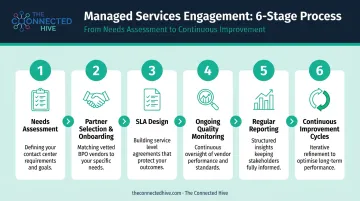
In a traditional outsourcing arrangement, most of these steps remain the client's burden. Under managed services, they transfer to the provider.
The Strategic Advantage
Because managed services providers are invested in long-term outcomes, they develop institutional knowledge of your brand, customers, and operational goals. That depth translates into better customer experience, lower agent attrition, and tighter alignment between your business objectives and frontline execution.
This model is the right fit when:
- Your organization lacks internal expertise or bandwidth to manage a complex function
- You need 24/7 operational coverage without building it in-house
- You're scaling rapidly and need operational capacity to keep pace
- You want to convert fixed staffing costs into a flexible, performance-driven model
Use Cases in Contact Center Operations
- A health insurance company engaging a managed services partner to handle all member experience operations year-round — enrollment, billing inquiries, appeals, and more — with a single accountable provider
- A financial services firm using a managed contact center partner across customer care, fraud alerts, and account services on multiple channels
In regulated industries, this model carries an additional advantage: managed services partners with HIPAA or PCI expertise reduce the client's compliance exposure while maintaining service quality. That said, PCI DSS v4.0.1 makes clear that using a third-party provider does not transfer compliance obligations — the client must still verify, document, and monitor the relationship.
Experienced partners who understand this shared responsibility model provide more defensible coverage than those who treat compliance as the client's problem alone.
The Connected Hive's founder Tim Austrums has worked directly with Humana on enrollment operations and member experience, and with Blue Cross/Blue Shield on member care — engagements where the depth and continuity of a managed services relationship directly shaped outcomes.
Which Model Is Right for Your Business?
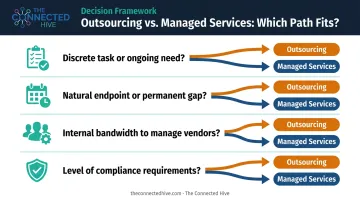
The decision comes down to four questions:
- Is this a discrete task or an ongoing operational need? Short-term, well-defined work points toward outsourcing. Complex, continuous functions point toward managed services.
- How long does this engagement need to run? If there's a natural endpoint, outsourcing fits. If this is a permanent capability gap, managed services is the better investment.
- Does your team have the bandwidth to manage vendor execution? Outsourcing requires client-side oversight. Managed services shifts that accountability to the provider.
- What are the compliance requirements? HIPAA and PCI-regulated functions require careful vetting regardless of model — but ongoing managed services relationships allow deeper compliance integration and monitoring over time.
Situational Recommendations
Choose outsourcing when:
- The scope is clearly defined with a predictable endpoint
- Your internal team can oversee execution and QA
- The function doesn't require deep brand knowledge or relationship continuity
Choose managed services when:
- The function is complex, ongoing, or mission-critical
- You lack in-house expertise to manage the function or vendor relationship
- You need a partner accountable for performance metrics, not just task completion
- The function involves sensitive data requiring sustained compliance oversight
The Hybrid Approach
These two models aren't mutually exclusive. Many organizations run both simultaneously — maintaining a managed services partner for core customer care operations while outsourcing specific campaigns or overflow volume to a separate vendor. This works well when structured deliberately: the managed services partner holds the institutional knowledge and brand alignment, while the outsourcing vendor absorbs defined, temporary volume spikes.
Navigating this decision — especially in contact center and BPO environments — involves vendor evaluation, SLA structuring, compliance vetting, and cultural fit assessment. If you're working through that process, The Connected Hive matches businesses with vetted contact center and BPO partners across onshore, nearshore, and offshore locations at no cost to you, drawing on a network of 3,500+ domestic US contact centers and 8,000+ globally.
Real-World Perspective: When the Model Choice Mattered
Consider a leading insurance corporation facing declining customer retention. The initial instinct was to outsource a focused customer engagement campaign — a defined scope, a clear endpoint. But after a needs assessment, the real problem came into focus: member interactions across billing, renewals, and service inquiries were fragmented across vendors with no unified accountability.
The decision shifted toward a managed services model — a single partner accountable for the full member experience, with continuous performance monitoring and improvement cycles built in. The outcome: a 30% increase in customer retention over six months.
The takeaway isn't that managed services is the better model. It's that model-fit matters more than execution quality. A well-run outsourcing campaign applied to a structural problem will still underdeliver — not because the vendor failed, but because the engagement was scoped incorrectly from the start. Fixing that mid-contract costs far more than getting it right upfront.
Signs you may be using the wrong model:
- Recurring issues that "solved" campaigns keep reopening
- Multiple vendors handling related functions with no single point of accountability
- Performance improves short-term but doesn't hold after the engagement ends
Unsure which model fits your situation? The Connected Hive has spent over 20 years helping companies in healthcare, insurance, and financial services make this call — including work with Humana, Blue Cross/Blue Shield, Discover, Ameriprise, and FEMA. Schedule a consultation to talk through your specific needs.
Conclusion
Outsourcing and managed services are not interchangeable — each serves a fundamentally different business need.
Outsourcing is the right tool for defined, short-term engagements where scope is clear and your team can manage execution. Managed services deliver the ongoing accountability and strategic depth that complex, mission-critical functions require.
Before committing to either model, evaluate the scope and duration of the function, your internal capacity to manage a vendor relationship, and the compliance requirements involved. Those factors — not vendor pricing or convenience — should drive the decision.
If you're still weighing which model fits your operation, that's precisely where an experienced advisor can shorten the path to the right answer.
Frequently Asked Questions
What is the difference between managed services and outsourcing services?
Outsourcing involves contracting a third party to handle a specific, often time-bound task or process — like managing inbound calls during a campaign. Managed services involve a provider taking ongoing, comprehensive responsibility for an entire operational function, including performance management, reporting, and continuous improvement — the key distinction is scope and accountability.
What is an example of outsourcing services?
A healthcare company outsourcing inbound call support for a 90-day open enrollment period is a typical example. The third-party call center handles volume for the campaign duration, then the engagement ends once enrollment closes.
Is outsourcing illegal in the US?
Outsourcing is entirely legal in the US. However, businesses must ensure third-party providers comply with applicable regulations — such as HIPAA for healthcare data or PCI DSS for payment information. Contracts should clearly define data security obligations, permissible data use, and breach notification requirements.
Can a company use both outsourcing and managed services at the same time?
Yes. Many companies use a hybrid approach — relying on a managed services partner for core ongoing operations while outsourcing specific campaigns or overflow volume to a separate vendor. Brand-sensitive interactions stay with the managed partner; defined, temporary demand goes to the outsourced vendor.
What is the difference between BPO and managed services?
BPO (Business Process Outsourcing) refers to contracting external providers to handle business processes. Managed services is a subset of BPO characterized by ongoing, proactive management of an entire operational function with defined SLAs and continuous performance optimization — rather than simple task execution.
How do I know which model is right for my contact center needs?
Evaluate the complexity and duration of the function, your team's capacity to manage vendor relationships, and whether the need is project-based or ongoing. If you're in a regulated industry, factor in compliance requirements. A BPO consultant who specializes in contact center selection — like The Connected Hive — can assess your situation objectively and match you with the right model before you commit.