The problem isn't just the total number. It's that most of these costs are fixed. You pay them whether your team is fully utilized or sitting idle through a slow quarter.
Outsourcing, when approached strategically, addresses exactly that problem. This article examines where in-house cost bloat originates, what drives it, and how outsourcing — applied to the right functions in the right way — can reduce or eliminate specific categories of spend. This isn't a blanket argument for outsourcing everything. It's a structured look at where it creates genuine financial leverage.
Key Takeaways
- Benefits alone add 43% on top of base wages, before training, equipment, or overhead
- The biggest cost driver is fixed-cost structure — paying for capacity you don't always need
- Outsourcing converts fixed costs to variable ones, reducing spend during low-demand periods
- Realized savings hinge on clear scope definition and choosing a vendor matched to your actual needs
- Outsourcing works best as an active relationship — not a set-it-and-forget-it contract
How In-House Operational Costs Build Up
Most companies underestimate what an in-house team actually costs — because only salaries show up as a clean line item.
The rest hides across separate budget lines that rarely get consolidated:
- Benefits (healthcare, PTO, retirement contributions)
- Payroll taxes and employer-side FICA
- Workspace, equipment, and software licenses
- Onboarding, training, and ongoing development
- Management time required to oversee all of it
For office and administrative support roles — the category covering most customer-facing and back-office functions — BLS data shows benefits averaging 45.6% of wages, before factoring in those additional items.
The Compounding Effect of Headcount Growth
Cost build-up accelerates when teams expand to meet demand spikes. The hiring made sense at the time. But when demand normalizes, the headcount often doesn't shrink with it — it becomes a permanent fixed cost embedded in the operating structure.
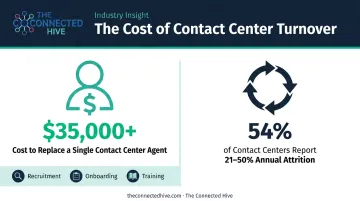
This pattern is particularly visible in contact center environments. ICMI reports that replacing a single contact center agent costs more than $35,000 when recruitment, onboarding, and training are fully accounted for. With 54% of contact centers reporting annual attrition rates between 21% and 50%, those replacement costs compound continuously.
The Hidden Costs of High Turnover
Turnover is where the math becomes difficult to track. Gallup estimates that replacing a frontline employee costs approximately 40% of their annual salary — rising to 80% for technical roles and 200% for leaders. None of that shows up neatly in a per-seat staffing budget.
By the time leadership runs a full cost audit, the gap between perceived and actual staffing spend is often large enough to make outsourcing look like an obvious move — not just a tactical one.
Key Cost Drivers for In-House Operations
Understanding what drives cost is the prerequisite for knowing where outsourcing will actually help.
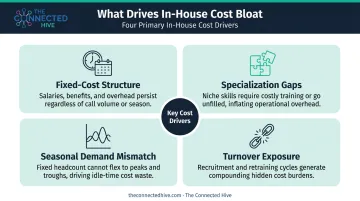
Fixed-cost structure is the dominant driver. Hiring full-time employees to handle functions that don't require consistent 40-hour-per-week utilization forces companies to pay for capacity they frequently don't need. Customer service, IT helpdesk, HR administration, and finance are all prone to this — demand fluctuates, but headcount stays flat.
Specialization gaps compound the problem. When companies build in-house expertise in functions outside their core competency, they face:
- Higher recruitment costs to find specialized talent
- Longer ramp times before new hires reach full productivity
- Ongoing investment in tools, certifications, and training to stay current
- Greater exposure when key individuals leave
This gap hits hardest in technical, compliance-heavy, or rapidly evolving functions — areas where an outsourced specialist already has the infrastructure, credentials, and depth of experience a company would need years to replicate.
The severity of these drivers depends on context. A company with seasonal demand, limited HR infrastructure, or rapid growth faces compounding cost pressure. A stable, mature organization with consistent utilization faces different exposure. The point is that cost driver analysis should precede any outsourcing decision, not follow it.
Cost-Reduction Strategies Through Outsourcing
Most outsourcing arrangements that fail to deliver savings fail for predictable reasons: poor scoping, wrong-fit vendors, or a structural mismatch between what's outsourced and what actually drives cost. The strategies below address each failure point — before the contract is signed, during active management, and at the operational level.
Strategies That Start With Better Decisions
The decisions made before outsourcing begins determine more of the outcome than most companies expect.
Outsource non-core functions first. Identify functions that fall outside the company's core value proposition — customer support, payroll, data entry, IT helpdesk — and prioritize those. Keeping internal resources focused on revenue-generating activities produces savings directly (lower per-function cost) and indirectly (higher output from retained staff).
Match the outsourcing model to the need. Fully managed BPO, project-based, and staff augmentation models carry different cost profiles. A high-volume, ongoing function like customer service handled under a project-based structure may produce coverage gaps or overpayment. Choosing the right structure from the outset eliminates avoidable cost from day one.
Define scope and SLAs with precision before signing. Vague contracts invite scope creep, disputes, and change orders — all of which add cost. Companies that invest in specifying deliverables, response times, quality standards, and escalation paths before a contract is signed consistently achieve better cost outcomes. Working with an experienced BPO advisor helps ensure scope is defined correctly the first time. The Connected Hive specializes in exactly this — contact center and BPO partner selection, including RFP/RFI creation and vendor vetting.
Vet partners for fit beyond price. The lowest-cost provider is rarely the least expensive over the full contract term. Factor in:
- Implementation and ramp-up costs
- Staff turnover rates at the vendor
- Technology compatibility
- Compliance credentials (HIPAA for healthcare, PCI for financial services)
A vendor mismatch discovered six months in generates switching costs that erase projected savings entirely.
Strategies That Improve Active Management
Even well-chosen vendors deliver less than expected without consistent oversight. Costs creep back through rework, drift, and gaps in accountability — not because the vendor is the wrong fit, but because the relationship goes unmanaged.
Establish measurable KPIs from day one. Define the indicators that matter most for the outsourced function — handle time, resolution rate, error rate, turnaround time — and build reporting into the contract. Vendors perform to what is measured.
Convert fixed costs to variable through output-based pricing. Rather than paying for headcount, negotiate pricing tied to volume, transactions, or outcomes. This structure means outsourcing spend scales with actual business activity, eliminating payment for idle capacity during slow periods — one of the most direct structural savings outsourcing can deliver. The Connected Hive's partner pricing ranges from $8 to $35 per agent-hour depending on location, complexity, and volume, giving clients real flexibility to align cost with demand.
Consolidate vendor relationships where possible. Managing multiple outsourcing vendors across similar functions creates coordination overhead, duplicated onboarding, and diluted accountability. Fewer, higher-performing partnerships reduce management load and often create leverage for better pricing through higher volume commitments.
Review and renegotiate contracts on a defined cycle. Market rates shift, vendor capabilities evolve, and business needs change. Contracts that go unexamined for years gradually drift out of alignment with actual value delivered. Annual or milestone-based reviews give companies the opportunity to recapture savings as conditions evolve.
Strategies That Change the Operational Context
Some of the most meaningful cost savings from outsourcing come not from what's outsourced or how it's managed, but from the broader environment outsourcing creates — including scale, geography, and demand variability.
Leverage provider economies of scale. Outsourcing providers distribute overhead, technology, management infrastructure, and training costs across multiple clients simultaneously. A single company building those capabilities in-house bears 100% of the cost. The global BPO market reached $328.4 billion in 2025 — reflecting the scale at which specialized providers operate and the infrastructure investment that scale supports. Clients benefit from shared investment without carrying it on their own books.
Use outsourcing to avoid capital expenditure on infrastructure. Contact centers, IT systems, compliance platforms, and workforce management tools represent significant upfront investment. The capital cost categories alone — hardware, data-center infrastructure, software licenses, maintenance contracts, integrations, and staff retraining — are substantial before a single call is handled. Outsourcing to a provider already operating this infrastructure converts those capital expenditures into predictable operating costs: no depreciation, no maintenance budgets, no upgrade cycles.
Design outsourcing for demand flexibility. Companies with seasonal volume spikes — healthcare open enrollment, retail holiday periods, financial services tax season — face a binary choice: maintain permanent overstaffing year-round or risk being caught short during peaks. ICMI's 2024 survey found 47% of contact centers identify October through December as their peak period. Outsourcing support functions to a BPO partner enables rapid scaling without permanent headcount, directly reducing annual labor spend.
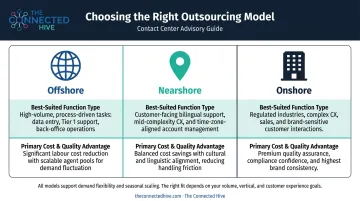
Evaluate geographic models based on function requirements. The right geography depends on the function, not a blanket cost-minimization instinct:
| Model | Best Suited For | Primary Advantage |
|---|---|---|
| Offshore | High-volume, standardized, language-compatible work | Significant labor cost reduction |
| Nearshore | Culturally aligned, time-zone-sensitive functions | Balance of cost and proximity |
| Onshore | Compliance-critical, complex, high-value interactions | Quality, control, real-time collaboration |
The Connected Hive works across all three models, helping clients match geographic strategy to function requirements — not the other way around.
Conclusion
Outsourcing reduces costs most effectively when the analysis starts with where cost actually originates — fixed-cost structures, specialization gaps, underutilized capacity — not with a general goal of spending less. Cutting spend without understanding what drives it produces short-term savings that reverse quickly.
Effective cost reduction through outsourcing requires informed decisions before a contract is signed, active management throughout the relationship, and regular reassessment as business conditions shift. It's not a one-time project — it's an ongoing discipline.
For companies navigating the BPO and contact center marketplace, working with an advisor like The Connected Hive can accelerate time-to-savings and reduce the risk of costly mismatches. Their model is built on matching businesses to high-performing partners with full transparency, at no cost to the client.
Frequently Asked Questions
What do you mean by outsourcing?
Outsourcing is the practice of contracting an external organization to perform tasks or functions that would otherwise be handled internally — typically to reduce costs, access specialized expertise, or improve operational efficiency. It can apply to a single function or broad operational areas.
What is one example of outsourcing?
A common example is a company outsourcing its customer service operations to a specialized contact center provider. This allows the business to reduce staffing overhead, access trained agents and established technology, and maintain consistent customer support without building the capability in-house.
How much can outsourcing reduce business costs?
The Connected Hive's client work consistently shows savings of 20–30% compared to equivalent in-house operations, driven by reduced labor overhead, shared infrastructure, and economies of scale. Results vary by function, volume, and geographic model — a retail client achieved a 30% cost reduction alongside a 20% increase in customer satisfaction.
What functions are most commonly outsourced to save money?
The most frequently outsourced non-core functions include customer service and contact center operations, IT helpdesk, payroll and HR administration, accounting, and data processing.
What is the difference between outsourcing and offshoring?
Outsourcing means contracting any external provider, regardless of where they're located. Offshoring is a subset — it specifically means moving a function to another country, whether onshore, nearshore, or offshore.
What are the risks of outsourcing and how can they be managed?
Real risks include loss of direct control, data security exposure, communication gaps, and vendor dependency. Most are manageable through rigorous vendor vetting, clear contracts with measurable SLAs, and ongoing performance monitoring — particularly important in regulated industries requiring HIPAA or PCI compliance.