Using an RFQ when you need an RFP means selecting the cheapest vendor instead of the best fit. Skipping the RFI phase means writing requirements without enough market knowledge, which leads to weak vendor responses. The consequences aren't minor — they can cost months of rework, budget overruns, and partnerships that fail to deliver.
Each document serves a distinct purpose and signals a different level of buyer readiness to vendors. Getting this right determines how competitive, efficient, and defensible your vendor selection process becomes.
Key Takeaways
- RFI: An early-stage exploration tool to map the vendor landscape before requirements are defined
- RFQ: A targeted pricing document for when scope is fully specified and cost comparison is the goal
- RFP: Used when vendors must propose both a solution and a price for a complex, open-ended need
- Use them in sequence: Start with RFI to explore, RFP to evaluate solutions, RFQ to lock in pricing
- Using the wrong document wastes time, draws mismatched vendors, and stalls the selection process
RFP vs RFI vs RFQ: Quick Comparison
| RFI | RFQ | RFP | |
|---|---|---|---|
| Full Form | Request for Information | Request for Quote | Request for Proposal |
| Primary Purpose | Gather market intelligence | Compare pricing | Evaluate solutions and pricing |
| Stage of Procurement | Early/exploratory | Late/final pricing | Mid-process/competitive evaluation |
| Detail Required from Vendor | Capabilities overview | Itemized pricing | Full solution proposal |
| Best Used When | You don't yet know what you need | Scope is fully defined | Need is complex with multiple evaluation criteria |
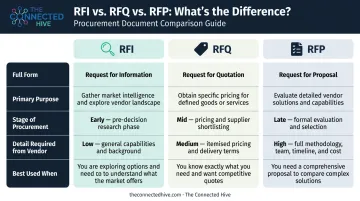
These documents are not interchangeable — each one signals a different level of buyer readiness. An RFI tells vendors you're still exploring; an RFP signals you're ready to evaluate seriously. Using the wrong document at the wrong stage can drive away qualified vendors or flood your inbox with proposals that miss the point entirely.
What Is an RFI (Request for Information)?
An RFI is a preliminary, exploratory document. As defined by CIPS, it's used before formal procurement begins — when an organization wants to understand what vendors and solutions exist, not commit to buying anything. Under the U.S. Federal Acquisition Regulation, an RFI response is not an offer and cannot form a binding contract.
The core use case is when your organization is new to a category. If you've never outsourced a contact center function before, you don't yet know what the market looks like, which delivery models exist (onshore, nearshore, offshore), or what compliance requirements apply to your industry.
An RFI fills that gap — giving you the market intelligence needed to build a qualified vendor shortlist and make the case internally before committing to a full procurement process.
What an RFI Typically Contains
- Company background and a general description of the need
- Open-ended questions about vendor capabilities, experience, and technology
- Questions about geographic footprint, capacity, and compliance posture
- No pricing request and no binding commitment from either party
Once you understand what an RFI includes, the question becomes: when should you actually use one?
Use Cases for an RFI
An RFI is the right starting point when:
- You're evaluating outsourcing a function for the first time and need to understand the provider landscape
- You're entering a new segment — healthcare BPO, financial services support — where compliance requirements aren't yet fully understood
- You want to build a qualified vendor shortlist before investing time in a detailed RFP
- You need internal buy-in and need market data to support the business case
What Is an RFQ (Request for Quote)?
An RFQ is a targeted pricing document. GSA defines it as appropriate when needs are already known and vendors can be compared primarily on price and basic qualifications. There's no ambiguity in scope — the deliverables, volumes, and specifications are locked in.
The key distinction from an RFP: an RFQ is transactional. You already know the solution — you're asking vendors how much it costs, not how they'd approach the problem.
A practical example: you need 50 agent seats handling inbound calls, Monday through Friday, 8am–8pm, with a defined average handle time target. Every vendor is pricing the same thing. That's an RFQ scenario.
Where RFQs Fall Short
Procurement best practices consistently warn against over-relying on price in professional services. For complex, relationship-driven engagements, an RFQ misses what matters most:
- Cultural alignment between the vendor and your brand
- Technology compatibility with your existing CRM and IVR platforms
- Compliance posture for HIPAA or PCI-regulated environments
- Vendor stability, references, and implementation capability
Price comparison without qualitative evaluation often leads organizations to the cheapest vendor, not the right one.
Use Cases for an RFQ
An RFQ works well when:
- Purchasing commodity services with clearly defined specifications
- Renewing a well-defined contract where scope hasn't changed
- Comparing final pricing from two shortlisted vendors after qualitative evaluation is already complete
What Is an RFP (Request for Proposal)?
An RFP is the most comprehensive procurement document in the toolkit. NIGP identifies it as the right instrument for requirements that are technical, qualitative, or solution-oriented — where price alone should never drive the award decision. Vendors propose both their approach and their pricing, enabling comparison across multiple dimensions.
For contact center and BPO sourcing, the RFP is almost always the right instrument. You're not buying a commodity — you're selecting an operating partner who will represent your brand, handle sensitive healthcare or financial data, and integrate directly with your technology stack.
Core Components of a Well-Structured RFP
A strong RFP includes:
- Company and project background
- Detailed scope of work and expected volumes
- Required deliverables and performance metrics
- Timeline and budget parameters
- Compliance requirements (HIPAA, PCI-DSS)
- Evaluation criteria and weighting
- Submission instructions and deadlines
The structure forces internal clarity: buyers must articulate exactly what they need before going to market. That discipline produces more comparable, substantive vendor responses — and reveals gaps in requirements before they become contract problems.
Why RFPs Produce Better Outcomes
RFPs create a documented, defensible selection process — particularly important in regulated industries like healthcare and financial services. HIPAA requires written business associate contracts governing PHI handling, and the Federal Reserve, FDIC, and OCC's 2023 joint guidance on third-party relationships calls for risk-based due diligence covering financial condition, security, operational resilience, and subcontractor management.
An RFP process surfaces these requirements systematically, before contracts are signed — not after.
RFPs also involve broader stakeholder alignment. Procurement, legal, IT, operations, and executive leadership all need visibility into the selection criteria — and an RFP process creates the structure to get everyone aligned around the same decision framework.
How Advisory Support Strengthens Your RFP
Contact center and BPO RFPs carry nuances that generic templates miss: compliance-specific vendor questions, technology integration requirements, cultural fit assessment, and transition planning. Getting these wrong leads to misaligned vendor responses and difficult contract negotiations.
The Connected Hive's founder, Tim Austrums, has spent 20+ years negotiating multi-million dollar BPO relationships for clients including Humana, Blue Cross/Blue Shield, Discover, and FEMA. The firm provides hands-on RFP and RFI creation, custom vendor question development, site visit audits, and needs assessments — so procurement documents reflect your actual requirements, not a generic template.
Use Cases for an RFP
An RFP is the right choice when:
- Launching a new customer service operation or outsourcing an existing one
- Selecting a healthcare member experience or HIPAA-compliant BPO partner
- Evaluating contact center vendors across multiple criteria: capability, compliance, technology, cultural fit, and price
- The engagement is high-value, complex, or long-term
RFI, RFQ, or RFP: Which One Should You Use?
The right document depends on where you are in the procurement journey.
| If you're here... | Use this |
|---|---|
| Exploring the market, don't know what's available | RFI |
| Know what you need, want full solution + price proposals | RFP |
| Scope is locked, comparing final costs from shortlisted vendors | RFQ |
How They Work Together
These documents are often most effective when used sequentially rather than as alternatives:
- Issue an RFI to identify capable vendors, understand delivery models, and shortlist 8–10 candidates
- Issue an RFP to the shortlist — typically 5–6 vendors — with detailed evaluation criteria covering approach, compliance, technology, and pricing
- Issue an RFQ to the top 2 finalists to compare final pricing before contract negotiation
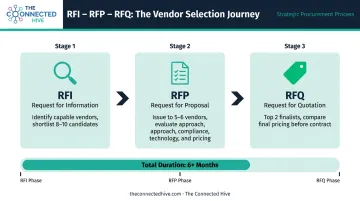
According to Everest Group, complex procurement processes that follow this kind of structured sequence can take more than six months from requirements gathering through contracting. That timeline is exactly why skipping steps creates problems rather than saving time.
Common Mistakes to Avoid
- Substituting an RFQ for an RFP selects the lowest-cost vendor without evaluating capability, compliance, or fit — a pattern NIGP's best-value guidance explicitly warns against
- Skipping the RFI phase produces poorly scoped requirements and attracts mismatched vendor responses
- Limiting evaluation to a single decision-maker undermines selection quality; procurement, legal, IT, operations, and executive stakeholders should all have input
These mistakes are common precisely because procurement document selection looks simpler than it is. For contact center and BPO engagements specifically, The Connected Hive helps businesses identify the right document for their stage, structure requirements that attract qualified responses, and connect with vetted partners from a network of 3,500+ domestic and 8,000+ global contact centers — with no cost to the buyer.
Frequently Asked Questions
What is the purpose of an RFP?
An RFP announces a defined project need and invites qualified vendors to propose both their solution approach and pricing. It enables buyers to compare vendors across multiple dimensions — capability, methodology, compliance, and cost — rather than selecting on price alone.
Who typically issues RFPs?
Government agencies, healthcare organizations, financial institutions, insurance companies, and large private enterprises commonly issue RFPs, particularly for complex, high-value, or regulated engagements where a structured, defensible selection process is required.
What's the difference between RFP, RFQ, and RFO?
An RFP solicits full solution proposals; an RFQ requests pricing for a clearly defined need. An RFO (Request for Offer) is a less common variant — Texas DIR defines it specifically for IT goods and services procurement — and its meaning varies by jurisdiction and industry context.
Can you use an RFI, RFP, and RFQ together in the same vendor search?
Yes, and it's often the most effective sequence. Start with the RFI to map the market, move to the RFP to evaluate shortlisted proposals, then use the RFQ to nail down final pricing before contract negotiation.
What should be included in a contact center or BPO RFP?
A contact center RFP should go well beyond headcount and hourly rates. Core elements include:
- Scope of services and expected interaction volumes
- Technology requirements and compliance needs (HIPAA, PCI-DSS)
- Performance metrics, SLAs, and cultural fit expectations
- Transition planning and pricing structure
How long does the RFP process typically take?
Complex BPO or contact center engagements routinely run six months or more from requirements gathering through contracting. Simpler procurements move faster, though vendors typically need 2–4 weeks just to respond — and evaluation takes additional time on top of that.