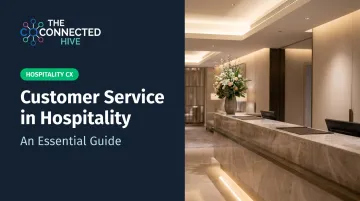
Customer service in hospitality isn't a soft function tucked into operations. It's a direct revenue driver. Properties that deliver exceptional guest experiences command higher rates, fill rooms through organic referrals, and retain guests who cost far less to keep than to replace. This guide covers what great hospitality service actually looks like, why it matters to your bottom line, the principles behind it, common challenges teams face, and practical strategies to raise your service standards — including when to bring in outside support.
Key Takeaways
- Hospitality service covers every guest touchpoint — from first inquiry to post-stay follow-up — blending reactive problem-solving with proactive care
- Outstanding service rests on five principles: anticipating needs, clear communication, fast problem resolution, consistency, and timeliness
- Poor service drives negative reviews, erodes guest loyalty, and cuts into upsell revenue
- Training, technology, feedback loops, and outsourcing partnerships are the strongest levers for lifting service quality
What Is Customer Service in Hospitality?
Customer service in hospitality is the ongoing effort to assist guests — providing accurate information, resolving problems, and meeting needs at every stage of their stay. It's both reactive (responding when something goes wrong) and proactive (anticipating what guests need before they ask).
Hospitality vs. Customer Service: Understanding the Distinction
These two concepts are related but not identical, and confusing them leads to service gaps.
- Customer service is transactional — it's the functional delivery of assistance: answering questions, processing requests, resolving complaints
- Hospitality is relational — it's the emotional layer: warmth, belonging, making guests feel genuinely welcome rather than just processed
Neither works without the other. A hotel can run flawless operations but feel cold and impersonal. Another property can radiate warmth but fumble basic requests. The guest experience suffers in both cases. The properties that stand out pair operational consistency with attentive, personal service — not one or the other.
Why Customer Service Is Critical to Hospitality Success
Every guest interaction — a phone call before booking, a check-in exchange, a complaint about the room temperature — shapes how that guest perceives your brand. Those perceptions flow directly into reviews, referrals, and whether they return.
Building Guest Loyalty and Repeat Business
Personalized, attentive service creates something transactional amenities can't: trust. When a front desk agent remembers a returning guest's preference for a high floor, or the restaurant team notes a dietary restriction without being asked again, guests feel recognized rather than anonymous.
That recognition compounds over time. Guests who feel valued return — and they bring others. Marriott's 2024 annual report makes the scale of this clear: Bonvoy loyalty members accounted for 73% of U.S. room nights in Q4 2024, a direct result of consistent, personalized service translating into reliable demand.
Driving Positive Reviews and Referrals
Online reviews now function as the default trust signal in hospitality booking. According to Tripadvisor's Power of Reviews study, 82% of consumers rated online reviews as extremely or very important when choosing accommodations — and 68% said they were likely to book after reading a detailed review.
That means service failures that generate negative reviews don't just sting the ego. They actively suppress bookings. Conversely, exceptional service experiences that prompt positive reviews have measurable financial consequences: Cornell University's research found that a 1% improvement in a hotel's online reputation corresponded to up to a 1.42% increase in RevPAR.
Differentiating in a Competitive Market
Price and amenities are easy to replicate. A competitor can match your spa, renovate their lobby, or undercut your rate. What they cannot copy quickly is your service culture — the accumulated habits, attitudes, and standards embedded across every role in your organization.
Properties with a genuine reputation for service attract guests who prioritize quality and are willing to pay for it. That rate premium takes years to earn through consistent delivery — and competitors can't close that gap with a renovation budget.
Impact on Revenue and Operational Efficiency
Service quality connects to the bottom line across more than just guest satisfaction metrics:
- Guests who trust your team are more receptive to room upgrades and add-on offers, lifting upsell conversion
- Problems resolved on-property cost far less than complaints that escalate to public reviews or chargebacks
- Retaining existing guests consistently costs less than replacing them with new bookings
Key Principles of Outstanding Customer Service in Hospitality
Great service isn't a checklist that gets completed at check-in. It's an operating philosophy that has to live in every department, every shift, every guest interaction.
Anticipating Guest Needs Before They Ask
Proactive service means using what you know — prior stay history, booking notes, loyalty profile data — to prepare before the guest has to voice a request. A frequent business traveler who always calls ahead for early check-in shouldn't have to ask on their tenth visit. Pre-arranging it, unprompted, signals genuine investment in the relationship.
This level of anticipation requires structured systems: CRM notes that travel with the reservation, pre-arrival communication that surfaces preferences, and staff briefings that flag VIP or returning guests before arrival.
Warm, Authentic Communication at Every Touchpoint
How you say something matters as much as what you say. A scripted, robotic check-in greeting ("Welcome. Name on the reservation?") and a genuine one ("Welcome back — we have you in a quiet room on the sixth floor, which I know you prefer") convey fundamentally different things about whether a guest is seen or just processed.
Authenticity can't be mandated by a script. It comes from training staff to understand why personalized communication matters, not just what words to use.
Swift and Effective Problem Resolution
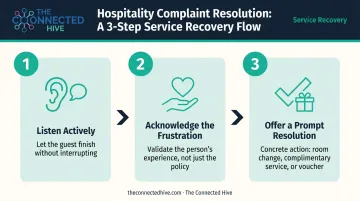
Complaints are inevitable in hospitality. What separates good properties from great ones is the speed and quality of the recovery. The sequence matters:
- Listen actively — let the guest finish, without interrupting or defending
- Acknowledge the frustration — not the policy, the person's experience
- Offer a prompt, fair resolution — a room change, a complimentary service, a voucher — something concrete, not a vague promise
Document every complaint and resolution in your property management system. Patterns reveal systemic problems — a recurring noise complaint on one floor, repeated slow room service on weekend nights — that proactive fixes can eliminate entirely.
Consistency Across All Departments and Shifts
Guest experience doesn't end at the front desk. If the restaurant team is warm and attentive but housekeeping is slow to respond to requests, guests experience inconsistency — and inconsistency erodes trust. Service standards need to be uniform across every department and every shift rotation.
Consistency comes from systems, not individuals. Practical tools that make it work:
- Documented service standards accessible to every department
- Cross-department handoff notes (front desk flagging a VIP to housekeeping)
- Regular all-staff training that holds every team to the same baseline
- Shift-change briefings that carry service context from one team to the next
Timeliness: Responsiveness as a Form of Respect
Speed of response signals priority. A guest waiting 45 minutes for an in-room maintenance fix, or left on hold for 10 minutes trying to extend their checkout, isn't just inconvenienced — they're receiving a clear message about where they rank in your operations.
Responsiveness applies across every channel: in-person requests, phone calls, messaging apps, and email. Digital channels in particular have raised guest expectations — many guests now expect responses via messaging platforms within minutes, not hours.
Common Challenges in Hospitality Customer Service
Even strong service teams run into obstacles. Recognizing them makes systematic solutions possible.
Handling Difficult Guests and High Expectations
Some guests arrive frustrated before anything has gone wrong. Others have expectations the property simply cannot meet. The instinct to defend or explain is understandable — but it escalates rather than resolves.
The better approach: stay calm, listen without taking complaints personally, acknowledge the frustration directly, and offer a fair resolution quickly. Most difficult interactions can be recovered. The ones that can't usually involve a mismatch that no amount of service can fix — and recognizing that distinction protects staff from unnecessary emotional strain.
Navigating Cultural Differences
The U.S. hosted 48.3 million international air travelers in 2024, with major source markets including the UK, India, Germany, and Brazil. Hospitality teams regularly serve guests whose communication styles, service expectations, and cultural norms differ significantly from the domestic default.
Cultural awareness training — including guidance on power distance, communication directness, and service etiquette across key source markets — reduces misunderstandings and creates more inclusive guest experiences. Multilingual capabilities, where feasible, add a meaningful layer of comfort for international guests.
Staff Burnout and High Turnover
The emotional labor of hospitality work is substantial. Long hours, demanding guests, and high-pressure service environments take a real toll on staff, and burnout shows up directly in service quality — shorter patience, less warmth, inconsistent effort.
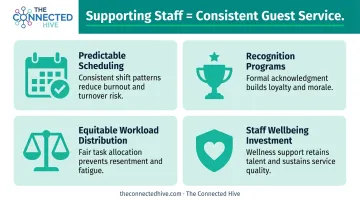
BLS data from 2025 recorded a 5.5% average separations rate across accommodation and food services combined — reflecting the sector's persistent churn challenges. Management practices that reduce attrition include:
- Adequate rest periods and predictable scheduling
- Recognition programs tied to service quality
- Equitable workload distribution across shifts
- Genuine investment in staff wellbeing and development
When employees feel supported, guests notice. Turnover drops, institutional knowledge stays, and service consistency improves across the board.
Maintaining Consistency Across Departments and Locations
Fragmented communication systems are one of the most common causes of dropped service standards. When a guest's special request is logged at check-in but never reaches housekeeping, or a complaint is verbally noted but never entered into the system, the result is a guest who feels invisible — and frustrated.
The most practical fixes include:
- Shared CRM access so guest requests and complaints follow them through every touchpoint
- Structured cross-department handoff protocols (not just verbal notes)
- Regular joint briefings between front desk, housekeeping, and F&B teams
At multi-property operations, standardizing training and quality assurance processes ensures consistent service standards across every location.
Practical Strategies to Improve Customer Service in Hospitality
Build a Customer-First Service Culture Through Training
Service excellence starts with a clearly defined service philosophy — one that every role in the organization understands, not just front-of-house staff. That philosophy only becomes real through regular, structured reinforcement:
- Onboarding that covers service standards, not just operational procedures
- Team meetings anchored in guest feedback — reviewing what worked, what didn't, and why
- Scenario-based training that gives staff tools to handle difficult interactions before they happen
- Accessible service standards documentation that travels with every new hire and department transfer
Leverage Technology to Enhance — Not Replace — Human Connection
Technology's best role in hospitality service is handling the routine so staff can focus on the personal. CRM systems maintain guest history and preferences across stays. Messaging platforms reduce friction for low-complexity requests. Chatbots handle FAQs and booking inquiries at volume.
The results can be meaningful. At Hilton, messaging handled through Kipsu across 3,618 properties generated over 10.5 million conversations in 2023 — and 70% of guests who used messaging reported it improved their overall stay satisfaction (Hilton-reported operational data).
That said, technology amplifies service culture; it doesn't create it. A chatbot that responds in seconds but sounds robotic still leaves guests cold. The goal is smooth handoffs between digital and human touchpoints — not a digital wall between the guest and a real person.
Use Guest Feedback as an Ongoing Improvement Loop
Feedback is only useful if it's collected systematically and acted on visibly. Post-stay surveys, real-time comment cards, and active review platform monitoring create a continuous signal about where service is hitting and where it's falling short.
Cornell University research across 515 hotels found that inviting guests to complete satisfaction surveys increased the probability of loyalty by almost 50% — not just because the data was valuable, but because the act of asking signals that the guest's experience matters.
Closing the loop matters equally. When guests see that their feedback led to a visible change — a menu addition, an updated check-in process, a fixed maintenance issue — they develop a sense of investment in the property that drives return visits.
Partner with Specialized Support for Scalable Service Delivery
Seasonal demand spikes, peak travel periods, and rapid growth can strain internal service teams past the point where quality holds. Maintaining standards then means either overstaffing year-round or accepting degraded service during peak periods — neither is a good outcome.
Partnering with a specialized contact center or BPO provider lets hospitality operators scale guest support functions without building permanent overhead. Common areas where this model adds capacity include:
- Reservations lines and booking inquiries
- Complaint handling and escalation management
- Loyalty program support
- Concierge and pre-arrival assistance

The key is finding a partner whose service standards and communication style align with your brand, not just one that handles volume.
Navigating that vendor landscape is where a consultancy like The Connected Hive fits in. The firm matches hospitality operators with pre-vetted contact center partners drawn from a network of over 3,500 domestic and 8,000 global providers. The process covers needs assessment, RFP creation, site audits, and partner selection — structured to find the right operational and cultural fit. The advisory engagement carries no direct cost to the client; partner fees cover the service.
Frequently Asked Questions
What is customer service in hospitality?
Customer service in hospitality is the process of assisting guests across all touchpoints — from pre-arrival inquiries through post-stay follow-up. It combines reactive problem-solving with proactive anticipation of guest needs, with the goal of creating experiences that drive loyalty and positive word-of-mouth.
What are the 7 qualities of good customer service?
The core qualities are responsiveness, empathy, clear communication, product and service knowledge, patience, consistency, and effective problem resolution. In hospitality, all seven must show up consistently — not just at the front desk, but in every department and every channel.
What are the 5 C's of hospitality?
The 5 C's are Cleanliness, Courtesy, Consistency, Communication, and Comfort. Each shapes a distinct part of the guest experience, and all five need to work together for the stay to feel cohesive.
How does customer service differ from hospitality?
Customer service focuses on meeting specific functional needs efficiently. Hospitality goes further — it creates warmth and emotional connection that makes guests feel genuinely welcome. You need both to build lasting loyalty; one without the other falls short.
How can hospitality businesses handle difficult or demanding guests?
Stay calm, listen without interrupting, and acknowledge the guest's frustration before offering a solution. Most difficult interactions can be recovered with a genuine, swift response — a room change, a complimentary service, or simply an empathetic ear. The goal is de-escalation through respect, not defense.
What role does technology play in hospitality customer service?
Technology — CRM systems, messaging platforms, chatbots, and in-room devices — handles routine requests, reduces response times, and frees staff for higher-value personal interactions. It works best as a complement to human service, not a substitute for it. The strongest implementations use technology to make human connections easier, not to replace them.