Introduction
The global business process outsourcing market is valued at close to $300 billion, yet the results companies actually capture tell a more complicated story. Cost reduction motivates the majority of outsourcing decisions, but only 38% of BPO decision-makers rate their achieved savings as "very good" or "excellent", according to ISG's survey of 368 executives.
That gap between expected and actual savings doesn't appear as a single line item. It shows up across multiple cost categories most companies never fully account for:
- Budget overruns during vendor transitions
- Internal staff hours absorbed by oversight and coordination
- Scope disputes that trigger contract amendments
- Quality failures that generate rework no one budgeted for
Outsourcing itself isn't the problem. The cost outcomes are almost entirely determined by the decisions made before, during, and around the engagement—not by the base contract price.
This guide breaks down exactly where outsourcing costs accumulate, what drives them up, and which strategies reduce them at each stage — covering the full arc from vendor selection through ongoing contract management.
Key Takeaways
- BPO delivers 15% average savings over in-house operations—but only when the engagement is structured and managed well
- The biggest costs are invisible at signing: transition expenses, governance overhead, scope creep, and quality rework
- Cost reduction strategies span three areas: pre-engagement decisions, day-to-day management, and organizational structure
- Competitive vendor selection can reduce initial pricing by 35–40% between RFP and contract
- The wrong partner or an incomplete contract erases the cost advantage outsourcing is meant to deliver
How Outsourcing Costs Typically Build Up
Outsourcing costs rarely arrive as a single invoice. They accumulate in layers, and most businesses don't see the full picture until the engagement is already live.
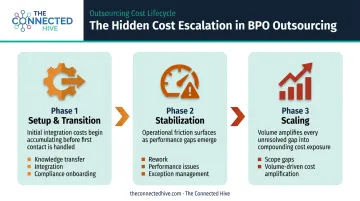
The Three-Phase Cost Pattern
Cost build-up follows a predictable arc:
- Setup and transition — Knowledge transfer, system integration, compliance onboarding, and training. This phase carries the highest risk in any outsourcing lifecycle and generates costs that are rarely reflected in the original proposal.
- Stabilization — The period after go-live where performance issues surface, rework accumulates, and internal staff spend disproportionate time managing exceptions.
- Scaling — As volume grows or contracts renew, gaps in scope definition and pricing structures become expensive. What was a minor ambiguity at 1,000 interactions per month becomes a significant cost driver at 10,000.
The Hidden Cost Problem
Many of the most significant costs never appear on a vendor invoice:
- Staff hours spent managing vendor performance, resolving escalations, and running reporting cycles
- Output that meets minimum SLA thresholds but still triggers downstream corrections
- Regulatory exposure that surfaces during audits — not during contract negotiation
- Knowledge transfer costs when a vendor relationship ends poorly and a new partner must be onboarded
Deloitte's outsourcing framework identifies a retained organization and vendor management function as necessary costs of any engagement. Yet 70% of organizations lack a fully mature vendor management office. For most companies, that means absorbing these costs through informal channels — with no baseline to measure them against and no mechanism to reduce them.
Key Cost Drivers in Outsourcing
Four primary forces shape the cost profile of any outsourcing engagement. They interact differently depending on the function involved, but they're present in virtually every arrangement.
Labor Arbitrage Assumptions
Most outsourcing business cases start with a wage comparison. It's a reasonable starting point, but wage rates alone don't tell the full story. The ISG benchmark of 15% average BPO savings reflects what companies actually capture after accounting for total operational costs, not just the rate differential. Businesses that anchor their projections to salary arbitrage alone consistently overestimate savings.
Scope Definition
Vague scope is the primary source of contract amendments, hidden fees, and performance disputes. When the vendor's responsibilities aren't precisely defined at the outset, every gray area becomes a negotiation—and those negotiations rarely go in the client's favor. The cost isn't always direct; it's the internal time spent managing exceptions that were never priced into the original agreement.
Governance Overhead
The internal cost of managing an outsourcing relationship is real and frequently underestimated. Regular performance reviews, escalation handling, invoice validation, and reporting all consume staff hours — often more than anticipated. Without a structured governance model, these costs compound steadily as the engagement scales and new service tiers get added.
Key governance tasks that drive overhead:
- Ongoing performance reviews and SLA tracking
- Escalation management and issue resolution cycles
- Invoice reconciliation and billing dispute resolution
- Reporting, dashboards, and stakeholder communication
Compliance Requirements
Regulated industries carry a distinct cost layer that must be accounted for before vendor selection, not after. Key compliance obligations include:
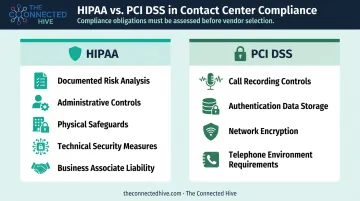
- HIPAA — Business associates are directly liable for applicable HIPAA provisions, requiring documented risk analysis, administrative controls, physical safeguards, and technical security measures
- PCI DSS — Applies to telephone and payment card environments, requiring controls around call recordings, authentication data storage, and network encryption
Neither framework publishes a benchmark cost for contact center compliance. The implementation burden—vendor vetting, audit processes, contractual language, and documentation standards—is material regardless of vendor size.
For healthcare and financial services companies, compliance fit should be a gate in vendor selection, not an afterthought.
Cost-Reduction Strategies for Outsourcing
Sustainable outsourcing cost reduction comes from three distinct levers: the decisions made before a vendor is selected, how the engagement is managed once it's live, and whether the organizational context around the vendor supports or sabotages their work. Most cost overruns trace back to at least one of these areas being neglected.
Strategies That Reduce Costs by Changing Decisions
These approaches set the ceiling on what savings are achievable. Poor decisions here can't be fully recovered through excellent management.
Conduct a true total-cost comparison. Go beyond salary arbitrage. A complete baseline should include transition costs, internal oversight time, technology integration, compliance setup, and the cost of poor quality. Without this, projected savings are unreliable. The Connected Hive's needs assessment process is specifically designed to surface these categories before clients go to market—helping them build a realistic cost picture rather than an optimistic one.
Define scope with precision before engaging vendors. Ambiguity in vendor responsibilities is the primary source of contract amendments and hidden fees. Invest in a detailed scope document first. The Connected Hive assists clients through formal RFI and RFP creation, establishing clear requirements before any provider conversations begin.
Align outsourcing decisions with function criticality:
- Non-core, high-volume, well-documented processes yield the most predictable savings
- Functions that are still evolving or poorly documented create instability that generates cost
- Outsourcing a broken process transfers the inefficiency to the vendor—who will price for it
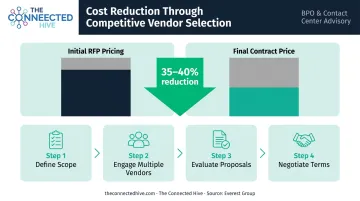
Use competitive selection to establish realistic pricing. Engaging multiple qualified providers surfaces the actual cost range for a given scope and creates negotiating leverage. Everest Group's deal analysis found that provider pricing fell 35–40% between initial RFP and final contract—a gap that only exists when clients run a structured competitive process rather than accepting the first proposal.
The Connected Hive draws from a network of over 3,500 domestic US contact centers and 8,000+ globally, hand-selecting qualified vendors and managing the RFP process on behalf of clients—typically at no cost to the buyer, as compensation comes from the placed partner.
Once the right decisions are in place, execution quality becomes the next cost driver.
Strategies That Reduce Costs Through Better Engagement Management
A well-priced contract can still become an expensive engagement. Poor management is where savings erode.
Establish SLAs tied to cost consequences. Vague quality expectations produce acceptable-but-subpar output that triggers internal rework, escalation handling, and customer experience failures. These costs never appear on the vendor invoice but are real at volume.
SLAs should define performance thresholds clearly, with consequences that create real accountability—not just language that both sides ignore when things slip.
Create a consistent governance cadence:
- Regular structured check-ins with shared performance dashboards
- Clear escalation paths that prevent small issues from becoming expensive disruptions
- A designated internal owner for the vendor relationship—not a shared responsibility that falls to no one
Monitor scope creep actively. Incremental requests outside the original agreement accumulate quickly. A formal change management process prevents uncontrolled cost growth between contract reviews. Without it, scope expands informally and billing disputes follow.
Track the true cost of quality failures. Rework, re-training, and customer service failures caused by underperforming vendors rarely appear in standard budget reporting. ISG's review of a $35.1M annual BPO spend identified $1.7M in potential savings through rate-card and delivery-location analysis alone—the kind of visibility that only becomes possible when costs are tracked systematically.
Decisions and management account for most of the cost equation. But in many cases, the environment surrounding the vendor is doing quiet damage on its own.
Strategies That Reduce Costs by Fixing the Context Around the Vendor
In many cases, the cost problem isn't the vendor. It's the environment the vendor is operating in.
Clean up internal processes before outsourcing. When the function being outsourced is internally inefficient, the vendor inherits that inefficiency and prices for it. Cleaning up workflows, documentation, and decision rights before transition reduces operational complexity—and lowers the cost basis.
McKinsey's research on digital BPO models found that end-to-end process redesign before outsourcing produced 2–3 times the impact of traditional outsourcing approaches. That gap reflects how much inefficiency vendors absorb when clients hand off broken processes.

Right-size the model to actual demand variability. Over-contracting for capacity that isn't consistently used is a common source of wasted spend. Providers who can scale flexibly reduce cost during low-demand periods without sacrificing readiness for peak periods.
The onshore, nearshore, and offshore mix matters here. The Connected Hive evaluates geographic model fit as part of its needs assessment, matching clients to the cost structure that reflects their actual volume and quality requirements.
Use vendor technology rather than replicating it. One genuine advantage of outsourcing is access to enterprise-grade platforms—AI, CCaaS, IVR, WFM—that the vendor already operates at scale. Replicating these internally eliminates the cost benefit of the arrangement. The Connected Hive's vendor network includes access to leading contact center technology platforms, allowing clients to access these capabilities without the capital investment of building them internally.
Conclusion
The outsourcing cost reduction formula isn't a single calculation. It's the cumulative result of better decisions before the engagement, stronger management during it, and smarter structural setup around it. Businesses that treat outsourcing as a set-and-forget cost play consistently underperform on savings—because the savings don't come from signing a contract, they come from everything that happens before and after.
The organizations that capture durable results approach outsourcing strategically. That means understanding the full cost equation—not just the contract line—and selecting partners whose capabilities, compliance posture, and operational model actually match the function being outsourced.
That's where experienced advisory support pays off. The Connected Hive works with businesses across healthcare, financial services, insurance, retail, and government to structure outsourcing engagements from the ground up:
- Needs assessment and scope definition
- Competitive vendor selection and RFP management
- Site visit audits and due diligence
- Ongoing advisory support post-contract
Founder Tim Austrums brings 20+ years of negotiating multi-million dollar vendor relationships across healthcare, financial services, and government—the kind of experience that turns a vendor search into a measurable cost-reduction outcome.
Frequently Asked Questions
What are the basics of outsourcing?
Outsourcing involves contracting an external organization to perform specific business functions—such as customer service, finance and accounting, or IT support. It allows businesses to reduce costs, access specialized expertise, and focus internal resources on core operations rather than support functions.
What are the four types of outsourcing?
The four primary types are Business Process Outsourcing (BPO), Information Technology Outsourcing (ITO), Knowledge Process Outsourcing (KPO), and offshoring. Each carries different cost implications: BPO and offshoring typically offer the strongest labor cost arbitrage, while KPO engagements command higher rates due to specialized expertise requirements.
What is an example of outsourcing?
A healthcare company outsourcing its member services contact center to a specialized BPO provider is a practical example. It reduces staffing overhead and infrastructure costs while maintaining HIPAA-compliant support at scale — one of the most common outsourcing scenarios in regulated industries.
How much can outsourcing reduce costs?
ISG's survey of 368 BPO decision-makers found an average of 15% savings over equivalent in-house operations. Actual results depend heavily on scope definition, vendor selection quality, and how well the engagement is managed after go-live.
What are the hidden costs of outsourcing?
The most common hidden costs are transition and onboarding expenses, internal vendor management overhead, compliance setup for regulated industries, rework triggered by quality failures, and contract amendment costs from poorly defined scope. None of these show up on a vendor invoice, yet all of them affect your total cost of outsourcing.
How do you choose the right outsourcing partner to reduce costs?
Evaluate providers on scope fit, compliance certifications, performance track record, pricing transparency, scalability, and cultural alignment. Working with an experienced BPO consultant who can run a competitive RFP process, vet providers beyond their marketing materials, and negotiate terms from an informed position gives you a measurable advantage in hitting your projected savings.