Strategic sourcing is a systematic, data-driven approach to procurement that focuses on finding the best total value from suppliers — not just the lowest price. That distinction matters more now than it did five years ago. Supply chain disruptions, rising operational costs, and an increasingly complex vendor landscape have pushed procurement from a back-office function to a board-level conversation.
This guide is written for business owners, operations leaders, and decision-makers who are new to procurement or looking to formalize their approach. You'll find a clear explanation of what strategic sourcing is, how it differs from traditional purchasing, a step-by-step breakdown of the process, and the common misconceptions worth addressing before you start.
Key Takeaways
- Strategic sourcing evaluates total value — cost, quality, risk, and reliability — not just price
- It replaces one-off purchasing with a structured, repeatable process for supplier selection and management
- The methodology follows a 7-step framework, from spend analysis through ongoing performance monitoring
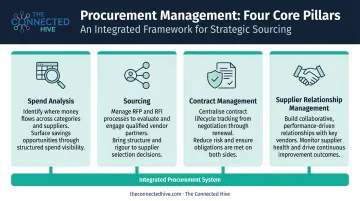
- A mature sourcing function rests on four pillars: spend analysis, sourcing, contract management, and supplier relationship management (SRM)
- Consistent application leads to measurable cost savings, lower supply chain risk, and more reliable vendor partnerships
What Is Strategic Sourcing?
Strategic sourcing is a structured methodology for evaluating, selecting, and managing suppliers — one that goes beyond price to align purchasing decisions with long-term business goals. Rather than buying from whoever offers the lowest quote, it asks a more complete question: which supplier delivers the best outcome over time, across cost, quality, reliability, and risk?
According to CIPS (the Chartered Institute of Procurement & Supply), strategic sourcing is a proactive, planned approach grounded in supply-market analysis and supplier selection, applied to longer-term, higher-risk, or higher-value decisions.
How It Differs from Traditional Procurement
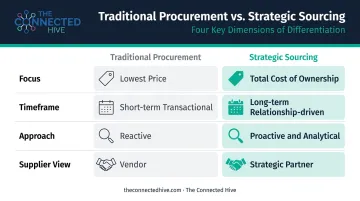
Traditional procurement is transactional — it prioritizes short-term cost reduction and focuses on purchase orders, invoicing, and payment. Strategic sourcing operates upstream: it decides who to buy from, why, and on what terms before a purchase order is ever raised.
| Dimension | Traditional Procurement | Strategic Sourcing |
|---|---|---|
| Focus | Lowest price | Total cost of ownership |
| Timeframe | Short-term, transactional | Long-term, relationship-driven |
| Approach | Reactive | Proactive and analytical |
| Supplier view | Vendor | Strategic partner |
Strategic sourcing is also distinct from category management. Sourcing is project-specific — it manages a single sourcing event for a defined category. Category management is the broader, ongoing oversight of a group of related spend categories. Think of sourcing as the execution engine; category management sets the direction it runs in.
Why Strategic Sourcing Matters Today
Supply chain risk has moved from a procurement problem to a business continuity problem. McKinsey research estimates that disruptions lasting at least one month occur on average every 3.7 years across value chains — and a modeled 100-day production shock could erase 30–50% of a single year's EBITDA.
The COVID-19 pandemic put that risk in sharp relief. A sponsored survey by HBR Analytic Services and Workday found that 95% of global executives reported pandemic-related disruption to sourcing and supplier management — one of the most broadly shared operational failures of the last decade.
What Goes Wrong Without It
Organizations that skip strategic sourcing typically encounter a predictable set of problems:
- Maverick spending — employees buying outside approved channels, inflating costs and creating compliance gaps
- Single-source dependency — over-reliance on one vendor creates catastrophic exposure when that supplier fails
- Missed savings — without spend visibility, consolidation opportunities go unrecognized
- Reactive crisis management — problems surface only after a supplier has already failed to deliver
- Compliance violations — particularly in regulated industries where vendor oversight is mandatory
Where It's Required, Not Just Recommended
In many contexts, strategic sourcing isn't optional. Several regulatory frameworks make structured vendor evaluation a legal or operational requirement:
- US federal contracting — FAR Part 6 requires full and open competition for government procurement
- European Banking Authority — outsourcing guidelines mandate documented due diligence on third-party providers
- Healthcare and financial services — both sectors carry their own vendor selection and oversight requirements
The methodology aligns naturally with what these environments already require, whether or not they use that term explicitly.
How Strategic Sourcing Works: The 7-Step Process
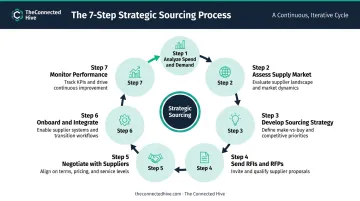
The strategic sourcing process is iterative, not linear. It ends with performance monitoring that feeds directly back into the next cycle — making it a continuous improvement discipline rather than a one-time project. CIPS publishes a seven-stage framework that forms the basis for most modern sourcing methodologies.
Step 1: Analyze Spend and Demand
The first step is visibility. Collect and review all purchasing data to understand what's being bought, from whom, in which categories, and at what total cost. The goal isn't just accounting — it's identifying patterns, redundancies, and opportunities that aren't visible at the invoice level.
Step 2: Assess the Supply Market
Research the supplier landscape for each category. Key questions to answer:
- Who are the available vendors and what do they offer?
- What does pricing look like across the market?
- What risk profiles do different suppliers carry?
This step prevents organizations from negotiating in a vacuum.
Step 3: Develop the Sourcing Strategy
A cross-functional team uses insights from steps 1 and 2 to determine the approach:
- Single supplier vs. a diversified panel
- Competitive bid vs. negotiated contract
- How to weight cost against quality, risk, and compliance requirements
For specialized categories like contact center and BPO services, outside expertise at this stage makes a measurable difference. Agent-hour rates range from $8–$35 depending on model and geography — a spread wide enough that without current market data, strategy decisions are largely guesswork. The Connected Hive helps organizations build sourcing strategies grounded in those benchmarks and the evaluation criteria that actually matter for the program.
Step 4: Send RFIs and RFPs
Formal Requests for Information (RFI) and Requests for Proposal (RFP) go to shortlisted suppliers. These documents create a structured, level playing field — enabling objective comparison across pricing, capabilities, compliance certifications, and service terms. Poorly constructed RFPs produce proposals that can't be compared meaningfully, which is why document quality matters here.
Step 5: Negotiate with Suppliers
Negotiation covers far more than price. All of the following are in scope:
- Delivery timelines and service levels
- Payment terms and contract flexibility
- Compliance requirements
- Transition costs
Market data gathered in steps 2 and 3 gives the buyer real leverage. Walk in without it and the negotiation tips toward the supplier.
Step 6: Onboard and Integrate Suppliers
Onboarding sets the foundation for everything that follows. This step aligns both parties on:
- Communication channels and escalation procedures
- Performance expectations and KPIs
- Reporting cadence and accountability structures
- Compliance requirements specific to the industry or program
Skipping structured onboarding is a predictable way to undermine the first six months of an outsourcing relationship before it gets started.
Step 7: Monitor Performance and Optimize
Agreed KPIs create accountability. Regular performance reviews identify gaps, enable course corrections, and surface opportunities for improvement. This step feeds back into step 1 — closing the loop and making strategic sourcing a continuous process rather than a completed project.
The Four Pillars of Strategic Sourcing
While the 7-step process describes what to do, the four pillars describe the ongoing capabilities an organization builds. Together, they represent a mature sourcing function.
Spend Analysis
You cannot manage what you cannot see. Spend analysis involves cleansing, categorizing, and analyzing purchasing data to reveal inefficiencies, consolidation opportunities, and gaps in visibility. It's the foundation for every strategic decision that follows.
Sourcing
As an ongoing capability, sourcing covers the end-to-end process of identifying, vetting, and selecting qualified suppliers — including RFx processes, market research, supplier scoring, and stakeholder recommendations. Supplier markets evolve constantly — new entrants emerge, incumbents falter, and category conditions change — so sourcing requires continuous attention, not a set-it-and-forget-it approach.
Contract Management
Once a contract is signed, the value doesn't manage itself. WorldCC's procurement contract research found that procurement contracts lose an average of 11% of their value after signature — driven by missed obligations, unmanaged changes, and weak post-award governance. Disciplined contract management tracks compliance, monitors renewal dates, manages amendments, and holds both parties accountable.
Supplier Relationship Management (SRM)
SRM is the ongoing, strategic management of key supplier partnerships — sharing performance data, resolving issues together, and identifying opportunities for joint improvement. Where transactional vendor management focuses on orders and invoices, SRM focuses on outcomes, trust, and long-term value creation. McKinsey's research across 100+ large organizations found that regular supplier collaboration correlates with higher growth, lower operating costs, and greater profitability compared to industry peers.
The four pillars — spend analysis, sourcing, contract management, and SRM — work together as an integrated system. Weakness in any one area undermines the others.
Key Benefits of Strategic Sourcing
Cost Savings and Efficiency
Strategic sourcing reduces costs through negotiation, but also through spend consolidation, demand management, and elimination of maverick spending. Deloitte reports delivering 10–20% savings per initiative across 250+ category-specific projects covering $195 billion in spend, though actual outcomes vary by category, complexity, and execution quality.
Risk Mitigation and Supply Continuity
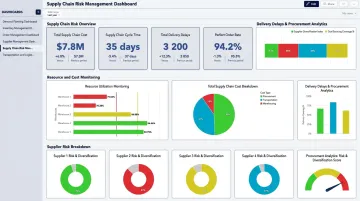
By diversifying the supplier base, evaluating financial stability, and monitoring performance on an ongoing basis, strategic sourcing reduces exposure to single-source failures, regulatory violations, and supply disruptions. McKinsey found that 81% of organizations implemented dual sourcing by 2022, up from 55% in 2020 — a direct response to the supply shocks of the pandemic era.
Better Alignment with Business Goals
Operational resilience matters, but sourcing decisions also need to support where the business is headed. Strategic sourcing connects procurement to organizational objectives, ensuring supplier relationships advance goals rather than work against them. This matters most in regulated industries, where misaligned vendor selection creates real exposure:
- Healthcare — HIPAA-compliant partners are a requirement, not a preference
- Financial services — PCI compliance and audit readiness depend on vendor vetting
- Government contracting — procurement decisions face regulatory scrutiny at every stage
Common Misconceptions About Strategic Sourcing
"It's just about getting a lower price." Strategic sourcing evaluates total cost of ownership — including quality, reliability, transition costs, compliance risk, and long-term relationship value. Lowest price is one input, not the goal. In fact, a vendor that wins on price but fails on compliance or reliability can cost far more than a higher-priced option.
"It's only for large corporations." Fortune 500 companies popularized the methodology, but the principles apply at any scale. McKinsey's sourcing research addresses small and medium-size enterprises, noting that SMEs comprising 86% of US and Canadian businesses face the same sourcing constraints — limited scale, single-source supply, weaker negotiating leverage — that strategic sourcing is designed to address.
"Once a supplier is selected, the process is done." Sourcing doesn't end at contract signature. WorldCC research found that organizations lose an average of 11% in post-signature value — a direct result of treating contract execution as the endpoint. Ongoing sourcing includes:
- Tracking supplier performance against agreed benchmarks
- Managing the relationship through regular check-ins and issue resolution
- Conducting periodic re-evaluations to confirm the partnership still fits your needs
Frequently Asked Questions
What is meant by strategic sourcing?
Strategic sourcing is a systematic, data-driven approach to procurement focused on achieving the best total value across cost, quality, risk, and organizational alignment — not just the lowest price. Unlike reactive purchasing, it's built on analysis and planning rather than immediate transactional need.
What are the steps of strategic sourcing?
The process follows seven steps: analyze spend, assess the supply market, develop a sourcing strategy, send RFIs and RFPs, negotiate with suppliers, onboard the selected supplier, and monitor performance. The process is cyclical: performance data from the final step feeds back into the next sourcing cycle.
What is the difference between strategic sourcing and procurement?
Strategic sourcing operates upstream : finding, evaluating, and selecting suppliers. Procurement handles the downstream execution: purchase orders, invoicing, and payment. Together, they form the source-to-pay process. Think of strategic sourcing as where decisions get made, and procurement as where those decisions get carried out.
What are the four pillars of strategic sourcing?
The four pillars are spend analysis, sourcing, contract management, and supplier relationship management. The 7-step process covers what happens during a single sourcing event. The four pillars describe the broader capabilities an organization develops and sustains over time.
Is strategic sourcing only relevant for manufacturing or product-based businesses?
No. Strategic sourcing applies to any category of spend including services, technology, outsourcing, and contact center partnerships . It's equally valuable in healthcare, financial services, government contracting, and other service-intensive industries where vendor selection carries compliance and performance implications.
How is strategic sourcing different from category management?
Strategic sourcing is project-specific : it covers a single sourcing event for a defined spend area. Category management is the broader, ongoing oversight of a group of related spend categories over time. Category management sets the long-term strategy that determines when and how sourcing events get triggered. Sourcing is how that strategy gets executed.