"Hosted call center" gets mentioned frequently in technology discussions, but the term rarely gets explained in terms of what it actually changes operationally. This article cuts through that. You'll get a clear definition, a practical look at what the benefits mean day-to-day, and an honest account of what businesses risk by delaying the shift.
Key Takeaways
- A hosted call center puts all core technology — routing, IVR, analytics — on servers managed by a third-party provider, accessed by agents over a secure internet connection
- Primary benefits are lower infrastructure costs, faster scalability, remote team support, and better performance visibility
- Healthcare, financial services, and government organizations gain built-in HIPAA and PCI compliance capabilities
- Businesses can save 20–30% compared to maintaining equivalent in-house infrastructure with the right partner match
- Most hosted platforms deploy in weeks, not months — eliminating the lengthy procurement and setup cycles of on-premise systems
What Is a Hosted Call Center?
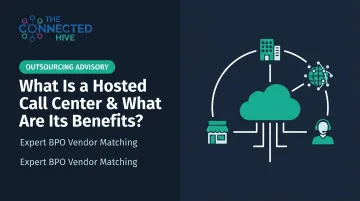
A hosted call center is a customer service operation where the software, telephony infrastructure, and call routing systems live on servers owned and managed by a third-party provider — not on your business premises. Your agents access the platform over a secure internet connection from wherever they work.
Where hosted call centers are typically deployed:
- Inbound customer support and inquiry management
- Outbound sales campaigns and lead generation
- Healthcare enrollment and member services
- Technical help desks and product support
- Government assistance programs and benefits administration
- Insurance claims and policyholder services
The hosted model is an infrastructure approach, not an end in itself. The actual goal is reliable, professional, scalable customer support — without requiring significant hardware investment or a large internal IT team to keep things running.
The global market for hosted contact center solutions (CCaaS) reached $7.2 billion in 2024, growing 20% year-over-year according to Metrigy's contact center platforms forecast. Remote workforce expansion and rising customer experience expectations across healthcare, financial services, and retail are the primary forces behind that growth — and they show no signs of slowing. Understanding what the hosted model actually delivers helps explain why so many businesses are making the switch.
Key Benefits of a Hosted Call Center
Each benefit below connects to something measurable — infrastructure spend, agent utilization, customer satisfaction scores. These aren't soft gains; they show up in the numbers.
Cost Efficiency and Reduced IT Overhead
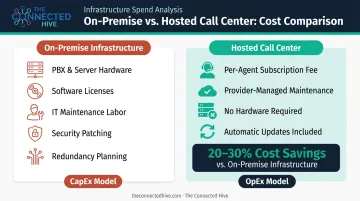
The most immediate financial impact of moving to a hosted model is the elimination of capital expenditure on physical infrastructure. No PBX hardware to purchase. No telephony servers to house. No on-premise software licenses to renew. Instead, the provider owns and manages the infrastructure, and your business pays a predictable per-agent or subscription-based fee.
That shift from capital expense to operating expense has a real budget impact: infrastructure costs appear on a monthly invoice, not in a multi-year depreciation schedule tied to hardware you may already be outgrowing.
Beyond hardware, businesses also stop absorbing the IT labor costs associated with maintenance, security patching, upgrades, and redundancy planning. The provider handles all of it.
KPIs this affects:
- Infrastructure cost per agent seat
- IT labor hours spent on system maintenance
- Total cost of ownership (TCO)
- CapEx-to-OpEx ratio
When this matters most: Small and mid-sized businesses with limited IT teams benefit most immediately, as do enterprises looking to reduce overhead during growth or restructuring phases.
The Connected Hive's experience across client engagements consistently points to 20–30% cost savings when businesses transition from in-house infrastructure to a well-matched hosted solution. In one documented retail engagement, a client achieved a 30% reduction in operational costs alongside a 20% increase in customer satisfaction — not by cutting service quality, but by eliminating the overhead of maintaining it internally.
Scalability and Support for Distributed Teams
Hosted call centers are built to scale in ways that on-premise systems structurally cannot. Adding agent seats, absorbing a seasonal volume surge, or onboarding remote agents in a new city doesn't require hardware procurement, IT lead time, or physical infrastructure changes. Agents need a computer and an internet connection.
Supervisors manage distributed teams through a central cloud-based dashboard with real-time visibility into agent availability, call queues, handle times, and service levels — regardless of where those agents are located.
ICMI research found that 73% of contact center professionals planned a remote or hybrid workforce following the pandemic. That intention requires infrastructure that supports it — something legacy on-premise systems weren't designed to do.
The core problem with rigid infrastructure:
- Over-provisioning wastes money during low-volume periods
- Under-provisioning during peaks drives call abandonment and customer churn
- Either scenario damages service quality and reputation
For organizations with predictable demand spikes — healthcare open enrollment, retail holiday rushes, insurance claim surges, government program renewals — the ability to scale without lead time is a risk management tool as much as a cost consideration.
KPIs this affects:
- Agent utilization rate
- Call abandonment rate during peak periods (industry average benchmark: 6%, with above 10% considered high)
- Time-to-onboard new agents
- SLA adherence during volume spikes
Tim Austrums and the team at The Connected Hive have supported clients like Humana and state government agencies through exactly these kinds of demand cycles — where the ability to ramp contact center capacity quickly isn't a convenience, it's operationally critical.
Improved Customer Experience and Operational Visibility
Modern hosted platforms go well beyond call routing. Real-time analytics dashboards, CRM integrations with screen-pop functionality, IVR automation, call recording, quality monitoring, and omnichannel support tools are standard features on most enterprise-grade platforms.
Together, these capabilities give agents the context they need before a conversation starts — and give supervisors the data to make informed decisions instead of reactive ones.
In practice, this looks like:
- Agents receiving customer history and prior interaction context the moment a call connects
- Supervisors monitoring live queue status, handle times, and escalation triggers from a single dashboard
- Managers using reporting data to identify routing bottlenecks, training gaps, and the agent behaviors correlated with first-call resolution
That last point is measurable. SQM research, cited by ICMI, shows that each 1 percentage-point improvement in first-call resolution (FCR) corresponds to a 1 percentage-point improvement in customer satisfaction (CSAT). Top-performing contact centers typically achieve FCR rates of 80% or higher. For high-volume contact centers, that correlation has direct revenue implications.
In regulated industries — healthcare, financial services, insurance, government — the visibility benefits extend to compliance. Call recording, interaction audit trails, and HIPAA- or PCI-ready infrastructure aren't just operationally useful; they're required. Hosted platforms built to these standards provide that capability without requiring clients to build internal compliance infrastructure.
KPIs this affects:
- First-call resolution (FCR) rate
- Average handle time (AHT)
- Customer satisfaction score (CSAT)
- Call abandonment rate
- Supervisor response time to escalations
What Happens When Businesses Delay Modernizing Their Call Center Infrastructure
Legacy systems don't hold steady — their costs and limitations grow with every quarter you delay.
A Deloitte contact center survey found that 72% of contact center leaders cited technology and system integration as a top challenge, while 58% named legacy systems specifically. These aren't just operational inconveniences — they represent structural limitations that affect every customer interaction.
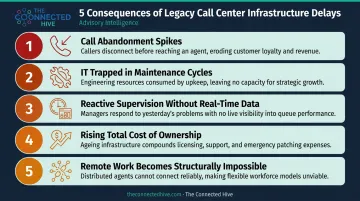
Common consequences of delayed modernization:
- Call abandonment spikes during peak periods when on-premise systems can't absorb volume surges — and customers who leave rarely return.
- IT teams get trapped in hardware maintenance cycles, troubleshooting aging infrastructure instead of building new capability.
- Supervisors manage reactively without real-time analytics, catching quality problems in customer complaints rather than dashboards.
- Total cost of ownership (TCO) climbs steadily as repairs grow more frequent and legacy systems require expensive custom development to connect with modern CRM, analytics, or compliance tools.
- Remote work becomes structurally off-limits, shrinking the talent pool and pushing agent turnover higher.
A NICE survey reinforces the stakes: **57% of consumers said they would abandon a brand after one or two negative customer service interactions**. In high-stakes verticals like financial services, healthcare, and insurance, that kind of attrition isn't a setback — it's a structural threat. Hosted call center infrastructure addresses these gaps directly, which is why modernization decisions have accelerated across industries.
How to Get the Most Value from a Hosted Call Center
A hosted call center delivers its full value only when it's matched to the specific operational profile of the business. A platform configured for a retail e-commerce operation may be poorly suited for a healthcare enrollment center operating under HIPAA. The technology is only as effective as the configuration behind it.
Three conditions where hosted platforms perform best:
- Call routing and IVR reflect actual customer journeys — not generic templates. Configuration that mirrors how customers actually call in, what they need, and how they escalate produces measurable improvements in FCR and handle time.
- Supervisors actively use reporting data on a regular cycle — not just during audits or when something goes wrong. Analytics tools that sit unused don't improve anything.
- The platform is reviewed against evolving business needs — hosted solutions aren't set-it-and-forget-it. As your business grows, your routing logic, channel mix, and compliance requirements should evolve with it.
Getting that configuration right — especially for regulated industries — is harder without someone who knows the vendor landscape.
The Connected Hive works with organizations across healthcare, financial services, insurance, and government to assess their operational needs, identify compliance requirements, and match them with the right hosted platform. With a vetted network of 3,500+ domestic and 8,000+ global contact center partners, the advisory process comes at no cost to the client.
Conclusion
The value of a hosted call center comes down to three compounding advantages: lower and more predictable costs, the flexibility to scale and support distributed teams, and the operational visibility needed to consistently deliver quality customer experiences.
These advantages grow when the right platform is matched to the right business. They diminish when organizations put off the transition or choose a platform without fully assessing their compliance requirements, integration needs, and support structure.
A hosted call center is an ongoing operational commitment, not a one-time purchase. It performs best when revisited regularly as the business evolves — and when the initial selection is grounded in honest assessment rather than feature lists alone. That's where working with an experienced advisor, like The Connected Hive, helps organizations cut through the noise and land on the right fit from the start.
Frequently Asked Questions
What is a hosted call center?
A hosted call center is a customer service operation where core technology — call routing, IVR, analytics, and telephony infrastructure — is managed off-site by a provider and accessed by agents over a secure internet connection. This eliminates on-premise hardware and the IT overhead required to keep systems running.
What is the difference between a hosted call center and a cloud call center?
A hosted call center typically runs on dedicated servers managed by a provider (single-tenant architecture), while a cloud contact center runs on shared, multi-tenant infrastructure. Both eliminate on-premise hardware, but cloud solutions tend to offer more elastic scalability and faster feature updates — and the terms are often used interchangeably.
How much does a hosted call center cost?
Pricing varies by features, agent count, and channel support. Entry-level solutions typically start around $25–$75 per agent per month; enterprise platforms with omnichannel capabilities and advanced analytics can reach $120–$200+ per user per month. Also factor in implementation, CRM integration, and compliance-specific configurations when estimating total cost.
What is the 80/20 rule in a call center?
The 80/20 rule refers to a common service level objective: answering 80% of incoming calls within 20 seconds. It's widely used as a staffing and queue management benchmark, though ICMI notes it was never a universal industry standard — it originated in early automatic call distributor manuals and spread informally from there.
Which CRM is best for call centers?
The right CRM depends on your industry and existing systems. Salesforce and HubSpot are widely used for their integration depth with hosted platforms, though healthcare operations typically require HIPAA-compliant configurations that narrow the field. Prioritize seamless integration with your hosted platform over brand preference.
Is a hosted call center right for small and mid-sized businesses?
Hosted solutions are particularly well-suited for SMBs because they eliminate large upfront hardware investments, offer subscription pricing that scales with headcount, and allow smaller IT teams to offload infrastructure management entirely. The result is full-featured contact center capability without the infrastructure budget that larger deployments typically demand.