Introduction
Picture this: a mid-sized healthcare company signs a BPO contract, excited about the operational relief and projected savings. Six months later, they're managing a data breach, fielding member complaints about poor service quality, and discovering that the vendor's "HIPAA-compliant" claim was largely self-certified. The cost of untangling that relationship far exceeded whatever they'd hoped to save.
Outsourcing is a legitimate, powerful strategy: the global BPO market is projected to reach $695.77 billion by 2033, growing at a 9.9% CAGR. That scale makes understanding its risks more important, not less.
This post covers the most critical outsourcing risks, why data security and compliance deserve special attention in regulated industries, and why vendor selection is the single highest-leverage decision you'll make in any outsourcing relationship.
Key Takeaways:
- Outsourcing transfers work, not accountability — you remain responsible for regulatory and reputational outcomes
- Third parties were involved in 30% of analyzed data breaches in 2025, up from roughly 15% the prior year
- Most outsourcing failures — poor quality, compliance gaps, financial losses — trace back to weak vendor selection
- Thorough due diligence, structured contracts, and ongoing monitoring are what separate successful engagements from costly ones
- For regulated industries, compliance verification must be active, not assumed
Why Businesses Underestimate the Risks of Outsourcing
The appeal of outsourcing is straightforward: reduce costs, access specialized expertise, and free up internal resources. The risks surface later — once a third party is running a function your customers depend on.
The Savings Calculation Is Often Incomplete
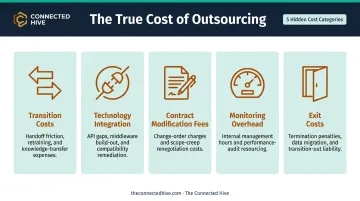
Many organizations enter outsourcing decisions focused on labor cost reduction. What they undercount are the surrounding costs:
- Transition costs — knowledge transfer, parallel operations during cutover, retraining
- Technology integration — connecting vendor systems to internal platforms rarely goes smoothly or cheaply
- Contract modification fees — changing scope after signing often triggers additional charges
- Monitoring overhead — managing a vendor relationship requires dedicated internal resources
- Exit costs — terminating a poor relationship early can carry significant penalties
Deloitte's 2024 Global Outsourcing Survey found that 38% of organizations cited poor contract and change management as an outsourcing challenge — a figure that points directly at deals where cost assumptions were made without adequate structural protections.
You Can Outsource a Process, Not the Risk
Cost surprises are manageable. Accountability gaps are not. When a vendor makes an error — a compliance violation, a data breach, a customer service failure — that accountability doesn't stay with the vendor.
US interagency guidance makes this explicit for financial institutions: third-party use does not diminish a bank's responsibility to comply with applicable laws. In practice, across most regulatory frameworks, the hiring organization remains in the accountability chain.
Healthcare follows the same logic. Business associates carry direct HIPAA liability, but covered entities must still execute compliant contracts and address any known material violations — the risk doesn't transfer cleanly to the vendor.
Understanding this shapes every decision that follows: how you vet vendors, what you put in contracts, and how closely you monitor performance once work begins.
The Most Critical Risks of Outsourcing
Financial and Hidden Cost Risks
What looks like a cost-reduction plan on paper can become financially unpredictable quickly. Several categories of cost consistently surface after contracts are signed:
- Early termination penalties if the relationship underperforms
- Volume-based pricing that creates surprises during peak periods
- Technology upgrade costs the contract doesn't clearly assign to either party
- Vendor transition costs if you need to switch providers mid-contract
The right move before committing is a full lifecycle cost comparison against in-house operations — not just a headline price per agent-hour. Pricing models should be explicitly documented in the contract, with clear rules for what triggers additional charges.
Vendor financial instability is a risk many buyers skip entirely during due diligence. After Capita's 2023 cyber incident, the UK Pensions Regulator contacted 383 pension schemes about disrupted administrative services. Capita expected £20–25 million in incident-related costs. If a vendor faces financial difficulty, service continuity can be threatened almost immediately — and your contract may not protect you from that exposure.
Operational, Quality, and Control Risks
Handing over a business function means accepting reduced visibility into how it runs day to day. The risks that follow from that include:
- Service quality degradation from inadequate vendor training or management
- Missed SLAs and deadlines that damage customer relationships
- Internal productivity losses when cross-functional coordination breaks down
- Loss of institutional knowledge that leaves with the outsourced function
Among organizations that considered bringing outsourced work back in-house, Deloitte found that 68% cited better control over service quality and performance as the motivation. The root cause is governance failure, not outsourcing itself.
Vendor dependency adds another layer of risk. Relying on a single provider for a critical function creates a single point of failure. If that vendor underperforms, exits the market, or faces a business disruption, you have limited options and limited time. Building clear exit strategies into contracts from the start — not as an afterthought — is the structural protection against this exposure.
Reputational and Communication Risks
An outsourcing partner's conduct reflects directly on the company they serve. Poor customer experiences, ethical lapses, or public controversies involving the vendor land on your brand, not theirs. This risk is highest in customer-facing functions like contact centers, where every interaction is a brand touchpoint.
Relationship friction compounds that exposure. Deloitte found that 38% of organizations reported poor contract and change management challenges — a number that traces back to predictable communication failures at the governance level:
- Language and cultural differences between teams
- Time zone gaps that slow escalation and decision-making
- Unclear scope definitions that create disagreements over deliverables
- Undefined escalation paths when performance issues arise
- Inconsistent reporting that obscures problems until they become critical
Data Security and Regulatory Compliance: High-Stakes Risks for Regulated Industries
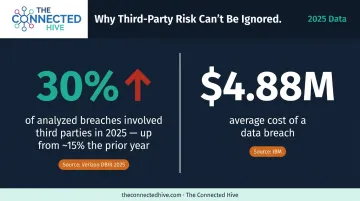
When sensitive data — patient records, financial accounts, government information — flows to a third-party vendor, the attack surface expands. According to the 2025 Verizon Data Breach Investigations Report, third parties were involved in 30% of analyzed breaches, up from approximately 15% the prior year. IBM measured an average breach cost of $4.88 million across organizations breached from March 2023 through February 2024.
Regulatory Accountability Doesn't Transfer to the Vendor
Different industries impose different compliance frameworks — HIPAA for healthcare, PCI-DSS for payment processing, state data privacy laws for consumer data. What they have in common: if a vendor fails to meet these standards, the hiring organization remains in the accountability chain.
The enforcement record is concrete. HHS Office for Civil Rights settled with:
- MedEvolve for $350,000 after an unsecured server exposed data on 230,572 people
- Doctors' Management Services for $100,000 after ransomware affected approximately 206,695 people
Both were business associates — third-party vendors that healthcare organizations routinely engage for revenue cycle management and practice administration.
PCI DSS v4.0.1 explicitly includes contact center and customer-service providers within its scope. Requirements include due diligence, written responsibility acknowledgments, compliance-status monitoring, shared-responsibility mapping, and incident cooperation. Vendor certification doesn't replace the customer's obligation to verify scope and controls.
What Rigorous Security Vetting Actually Looks Like
NDAs alone are not adequate protection. Before engaging any vendor handling sensitive data, businesses should specifically ask:
- What data encryption standards are in place (both in transit and at rest)?
- What access controls limit employee access to sensitive records?
- What does the incident response plan cover, and what are the required notification timelines?
- Have there been prior breaches or security incidents, and how were they handled?
- What subcontractors will access client data, and are they bound by the same obligations?
For regulated industries, self-attestation from a vendor isn't sufficient. The Connected Hive's vetting process independently verifies HIPAA and PCI compliance credentials for healthcare, financial services, and insurance clients. Founder Tim Austrums, a HIMSS member who has structured outsourcing engagements for organizations including Humana and Blue Cross/Blue Shield, treats compliance verification as a baseline — built into every vendor assessment from the start.
How to Choose the Right Outsourcing Partner
Vendor selection is where most outsourcing risk is created or prevented. Poor matches (between a business's actual needs and a vendor's real capabilities) are the root cause of most outsourcing failures.
What Due Diligence Actually Involves
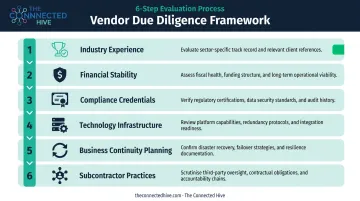
A thorough evaluation goes well beyond reviewing a vendor's sales materials. The framework should include:
- Industry experience — Does the vendor have a documented track record in your specific sector? Case studies and references from similar clients matter more than general service claims.
- Financial stability — A vendor that can't survive a disruption creates business continuity risk. Review financial health as part of due diligence, not just service capability.
- Compliance credentials — Verify certifications rather than accepting them at face value. For regulated industries, this step is non-negotiable.
- Technology infrastructure — Can vendor systems integrate with yours? What's their capacity to scale?
- Business continuity planning — What happens to your operations if the vendor faces a disruption?
- Subcontractor practices — Who else will touch your data or your customers?
Contract Structure Determines Accountability
A well-structured contract does more than document pricing. It defines:
- Specific, measurable KPIs with defined thresholds
- Service level agreements with consequences for non-performance
- Audit rights that let you verify what the vendor is actually doing
- Data security obligations that go beyond a general confidentiality clause
- Dispute resolution mechanisms that don't require litigation to trigger
- An exit strategy with defined transition responsibilities
Industry-standard contact center contracts are typically built around six core SLA metrics: service level (calls answered within agreed time), average speed of answer, abandonment rate, average handle time, first-contact resolution, and customer satisfaction. Targets should reflect the complexity of your specific program, not generic industry averages.
Ongoing Monitoring Is Not Optional
Signing the contract is not the end of risk management. It marks the start of vendor governance. Without structured oversight, a vendor relationship will drift.
Practical monitoring looks like:
- Regular performance reviews against agreed KPIs
- Defined communication cadences with escalation paths
- Customer satisfaction tracking with direct feedback loops
- Periodic compliance verification, not just at contract renewal
The Connected Hive supports clients past the contract signing, offering KPI monitoring guidance, quality assurance review frameworks, and accountability structures. Founder Tim Austrums holds direct relationships with contact center owners and CEOs across a network of over 3,500 domestic US contact centers and 8,000+ globally. For businesses in healthcare, financial services, or government, where vendor mismatch carries the steepest operational and compliance costs, that firsthand industry access translates into better-informed decisions. The advisory service is typically provided at no cost to the client.
Red Flags to Watch for When Evaluating Vendors
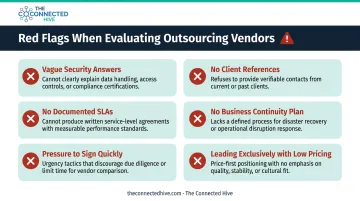
Some risk indicators become visible during the evaluation process, before any contract is signed. Watch for:
- Vague answers about security practices — a vendor that can't clearly describe their data encryption, access controls, or incident response plan hasn't built the infrastructure behind the claim
- Unwillingness to provide client references — particularly from clients in your industry or with similar program complexity
- No documented SLAs or performance metrics — if a vendor can't define how they'll measure success, you can't hold them to it
- No business continuity or disaster recovery plan — this signals operational immaturity
- Pressure to sign quickly — rushed timelines for contract review are a negotiating tactic that benefits the vendor, not you
- Leading exclusively with low pricing — vendors competing primarily on price often signal compromises in staffing quality, training, or compliance infrastructure
Subcontracting arrangements deserve specific scrutiny beyond this list. If a vendor plans to subcontract significant portions of the work, you need to know who those subcontractors are, what standards they operate under, and whether your contractual protections extend to them.
PCI SSC guidance explicitly requires shared-responsibility mapping and subcontractor disclosure for payment processing engagements. That standard is worth applying regardless of industry.
Frequently Asked Questions
What are the benefits and risks of outsourcing?
Outsourcing offers real advantages : cost reduction, access to specialized expertise, and operational flexibility that's hard to replicate in-house. On the risk side, quality control, data security, regulatory compliance, and vendor dependency are the recurring pain points. Those benefits are fully achievable, but only with the right partner and the governance structures to hold them accountable.
What is the biggest risk of outsourcing?
Choosing the wrong vendor. Most outsourcing failures trace back to a mismatch between what the business needed and what the vendor could actually deliver. Service quality problems, compliance gaps, and financial overruns are almost always symptoms of that original selection mistake. It's the most consequential decision in the entire process.
How can businesses protect sensitive data when outsourcing?
Require vendors to demonstrate current security certifications relevant to your industry (HIPAA, PCI-DSS), not just claim them. Include specific data protection obligations in the contract, implement access controls, confirm subcontractor standards, and schedule periodic audits well beyond the onboarding phase.
What should I look for when vetting an outsourcing partner?
Evaluate industry-specific experience, compliance credentials, financial stability, references from comparable clients, technology infrastructure, and the clarity of their SLAs and performance metrics. Pricing matters, but it should be the last factor you optimize, not the first.
Is outsourcing customer service a good idea?
It can be, with the right partner. The reputational risk is real: a contact center that underperforms becomes the face of your brand to customers who have no idea you've outsourced. Thorough vetting, clear SLAs, and ongoing performance monitoring are what separate a successful relationship from a costly one.
How do I know if outsourcing is right for my business?
Start by asking whether outsourcing will genuinely cut costs, improve service quality, and free your team for higher-value work. Then honestly assess whether your organization has the bandwidth to manage and monitor a vendor relationship. Outsourcing without governance capacity creates more risk than it solves.