Yet most decision-makers can't explain how their PBX actually works. That gap leads to real problems: over-reliance on aging hardware, purchasing cloud features that don't fit the operation, or missing the right moment to upgrade entirely.
This article breaks down what a call center PBX is, how it processes calls from entry to completion, which system type fits which environment, and how to recognize when your PBX has become the ceiling rather than the foundation.
Key Takeaways
- A call center PBX manages call switching between agents and external callers, letting many agents share a smaller pool of outbound lines
- PBX systems come in three forms: traditional on-premises, IP PBX (VoIP-based), and hosted/cloud PBX
- Metrigy's 2023 research found 41.5% of contact centers still on premises — on-premises telephony is far from obsolete
- Features like ACD, IVR, and skills-based routing layer on top of PBX infrastructure — they're not built in by default
- Signs you've outgrown a PBX: capacity bottlenecks, remote agent failures, and demand for omnichannel or AI-driven routing
What Is a Call Center PBX?
A Private Branch Exchange (PBX) is a private internal telephone network. The NIST definition describes it simply as "a private telephone switch located on a customer's premises" that connects to the public telephone network. In a call center context, that switch manages the routing of inbound and outbound calls across agent extensions — without requiring a separate external phone line for each agent.
The Cost Case for On-Site Switching
Before PBX, organizations used Centrex services, where every internal call was billed through the carrier's switching infrastructure. PBX moved that switching on-site, making internal calls free and external lines shared and reusable. For a call center handling thousands of calls daily, that shift from Centrex to PBX had real cost implications.
What a Call Center PBX Is Not
A call center PBX differs from three things it's often confused with:
- General business PBX: A standard office PBX covers extension dialing and basic transfers. A call center PBX is purpose-built (or configured) to manage high-volume routing, queues, and performance monitoring.
- Contact center software platforms: The PBX is the telephony backbone. Features like CRM integration, analytics dashboards, and ACD are layers built on top of it, not part of the PBX itself.
- A strictly legacy or cloud technology: Modern PBX spans IP-based, hosted, and virtual variants alongside traditional hardware — the concept isn't tied to one deployment model.
Where PBX Still Fits Today
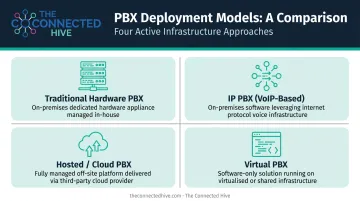
Healthcare, government, and financial services organizations frequently operate hybrid environments where a PBX manages physical telephony while cloud software handles routing logic, agent interfaces, and analytics. The UK National Cyber Security Centre's 2024 guidance still distinguishes four active PBX models:
- Traditional hardware — on-premises physical switches
- IP PBX — voice routed over internet protocol networks
- Hosted/cloud PBX — switching managed by a third-party provider
- Virtual PBX — software-only implementations with no dedicated hardware
That breadth reflects how much of the market still depends on PBX infrastructure in some form.
How Does a Call Center PBX Work?
Every call passes through a defined sequence: it enters the system, gets classified and routed, is maintained during the interaction, and is released when the call ends. Each stage affects call quality and agent efficiency.
How Calls Enter the System
Inbound calls arrive via the PSTN (Public Switched Telephone Network) or, in modern deployments, through SIP trunks (virtual phone lines connecting the PBX to the PSTN over IP). TechTarget's 2024 definition describes a SIP trunk as a virtual connection that replaces traditional carrier circuits.
The PBX is the first point of contact. It receives and authenticates the incoming call before any routing logic applies. The same system handles three call types:
- Inbound — customer-initiated calls arriving from the PSTN or SIP
- Outbound — agent-dialed or auto-dialed calls
- System-generated — automated callbacks or IVR-initiated outbound sequences
How the PBX Routes and Switches Calls
Once a call enters, the PBX applies switching logic to determine where it should go. In traditional systems, that switching was done by physical circuit hardware. In IP-based systems, it's handled via software-driven packet routing using SIP (Session Initiation Protocol) (the application-layer control protocol defined in IETF RFC 3261 that creates, modifies, and terminates sessions). One key distinction: SIP handles signaling only — setting up and tearing down calls — while voice media travels separately via RTP.
During an active call, the PBX:
- Maintains the connection between caller and agent
- Enables hold, transfer, and conference features
- Manages whether voice data moves over copper, internet packets, or both
Poorly configured routing logic here is a primary cause of unnecessary transfers and misrouted calls — which directly feeds into the next challenge: handling what happens when call volume exceeds capacity.
How the PBX Manages Load and Quality
The PBX monitors concurrent active connections. When capacity is reached, it queues incoming calls or returns a busy signal. On-premises hardware has a fixed ceiling — adding capacity requires procuring additional circuits or hardware. Cloud-hosted systems adjust limits dynamically based on contracted provider terms.
This stage is where volume spikes expose weaknesses. A PBX sized for average daily traffic but not peak scenarios will drop calls or overflow queues during:
- Open enrollment periods in healthcare and insurance
- Emergency response events requiring rapid scale-up
- Seasonal retail surges like holiday shopping or product launches
What the PBX Ultimately Delivers
A well-configured PBX connects the right caller to the right resource and generates the records that feed downstream tools — call recording software, analytics platforms, and CRM systems. That data foundation is what supervisors actually rely on for agent coaching, staffing decisions, and service-level reporting. Without clean call handling at this layer, everything built on top of it is less reliable.
Types of Call Center PBX Systems
The right system depends on a call center's size, IT infrastructure, compliance requirements, and workforce geography — not which model is newest.
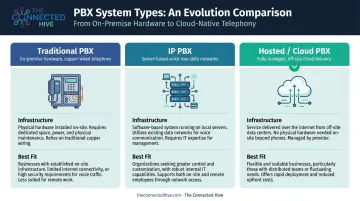
| Type | Infrastructure | Best Fit |
|---|---|---|
| Traditional PBX | On-premises hardware, copper wiring | Stable single-location operations, predictable volume |
| IP PBX | On-site servers, SIP/VoIP over data network | Organizations bridging legacy and cloud |
| Hosted/Cloud PBX | Off-site, provider-managed | Distributed teams, growth-stage operations |
Traditional PBX
Hardware-based, installed on-premises, using circuit switching over copper lines. Key characteristics:
- Strengths: Direct infrastructure control, reliable call quality on physical lines
- Tradeoffs: High upfront cost, limited scalability, physical changes required to add capacity
- Best fit: Single-location operations with predictable volumes and an in-house IT team managing telephony hardware
IP PBX
Routes calls over the organization's data network using VoIP and SIP trunking. Compared to analog, it offers lower per-call costs and more flexible trunk capacity — but on-site server management and technical expertise are still required. For organizations that have outgrown traditional PBX but aren't ready for full cloud migration, IP PBX is a natural intermediate step. Internal IT retains responsibility for security patching, SIP configuration, and capacity monitoring.
Hosted / Cloud PBX
The PBX infrastructure sits off-site with a third-party provider, accessed over the internet. This eliminates upfront hardware investment — agent seats scale via subscription, and remote agents connect from any location with a reliable internet connection.
This model reflects where the market is heading. Metrigy's 2026 research put the CCaaS market at $7.2 billion in 2024, up 20% year-over-year, while on-premises license revenue fell to $2.1 billion — down 5.3%. That gap is widening. Organizations still running on-premises systems represent a large installed base, but the migration trend is clear.
Key Features That Make a Call Center PBX Different from a Standard PBX
A standard business PBX handles extension dialing, basic transfers, and voicemail. A call center PBX — or more precisely, a PBX configured and layered for call center use — adds a distinct set of capabilities built around volume, routing complexity, and agent management.
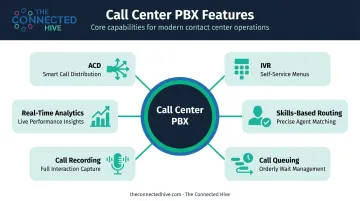
The core call-center-specific capabilities:
- ACD (Automatic Call Distribution) — distributes incoming calls to agents based on availability, skills, or routing rules rather than simple sequencing
- IVR (Interactive Voice Response) — collects caller intent through speech or keypad input, enables self-service, and feeds routing data to the ACD
- Skills-based routing — matches a caller to an agent with the required language, product knowledge, or authorization rather than the next available agent
- Call queuing — holds calls in a virtual line with configurable overflow rules, wait treatment, and priority settings
- Call recording — captures interactions for quality assurance, dispute resolution, and compliance purposes
- Real-time analytics — gives supervisors live visibility into queue depth, agent status, and call handling metrics
Native Capabilities vs. Integrated Layers
Not all of the features above come built into the PBX itself. Some — ACD, basic IVR, call queuing — are native to certain platforms. Others, particularly CRM integration and advanced analytics, are software layers added on top. Knowing which capabilities live where tells you whether a gap requires an upgrade to the existing system or a replacement of it.
Compliance Layers Require Separate Assessment
For healthcare and financial services call centers, HIPAA and PCI DSS compliance aren't determined by the PBX platform itself. Per HHS's Security Rule guidance, ePHI safeguards apply to any electronically stored call recording containing patient health information — the telephony label doesn't determine compliance.
PCI SSC FAQ 1574 confirms that audio recordings containing cardholder data fall within PCI DSS scope, with card verification codes prohibited from post-authorization storage under any circumstances.
The compliance evaluation has to trace the recording, storage, access, and deletion paths — not just the platform name. This is an area where The Connected Hive's work with clients like Humana, Blue Cross/Blue Shield, Discover, and Ameriprise has required careful assessment of the full data handling chain, not just the telephony layer.
When Does a Call Center Outgrow a Standard PBX?
Most signs of PBX strain show up operationally long before they register as a strategic problem. Common indicators include:
- Frequent busy signals or dropped calls during peak periods — a capacity ceiling, not a configuration problem
- Adding agent capacity requires hardware procurement — physical infrastructure changes slow growth cycles
- IT team spending significant time on telephony maintenance — an indicator that the system's operational burden has become disproportionate
- Remote or hybrid agents unable to connect reliably — on-premises PBX wasn't built for distributed workforces; a 2024 healthcare contact center survey found 63% of staff working from home versus 23% pre-pandemic, putting direct pressure on legacy telephony architecture
The PBX-to-CCaaS Threshold
A PBX — even a hosted one — is fundamentally a voice routing system. When a call center needs omnichannel support across chat, email, and social media, AI-assisted routing, integrated workforce management, or deep CRM automation, the operation has moved beyond what any PBX architecture alone can support.
Industry research on CCaaS migration consistently points to AI capability, elasticity, security compliance, and vendor consolidation as the primary migration drivers — not a specific agent count or call volume. The decision is about capability gaps and operational constraints, not size alone.
Where Expert Assessment Makes the Difference
Moving from a PBX-centric architecture to a full CCaaS platform involves more variables than most internal teams can assess objectively. Current infrastructure state, compliance obligations, agent geography, peak volume modeling, and integration requirements all factor in simultaneously.
The Connected Hive's advisory process works through exactly this kind of infrastructure evaluation — determining whether an upgrade, augmentation, or full platform replacement fits the specific operational context. That assessment carries no cost to the client.
Frequently Asked Questions
What is a call center PBX?
A call center PBX (Private Branch Exchange) is a private internal telephone network that manages inbound and outbound call routing within a call center. It allows multiple agents to share a smaller pool of external phone lines, handling calls through switching, queuing, and transfer capabilities that keep telecommunications costs manageable at scale.
What are the main types of PBX for call centers?
The three types are traditional on-premises PBX (hardware-based, high control), IP PBX (VoIP-enabled, runs on data networks), and hosted/cloud PBX (provider-managed, accessed over the internet). Hosted models have gained the most traction in recent deployments, largely for their lower maintenance burden and stronger support for distributed agent teams.
Which is better for call centers: PBX or VoIP?
This isn't a strict either/or choice — IP PBX and hosted PBX both use VoIP technology. The real comparison is between on-premises hardware-dependent systems and cloud-based VoIP platforms. Cloud VoIP generally offers more scalability, lower upfront cost, and better remote agent support.
Are PBX systems still used in call centers?
Yes. Metrigy's 2023 research found 41.5% of contact centers still on premises. IP PBX and hosted PBX remain active across many industries, though high-volume operations increasingly layer dedicated CCaaS platforms on top of, or replace, traditional PBX infrastructure altogether.
What is the difference between a PBX and an ACD system?
A PBX handles call switching and routing at the telephony infrastructure level. An ACD (Automatic Call Distributor) is a software layer that intelligently distributes incoming calls to the right agents based on skills, availability, and priority. Most call centers use both — the ACD sits on top of the PBX.
What features should I look for in a call center PBX?
Core features to prioritize: ACD and IVR for intelligent routing, call queuing and recording, real-time analytics, skills-based routing, and CRM integration. For healthcare or financial services environments, verify HIPAA and PCI DSS compliance across the full recording and data storage path, not just at the platform level.