Introduction
Labor typically accounts for about 70% of contact center operating costs, which means staffing decisions carry enormous financial weight. Understaff by 10% and customers wait too long, abandon calls, and churn. Overstaff by 10% and you're burning budget on idle agents. Neither outcome is acceptable.
Workforce management (WFM) is the discipline that navigates this balance. It replaces guesswork with a repeatable cycle of forecasting, scheduling, real-time adjustment, and continuous measurement — giving operations teams a structured way to hit service targets without overspending on headcount.
Whether you're building an in-house WFM practice or evaluating an outsourced contact center partner, understanding how WFM works — and what separates strong programs from weak ones — shapes every staffing and vendor decision you'll make.
Key Takeaways
- WFM is a continuous cycle built on four pillars — forecasting, scheduling, intraday management, and analytics — not a one-time staffing plan
- Shrinkage (30–35% on average) must be factored into every staffing calculation alongside raw demand
- 65% of contact centers still manage intraday operations manually, leaving them exposed to missed SLAs and avoidable overstaffing costs
- Interval-level planning (15–30 minute blocks) is what separates precise staffing from chronic under- or over-coverage
- When outsourcing, WFM maturity is one of the most consequential factors to evaluate in a BPO partner — and one of the most overlooked
What Is Workforce Management in a Call Center?
Workforce management in a contact center is the set of processes used to ensure the right number of agents — with the right skills — are available at the right times to meet service-level targets without overspending on labor. ICMI defines it as having the "right number of properly skilled people and supporting resources in the right place, at the right time" to handle forecast workload at the required service level and quality.
WFM is not a one-time staffing plan. It runs as a continuous cycle, recalibrating with every shift, every surge, and every unexpected deviation from forecast.
The Three Core Questions WFM Answers
Every WFM process is built to answer three questions:
- How many contacts will arrive? (Forecasting)
- How many agents are needed to hit service targets? (Staffing calculation)
- Who works which shift and when? (Scheduling)
WFM vs. HR Management
These are related but distinct disciplines. HR covers compensation, hiring, compliance, and broader workforce strategy. WFM is operationally focused — it's concerned with interval-level staffing alignment, real-time performance, and daily schedule execution. In outsourced environments, WFM is typically owned by a dedicated planning team within the BPO, separate from HR functions entirely.
Erlang C and Shrinkage: The Math Behind Staffing
Erlang C is the queuing formula at the heart of contact center staffing. It calculates how many agents are needed to answer a given call volume within a target wait time. One critical property: the relationship is non-linear. Tightening a service-level target — say, from answering 80% of calls in 30 seconds to 90% — can require significantly more agents than the percentage difference suggests.
Once you have an Erlang C number, you're not done. Shrinkage — the paid time agents are unavailable for contacts, including training, breaks, coaching, and absence — must be layered on top.
Calabrio cites an average shrinkage range of 30–35%, though actual figures vary widely by operation, channel mix, and training load. Skipping this step directly causes chronic understaffing.
The 4 Pillars of Call Center Workforce Management
Every WFM strategy rests on four pillars. Each one feeds into the next, and weakness in any single pillar compounds into SLA failures downstream.
Pillar 1: Demand Forecasting
Forecasting uses historical call volume data, seasonal trends, day-of-week patterns, and external factors — product launches, billing cycles, weather events — to predict how many contacts will hit the queue at each interval. Today's forecasting tools combine statistical models with AI to produce interval-level predictions 1–4 weeks out.
A 2023 COPC global benchmark survey of more than 1,000 participants found that only 38% of contact centers included all three core scheduling inputs — volume, handle time, and shrinkage — in their forecasts. That gap explains a lot of recurring staffing problems.
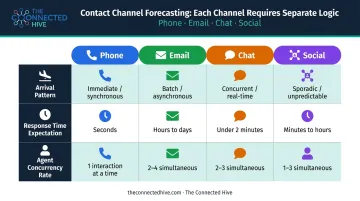
Multichannel complexity adds another layer. Phone, email, chat, and social contacts each behave differently — different arrival patterns, response-time expectations, and agent concurrency rates. Traditional Erlang C doesn't cover asynchronous channels at all. Only 47% of WFM users in ContactBabel's US survey used multichannel forecasting and scheduling, which means the majority are still flying partially blind on digital channels.
Pillar 2: Scheduling
Scheduling translates the forecast into actual agent shifts, matching staff availability and skills to expected demand patterns. Two capabilities separate effective scheduling from basic roster building:
- Multi-skill scheduling — assigning agents who handle multiple channels or query types so they can flex between queues as demand shifts
- Flexible scheduling — shift bidding, shift swapping, and agent-preferred start times that improve both coverage accuracy and agent satisfaction
Spreadsheets remain common. An ICMI study found 46% of contact centers used spreadsheets for long-term planning and 38% created agent schedules manually. The limitation isn't just speed — it's that spreadsheets can't model multi-skill agent pools, scenario-test schedule changes, or integrate with real-time data feeds. As volumes and channel complexity grow, those gaps widen — and no amount of supervisor effort reliably closes them. That's exactly what Pillar 3 is designed to address.
Pillar 3: Intraday (Real-Time) Management
Even a well-built schedule starts degrading the moment the day begins. Intraday management adjusts staffing allocations in real time to absorb unplanned disruptions, including:
- Agents calling in sick or arriving late
- Unexpected volume spikes during high-traffic periods
- System outages that flood the queue with repeat contacts
Central to this pillar is schedule adherence — whether agents are doing what they're scheduled to do at each interval. High-performing contact centers generally target adherence rates of 85–95%, with 85–90% more typical for programs with longer interactions.
The concerning reality: the ICMI State of Workforce Management report found that 65% of centers managed intraday operations manually, and only 29% agreed that reforecasting effectively closed staffing gaps. Daily adherence tracking — not weekly — is what catches drift before it becomes an SLA miss.
Pillar 4: Analytics & Reporting
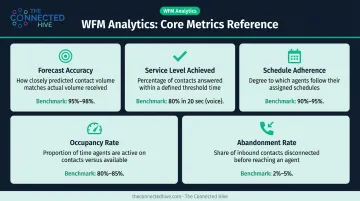
Analytics closes the WFM loop by comparing planned performance to actual outcomes. The core metrics to track:
- Forecast accuracy — how close were volume and handle time predictions to actuals?
- Service level achieved — what percentage of contacts were answered within target?
- Schedule adherence — did agents follow their scheduled activities?
- Occupancy rate — what percentage of logged-in time were agents handling contacts?
- Abandonment rate — how many callers gave up before reaching an agent?
This data feeds directly into the next forecast cycle. Centers that review these metrics weekly — rather than monthly — consistently narrow the gap between predicted and actual staffing needs.
The WFM Cycle: How It All Comes Together
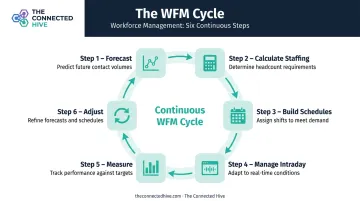
Workforce management runs as a six-step repeating cycle — each iteration feeding the next:
- Forecast contact volume and handle time by channel and skill queue
- Calculate staffing requirements using Erlang C plus shrinkage assumptions
- Build schedules that match agent skills and availability to demand patterns
- Manage intraday by monitoring adherence and adjusting to real-time deviations
- Measure forecast accuracy, service level, adherence, and occupancy against targets
- Adjust assumptions and feed learnings into the next forecast
Each iteration makes the next forecast tighter. Mature planning teams treat this cycle as an ongoing operational habit, not a monthly exercise.
When Disruptions Hit
A billing system outage, a product recall, or an unexpected open enrollment surge tests every element of the cycle simultaneously. An effective WFM operation responds with specific levers prepared well before the crisis hits:
- Reforecast remaining intervals as new volume data comes in
- Adjust break schedules to bring agents back to phones quickly
- Offer voluntary time-off when volume collapses unexpectedly
- Reroute contacts to agents with relevant skills for the surge type
The difference between centers that hold SLAs through disruptions and those that collapse is whether these mechanisms exist in advance — not whether supervisors work harder in the moment.
Where AI Fits In
Those manual levers become faster and more precise when automation handles the heavy lifting. AI is reducing the manual burden at multiple points in the cycle. Automated forecasting reduces the time required to build interval-level predictions. Automated scheduling tools generate and revise shift assignments in minutes rather than hours. Real-time adherence alerts flag deviations as they occur rather than surfacing them in end-of-day reports. The shift is from reactive correction to predictive decision-making — though ContactBabel's 2024 data shows that only 13% of WFM users have automated intraday changes, meaning most centers still have significant room to close the automation gap.
Key Benefits of Call Center Workforce Management
Operational Efficiency and Cost Control
With labor at roughly 70% of contact center costs, even small improvements in staffing accuracy translate to meaningful budget impact. Overstaffed intervals cost money in idle agent time. Understaffed intervals cost money in overtime, re-contacts, and customer churn. Well-executed WFM eliminates both failure modes through accurate interval-level planning.
Improved Customer Experience
Staffing accuracy directly determines wait times, and wait times directly affect customer satisfaction. Research from SQM Group shows a 1% improvement in first-call resolution corresponds to a 1% improvement in CSAT — making FCR one of the strongest levers for customer experience improvement. FCR improves when agents with the right skills handle the right contacts, which is a scheduling and routing decision at its core.
Better Agent Experience and Retention
ContactBabel's 2024 research notes that large contact centers tend to average 40% or more annual attrition , a staggering cost that compounds across recruiting, onboarding, training, supervisor time, and lost ramp productivity. Fair, predictable scheduling reduces burnout and voluntary absence. It also signals to agents that the organization values their time, which is increasingly a retention factor in its own right.
The business case for agent-centric WFM is well-documented. NICE's research on Nordia found qualitative reductions in both attrition and absenteeism after improvements to scheduling flexibility, and similar outcomes are driving broader adoption across the industry.
Key scheduling practices that reduce attrition include:
- Offering shift preference input so agents have a voice in their schedules
- Building in consistent off-queue time for coaching and recovery
- Minimizing last-minute schedule changes that erode trust and planning
- Using adherence data to coach fairly rather than punish reactively

Best Practices for Effective Call Center WFM
Plan at the Interval Level, Not Daily Averages
Daily call totals hide the intraday shape of demand. A center that handles 1,200 calls in a day may receive 200 of them in a single 90-minute window. Planning at 15- or 30-minute intervals reveals those peaks and valleys — and gives schedulers the precision to staff them correctly. Interval-level planning is what separates disciplined operations from centers that are perpetually over-covered at noon and under-covered at 10 AM.
Match Agent Skills to Contact Type
Skills-based routing is only as effective as the scheduling behind it. When agents are assigned to queues where their expertise is strongest, handle time drops, first-call resolution improves, and transfers decrease. In healthcare, for example, scheduling licensed agents specifically to benefits verification queues — rather than pooling all agents across all queues — reduces escalations and average handle time. In financial services, regulatory complexity makes skill matching a compliance consideration, not just an efficiency one.
Build a Culture of Adherence, Not Just Monitoring
Adherence targets work best when they're realistic, clearly communicated, and reinforced through coaching — not punitive tracking alone. Managers who hold themselves accountable for schedule accuracy — including how breaks and meetings are placed — create a shared ownership culture that outperforms command-and-control monitoring.
Set individual and team adherence targets, review them in regular one-on-ones, and treat deviations as coaching opportunities before they become patterns.
Incorporate Agent Feedback
Agents know where the scheduling friction points are. Soliciting structured input on scheduling preferences, workload balance, and shift change pain points improves forecast accuracy — agents who flag recurring understaffed periods are giving planners real data.
The retention benefit is just as significant. Staff who have a measure of control over their schedules show lower voluntary absenteeism, a pattern that holds consistently across the industry.
Treat WFM as a Continuous Improvement Process
Shrinkage assumptions, business volumes, and service-level targets all shift over time. A WFM program still running the same model it built 18 months ago is accumulating blind spots. Keep the planning model current with:
- Regular forecast-vs-actual reviews to catch drift early
- Scheduled shrinkage recalibrations as staffing patterns change
- Periodic revisits of service-level targets when business goals shift
What to Look for in a Call Center Partner's WFM Capabilities
When outsourcing customer service to a BPO, WFM quality is one of the most consequential factors to evaluate — and one of the most commonly underweighted. A partner can have strong technology, competitive pricing, and impressive references, and still consistently miss SLAs because their planning team operates on spreadsheets and reacts to problems rather than preventing them.
Key Questions to Ask Prospective Partners
| Evaluation Area | What to Ask |
|---|---|
| Forecasting | Do you forecast at the interval level? How do you separate volume, handle time, and shrinkage accuracy? |
| Scheduling | Is scheduling automated or spreadsheet-based? How are skill-based assignments managed? |
| Intraday | How do you handle unexpected volume spikes? What's your escalation process for SLA drift? |
| Adherence | What is your adherence target? How is it measured and enforced? |
| Client Reporting | What WFM performance data will we receive, and at what frequency? |
The answers reveal whether a partner has genuine WFM maturity or is describing aspirational processes. Ask for interval-level data from recent weeks — not summary metrics.
Navigating This Evaluation Without In-House Expertise
Most businesses evaluating BPO partners don't have a former contact center planning director on staff. WFM maturity is subtle to assess without knowing what to look for, what questions to probe, and how to interpret the answers.
That's where The Connected Hive comes in. Drawing on 20 years of BPO executive experience and a network of more than 3,500 domestic contact centers, The Connected Hive evaluates a prospective partner's WFM capabilities — forecasting rigor, scheduling automation, intraday response protocols — and helps businesses avoid costly mismatches before a contract is signed.
Compliance Considerations for Regulated Industries
Vendor selection is only part of the picture. For healthcare and financial services organizations, WFM practices intersect with regulatory requirements that can't be treated as afterthoughts.
- HIPAA: Under 45 CFR 164.308(a)(3)–(4), covered entities must maintain workforce security, access authorization, and termination procedures. For a healthcare BPO, the practical test is whether roster changes — transfers, promotions, departures — automatically trigger role-based ePHI access updates. Schedule changes that don't sync with access management create compliance gaps.
- PCI DSS v4.0.1: Requires least-privilege access by job function (7.2.1), unique user IDs (8.2.1), immediate access revocation for terminated users (8.2.5), and audit records with user identity and timestamps (10.2.2). The buyer-side question is whether the partner's WFM roster and access-management records can be reconciled — not whether they have a scheduling tool.
Frequently Asked Questions
What is WFM in a call center?
WFM (workforce management) is the set of processes used to ensure the right number of agents with the right skills are available at the right times to meet service-level targets. It operates as a continuous cycle: forecast demand, build schedules, manage real-time deviations, then measure outcomes to sharpen the next round of planning.
What are the 4 pillars of call center WFM?
The four pillars are demand forecasting, scheduling, intraday (real-time) management, and analytics & reporting. Each pillar feeds into the next: forecasts drive schedules, schedules are managed in real time, and analytics refine the next forecast.
What are examples of WFM in a call center?
Common examples include:
- Using historical data to anticipate Monday morning volume spikes and staff accordingly
- Auto-generating agent shifts from 30-minute interval forecasts
- Pulling agents off break during an unexpected call surge to protect service levels
- Running weekly forecast-vs-actual reviews to recalibrate handle time assumptions
What is the difference between WFM and workforce optimization (WFO)?
WFM focuses specifically on staffing alignment — forecasting, scheduling, and intraday management. WFO is a broader discipline that includes WFM plus quality management, performance coaching, and interaction analytics. WFM is the operational foundation that WFO frameworks are built on top of.
What is a good schedule adherence rate for a call center?
Most contact centers target adherence in the 85–90% range, with high-performing programs reaching 95% depending on queue type and interaction length. The right number varies by operation — tracking it daily rather than weekly is what prevents small gaps from becoming SLA misses.