Most businesses understand text-based customer service exists. Fewer have made a decisive move toward it, often because the operational change feels uncertain. But the data tells a clearer story: the costs of ignoring it show up in support budgets, agent productivity, and customer retention before leadership notices the pattern.
This article covers what text-based customer service actually delivers, what your operation risks by avoiding it, and the best practices that determine whether it works or falls flat.
Key Takeaways
- Text-based support — SMS, live chat, and messaging apps — resolves issues faster and costs less to operate than phone support
- Agents can handle multiple text conversations at once, a capacity that phone calls structurally cannot match
- 58% of consumers rate communicating through their preferred channel as very or extremely important
- Businesses without a text channel absorb higher call volume, increased costs, and customer loss they may never see coming
- Realizing that value requires the right automation, compliance guardrails, and integration with your existing support operations
What Is Text-Based Customer Service?
Text-based customer service covers any support interaction conducted through written messaging channels — SMS, live chat, and apps like WhatsApp or Facebook Messenger — rather than phone calls or email.
Businesses use it across a wide range of functions:
- Inbound support — answering questions, resolving complaints, handling refund requests
- Proactive outreach — order confirmations, appointment reminders, billing alerts
- Feedback collection — post-interaction surveys delivered via SMS
- Escalation handling — routing complex issues from automated flows to live agents
These use cases span industries — from healthcare appointment reminders to retail order tracking to financial account alerts.
The channel choice matters operationally. Text-based support isn't just a customer preference — it changes how support teams manage volume, response time, and satisfaction. One agent on the phone handles one customer. One agent on text can handle several at once.
Key Advantages of Text-Based Customer Service
The advantages below each tie directly to metrics support operations track: cost per contact, first response time, agent utilization, and CSAT. They compound when applied consistently and are strongest when text is part of an omnichannel strategy rather than a standalone add-on.
Advantage 1: Speed and Accessibility at Scale
Text-based support removes the friction customers hate most : hold times, phone trees, and being locked to a phone line. Customers already have their phones. They can send a message, continue their day, and receive a response without waiting.
According to Twilio's 2024 consumer research, 51% of consumers expect a support response within one hour. When that doesn't happen, the consequences accumulate fast: slow responses left 65% frustrated, made 72% feel the brand was wasting their time, and caused 46% to abandon a brand entirely.
Pre-built response templates and automation make near-instant first replies achievable even during high-volume periods. That first acknowledgment keeps the conversation moving — and prevents the multi-day email back-and-forth that erodes customer patience.
KPIs this directly improves:
- First response time (FRT)
- Average handle time
- First contact resolution rate
- Customer effort score
Best fit for: Peak periods, logistics and retail (where customers need status updates fast), and audiences under 40 who consistently choose messaging over phone.
Advantage 2: Lower Cost Per Interaction and Higher Agent Productivity
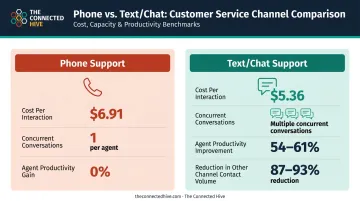
The structural cost difference between phone and text support comes down to one factor: concurrency. A phone call requires an agent's full attention for its entire duration. Text conversations don't. Agents can respond, move to another conversation, and return — running multiple threads simultaneously.
The 2024 ContactBabel US Contact Center Decision-Makers' Guide puts the numbers plainly: mean cost per inbound interaction was $6.91 for phone versus $5.36 for web chat in 2023. At thousands of interactions per month, that per-contact gap translates to real budget impact.
A Forrester study commissioned by Meta found that businesses using messaging channels reported agent-productivity improvements of 54–61% after implementation — and 87–93% reported reduced contact volume across other service channels.
KPIs this directly improves:
- Cost per contact
- Agent utilization rate
- Conversations handled per agent per hour
- Call volume reduction
When this matters most: High inbound volume operations, seasonal peaks where staffing is stretched, and SMEs where overhead efficiency directly affects margins.
Advantage 3: Higher Customer Satisfaction and Retention
Most customers don't just tolerate text-based service — they prefer it. Salesforce's State of the Connected Customer research tracked a clear shift: preference for SMS when engaging with companies rose from 19% in 2020 to 26% by 2022, with chat jumping from 28% to 44% over the same period.
The experience itself is less disruptive than a phone call. Customers respond on their own schedule, keep a written record of the interaction, and avoid repeating themselves to a new agent. Research published in the Harvard Business Review covering more than 75,000 customers found that 94% of customers with low-effort service interactions intended to repurchase — and 88% intended to increase their spending. Gartner's research sharpens the downside: only 14% of customers experiencing a high-effort service interaction were likely to continue doing business with the company.
Text also enables proactive communication — order shipped, appointment confirmed, payment processed, issue flagged before it escalates — that reduces inbound volume before customers need to reach out. ContactBabel's 2024 data shows 21% of contact center respondents believed proactive engagement could eliminate 26–50% of inbound calls.
KPIs this directly improves:
- CSAT score
- Net Promoter Score (NPS)
- Customer retention rate
- Repeat contact rate
- Churn rate
Where this pays off most: Competitive markets where CX is a primary differentiator, and regulated industries like healthcare and insurance where trust and clear communication carry higher stakes.
What Happens When Text-Based Customer Service Is Ignored
Avoiding text-based customer service isn't a neutral decision. The operational costs accumulate in the background — in call volume, agent capacity, and customer attrition — well before they surface on a leadership dashboard.
The most common outcomes businesses experience:
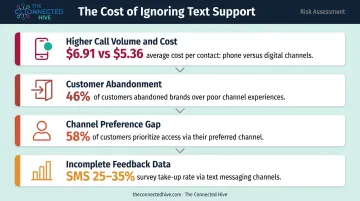
- Higher call volume and cost — Without a text channel, customers default to calling. Every call costs more to resolve ($6.91 versus $5.36 for chat, per ContactBabel's 2024 data), and agents handle fewer interactions per hour
- Twilio's 2024 research found 46% of consumers had abandoned a brand due to slow response times, with 58% rating access to their preferred channel as very or extremely important
- Phone-heavy operations become exponentially more expensive as volume grows; text-based support scales without a proportional increase in headcount
- Incomplete feedback data — SMS surveys achieve take-up rates of 25–35% according to ContactBabel's 2024 data, outperforming most other feedback methods; businesses without a text channel are working from a thinner data set
Customer expectations are also moving in one direction. Zendesk's 2026 CX Trends research found 88% of customers expected faster response times than they had the previous year. Businesses that delay text adoption aren't holding steady — they're falling further behind a benchmark that keeps moving.
Best Practices to Get the Most Value from Text-Based Customer Service
Text support works best when it's treated as an integrated operational capability, not an afterthought. These practices separate operations that see consistent ROI from those that don't.
Use Autoresponders to Set Expectations Immediately
Every incoming text should receive an instant acknowledgment. Even if a human agent won't respond for several minutes, an automated confirmation reduces customer anxiety and repeat contacts.
Keep it short: confirm receipt, state when a full response is coming, and stay on-brand. An autoresponder that says "We received your message and will respond within 15 minutes" prevents frustration before it starts — no follow-up survey needed.
Build Reusable Response Templates for Common Queries
Repetitive queries — order status, refund timelines, appointment confirmations, billing questions — should be handled with pre-built templates agents deploy quickly, not typed from scratch. This reduces handle time and maintains tone consistency across agents.
Templates need regular review. Outdated responses about policies that have changed, or product details that are no longer accurate, create more problems than they solve.
Automate High-Frequency, Low-Complexity Queries
Automation isn't about eliminating agents — it's about directing agent attention to interactions that actually need it. Automated responses to FAQs, order status (WISMO) queries, and routine status updates free agents for complex issues that genuinely require human judgment.
Clear escalation paths matter here. When a query exceeds what automation can resolve, it should transfer to a live agent with full conversation context — not restart the customer from the beginning.
Understand Compliance Requirements for Your Industry
For businesses in healthcare and financial services, text-based customer service carries regulatory obligations that can't be treated as an afterthought.
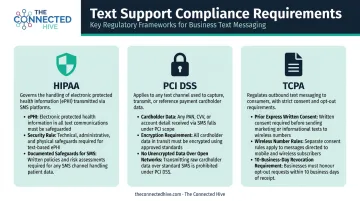
- HIPAA — The Security Rule applies to electronic protected health information (ePHI). SMS communications containing ePHI fall within its scope and require documented safeguards
- PCI DSS — Unencrypted cardholder data cannot be transmitted through end-user messaging technologies; strong cryptography is required for any payment data sent over open networks
- TCPA — Automated or prerecorded messages to wireless numbers require prior express written consent; consumers must be able to revoke consent at any time and revocations must be honored within 10 business days
Non-compliance carries both legal and reputational risk. Verify that any contact center partner handling your text interactions holds the relevant certifications before deployment.
Partner With a Contact Center That Has Genuine Text-Based Capabilities
For businesses outsourcing customer service, the quality of text-based support depends entirely on the partner's platform, agent training, and operational workflows. "Supports SMS" as a checkbox on a vendor profile is a starting point, not a qualification.
When evaluating contact center partners, ask specifically about:
- How text channels integrate with voice, email, and chat — not just whether they exist
- Automation capabilities and how escalations to live agents are handled
- Compliance certifications for your industry
- Response time SLAs for text channels specifically
- Agent training standards for text-based interactions
The Connected Hive helps businesses navigate exactly this evaluation process. With relationships spanning more than 3,500 domestic contact centers, the firm's needs assessment identifies partners with genuine omnichannel capability, not just those who claim it. For regulated industries including healthcare, financial services, and retail, compliance verification is a standard part of every partner assessment before a recommendation is made.
Conclusion
Text-based customer service is a measurable operational lever. When applied with the right infrastructure and consistent processes, it reduces cost per contact, improves agent productivity, increases customer satisfaction, and builds the kind of low-effort experience that drives retention.
Those gains build on each other. Operations that integrate text-based support early tend to outpace competitors on efficiency — and that gap widens over time as processes mature and agent proficiency increases.
Executing well depends on matching your operation with the right contact center partner — one with proven text-channel capabilities, not just a checkbox on a capability sheet. If you're evaluating whether your current setup can deliver this, or need a vetted shortlist of partners who can, reach out to Tim Austrums and The Connected Hive team to walk through what your situation requires.
Frequently Asked Questions
How can I chat with customer service?
Customers can contact businesses via text by sending an SMS to a designated support number, using a live chat widget on the company's website, or messaging through platforms like WhatsApp or Facebook Messenger. Available channels vary by business.
Is there a free text service for customers?
From a customer's perspective, texting a business uses standard SMS, which most mobile plans include at no additional cost. Businesses, however, use paid SMS platforms or contact center solutions to manage and respond to those messages at scale.
What types of issues can be resolved via text-based support?
Text handles a wide range of inquiries including order status, appointment reminders, billing questions, refund requests, and general FAQs. More complex issues, such as those requiring account verification or detailed troubleshooting, are typically escalated to phone.
How does text-based support compare to phone in terms of cost?
Text interactions are generally less expensive because agents can handle multiple conversations simultaneously, reducing cost per contact. ContactBabel's 2024 data puts mean phone resolution at $6.91 versus $5.36 for web chat. Automation reduces costs further by handling high-frequency queries without any agent involvement.
Can text-based customer service be used in regulated industries?
Yes. Healthcare businesses must address HIPAA obligations around ePHI; financial services firms must meet PCI DSS requirements for payment data. Verify that contact center partners are certified accordingly before deploying at scale.
What should I look for in a contact center partner for text-based support?
Evaluate partners on SMS platform capabilities, automation and escalation workflows, compliance certifications, text-channel SLAs, and omnichannel integration. The Connected Hive can assess these criteria and match you with the right fit for your operation.