The consequences extend well beyond the breach itself. American Express alone can impose non-compliance fees up to $100,000 per data incident, and that's just one card brand. Add mandatory forensic investigations, potential loss of payment processing rights, and lasting reputational damage — and it's clear this isn't a compliance checkbox. It's an operational risk that demands constant attention, especially when organizations outsource to call center partners whose security posture they haven't fully verified.
Key Takeaways
- Call centers handling cardholder data must comply with PCI DSS v4.0.1, regardless of payment channel
- Effective safeguards combine technical controls (encryption, tokenization, redaction) with physical and access policies
- Agent behavior remains one of the most common failure points — training must be ongoing, not a one-time onboarding event
- Remote agents expand the attack surface in ways that in-office controls don't address
- PCI compliance erodes without continuous monitoring: treating it as an annual audit exercise is a costly mistake
What PCI Compliance Means for Call Centers
PCI DSS (Payment Card Industry Data Security Standard) was established in 2006 by American Express, Discover, JCB International, Mastercard, and Visa to create a unified framework for protecting cardholder data across all transaction environments. The current active version is PCI DSS v4.0.1, published June 2024.
Why Voice Channels Are High-Risk
When agents receive payment data verbally, every connected system immediately comes into scope. According to the PCI SSC's guidance on telephone-based payments, recordings that capture cardholder data are subject to the same storage and protection requirements as any other stored cardholder data.
That means all of the following fall under PCI DSS scrutiny:
- Telephony infrastructure and IVR platforms
- Agent desktops and CRM systems
- Call recordings and connected cloud storage
- Any third-party vendor with access to payment data
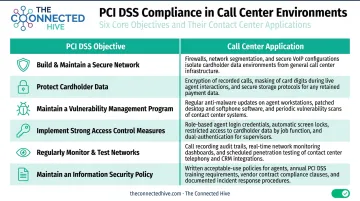
The Six Core PCI DSS Objectives — Applied to Call Centers
| PCI Objective | Call Center Application |
|---|---|
| Secure network | Firewalls, network segmentation between CDE and general systems |
| Protect cardholder data | Encryption at rest and in transit; no CVV storage post-authorization |
| Maintain anti-malware | Antivirus on all agent endpoints and connected systems |
| Restrict access | Role-based access controls; MFA for all CDE access |
| Monitor networks | Logging of all system access; quarterly vulnerability scans |
| Maintain security policy | Written policies reviewed annually; all staff acknowledge them |
Compliance Levels and What They Mean
Merchant compliance levels are set by each card brand, not universally by PCI SSC. Under Visa's current model:
- Level 1 (over 6 million annual transactions): Annual Report on Compliance (ROC) by a Qualified Security Assessor (QSA), plus quarterly scans
- Level 2 (1–6 million transactions): Annual Self-Assessment Questionnaire (SAQ) plus quarterly scans
- Level 3 (20,000–1 million e-commerce transactions): Annual SAQ plus quarterly scans
- Level 4 (fewer than 20,000 e-commerce or up to 1 million total): Validation determined by the acquirer
Your compliance level reflects the audit method required — not the rigor of your controls. A Level 4 merchant faces the same underlying security obligations as a Level 1.
PCI Scope Extends Further Than Most Expect
PCI DSS scope in a call center covers every channel where payment data flows — voice, chat, email, and SMS — plus cloud storage of recordings, CRM systems, IVR platforms, and the entire vendor ecosystem. Any third party that touches cardholder data is also in scope, meaning outsourced contact center partners handling payments carry the same compliance obligations as your internal team.
Core PCI Controls Every Call Center Must Have
No single tool solves PCI compliance in a call center. What works is layering technical controls with human and physical safeguards — gaps in any layer create exposure.
Technical Safeguards
Call recording redaction and pause-and-resume: Recorded calls are subject to the same rules as stored cardholder data. Two approaches exist:
- Pause-and-resume: Recording is paused while card data is spoken, then resumes afterward. Note — manual implementations fail when agents forget to pause, and automated systems can fail if agents can bypass the payment workflow.
- Automatic redaction: Post-call processing removes or masks sensitive segments from stored recordings.
Either approach, properly implemented, may remove recording systems from PCI scope. That said, the agent, agent desktop, and telephony environment remain in scope regardless.
Encryption and tokenization: PCI DSS requires "strong cryptography" for cardholder data in transit across open networks (Requirement 4.2.1) and whenever PAN is transmitted through messaging technologies — SMS, email, or chat (Requirement 4.2.2).
Tokenization replaces the primary account number (PAN) with a non-sensitive surrogate value, which can reduce the number of systems where actual card data exists. Scope reduction depends on how tokenization is implemented and who can access the tokenization system.
Network security: Required controls include:
- Firewalls between the cardholder data environment and all other networks
- Network segmentation to limit which systems and personnel touch payment data
- Antivirus and anti-malware on all endpoints
- Restricted internet access from cardholder data systems
Agent-Level and Physical Controls
Role-based access controls (RBAC) and MFA: Under PCI DSS v4.0.1 Requirement 8.4.2, multi-factor authentication is required for all access into the cardholder data environment — no exceptions. Agents, supervisors, and QA staff should have distinct permission tiers; no one should access data beyond what their role requires.
Physical workstation policies: These are frequently overlooked but directly reduce breach risk:
- No pen and paper for card numbers — use whiteboards that are regularly erased
- No personal mobile devices on the call floor
- No personal USB drives
- Screen masking or secure payment input portals so agents never see the full card number
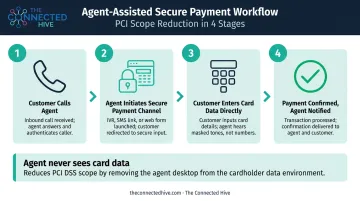
Agent-assisted secure payment workflows: The most effective scope-reduction strategy available. Technologies that allow customers to enter card data directly via a secure IVR, SMS link, or web form — while remaining on a live call with an agent — remove the agent from the payment data flow entirely. The agent hears tones, not numbers. This can cut what falls within PCI scope to a fraction of its original size.
Maintaining Compliance During Live Agent Operations
Training That Sticks
PCI DSS requires security awareness training upon hire and at least once every 12 months, with annual policy acknowledgment (Requirements 12.6.2–12.6.3). But the minimum is rarely enough for high-volume call centers.
Effective training programs cover:
- Why the rules exist, not just what the rules are
- Specific scenarios agents face (what to do when a customer reads a card number before the secure IVR prompt)
- Password hygiene and workstation locking procedures
- Recognizing phishing and social engineering attempts — now a required training component under v4.0.1
Continuous Monitoring vs. Annual Audits
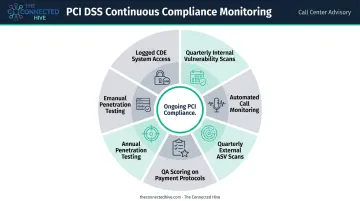
Call centers that treat PCI compliance as an annual checkbox expose themselves to breaches in the months between formal reviews. PCI DSS mandates:
- Internal vulnerability scans: At least every three months and after significant changes (Requirement 11.3.1)
- External scans: Every three months by a PCI SSC Approved Scanning Vendor (Requirement 11.3.2)
- Penetration testing: At least annually and after significant changes (Requirement 11.4.2)
Between those scheduled assessments, continuous monitoring fills the gaps. That means:
- Automated call monitoring flagged for compliance cues
- QA scoring tied to payment data handling protocols
- Logged access to all cardholder data environment (CDE) systems
Documented Policies Are Non-Negotiable
Monitoring and scanning only work when they operate within a defined written framework. PCI compliance policies must cover firewall management, breach response, business continuity, and agent device use — and every staff member must acknowledge them annually.
When turnover is high, as it routinely is in call centers, these documented policies are what keep security controls consistent when institutional knowledge walks out the door.
Remote and Hybrid Agent Considerations
Remote agents introduce security variables that simply don't exist in a controlled facility: shared household spaces, personal devices, home Wi-Fi networks with no enterprise-grade security, and no physical oversight. Each one is a potential entry point.
What PCI DSS Requires for Remote Agents
The PCI SSC's guidance on protecting payments while working remotely identifies specific safeguards:
- Company-issued or IT-approved devices with secure configurations
- Secure VPN connections — personal broadband alone is insufficient
- Controls preventing PAN from being copied to local or removable media
- Physical workspace protection: no unauthorized individuals with line of sight to the screen
- No printing or handwriting of card data at home
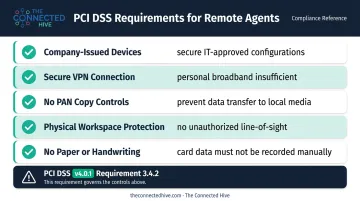
Under v4.0.1, Requirement 3.4.2 specifically addresses controls preventing unauthorized copying or relocation of PAN through remote-access technologies.
The Outsourcing Due Diligence Gap
Organizations that outsource to call center partners with remote workforces must verify — not assume — how those partners enforce endpoint security, monitor remote agent behavior, and maintain CDE controls outside a physical facility. This is a due diligence gap that surfaces repeatedly in outsourcing relationships.
PCI DSS Requirements 12.8.1–12.8.5 are explicit: clients must list their third-party service providers (TPSPs), obtain written acknowledgments of PCI responsibility, perform due diligence, and monitor TPSP compliance at least annually. A vendor's PCI status does not transfer to you automatically.
The Connected Hive's partner vetting process addresses this directly. Security protocol review (covering compliance certifications, incident response plans, and data security practices) is a required step before any partner recommendation.
Founder and CEO Tim Austrums brings over 20 years of executive BPO experience, including hands-on PCI compliance expertise from engagements with financial services clients such as Discover and Ameriprise. That background shapes how The Connected Hive identifies compliance gaps during the vetting process.
Common PCI Compliance Mistakes to Avoid
These are documented failure patterns that show up repeatedly across call center compliance assessments — and each one carries real liability:
Treating compliance as an annual event leaves your environment exposed. Staff turnover, software updates, and configuration changes all introduce gaps between audits — controls must be enforced continuously, not just at audit time.
Assuming your BPO partner's PCI compliance covers your organization is a common and costly misread. Their certification does not satisfy your own obligations — Requirements 12.8.1–12.8.5 require you to maintain independent assessments and controls.
Overlooking physical risks creates blind spots that no software can fix. An agent writing a card number on paper or taking a photo of a screen is a breach waiting to happen — and digital controls won't catch it.
Underestimating omnichannel scope is increasingly common as payment touchpoints multiply. PCI DSS applies to every channel carrying payment data — voice, chat, email, SMS — and compliance in one channel does not carry over. Each environment must be evaluated separately.
Retaining CVV data after authorization violates PCI DSS outright. Card-verification codes cannot be stored post-transaction — not in call recordings, screen captures, or CRM notes. Customer permission does not override this prohibition.
Conclusion
Call center PCI compliance isn't a project with a completion date. Controls erode, staff turns over, systems get updated, and new channels get added — each change is a potential gap. The call centers that protect their clients best are those that build compliance into their culture, not just their audit calendar.
For businesses outsourcing call center operations, the partner selection decision carries as much compliance weight as any internal control. A partner's security gaps become your liability. That's an explicit PCI DSS requirement, not a theoretical concern.
The Connected Hive specializes in helping organizations evaluate and select call center partners who meet rigorous PCI, HIPAA, and data security standards. That vetting process draws on Tim Austrums' two decades of executive experience across financial services, healthcare, and government — so the right controls are in place before a vendor ever touches cardholder data.
Frequently Asked Questions
What is PCI compliance for call centers?
PCI compliance for call centers means adhering to the Payment Card Industry Data Security Standard (PCI DSS), which sets security requirements for any organization that accepts, processes, or transmits cardholder data over the phone. The standard covers the voice channel, call recordings, agent desktops, CRM systems, and every connected vendor in scope.
Is PCI compliance legally required for call centers?
PCI DSS is not a statute — it's a contractual requirement enforced through card brand and acquirer agreements. Non-compliance can result in fines, mandatory forensic investigations, and loss of payment processing rights. Separate state or federal laws may independently reference payment-data security obligations, so legal exposure varies by jurisdiction.
What types of data does PCI DSS protect in a call center?
PCI DSS protects two categories of data: cardholder data (PAN, name, expiration date, service code) and sensitive authentication data (magnetic stripe or chip data, CVV/CVC codes, and PINs). CVV codes cannot be stored after authorization under any circumstances, even in encrypted form.
What happens if a call center is not PCI compliant?
Consequences include card brand fines, mandatory forensic investigations, increased transaction fees, and potential loss of payment processing rights. American Express alone can impose fees up to $100,000 per data incident, and total breach costs can reach millions when investigation and remediation are factored in.
How often should PCI compliance be audited in a call center?
Level 1 merchants need an annual Report on Compliance from a QSA; other levels complete annual SAQs. All merchants require quarterly vulnerability scans and annual penetration testing. Daily monitoring and access logging must run continuously — a once-a-year audit is not enough on its own.
What should businesses look for when choosing a PCI-compliant call center partner?
Verify the partner's current compliance level and request audit documentation. Ask specifically how they handle call recording redaction, remote agent security, and what their pause-and-resume or secure IVR implementation looks like. Confirm that their full vendor ecosystem — telephony, CRM, cloud storage — is also in scope and compliant. These are the types of vetting criteria The Connected Hive applies when matching clients with qualified, secure call center partners.