Introduction
Offshore teams have moved well past the "cost-cutting experiment" phase. For companies across healthcare, financial services, retail, and tech, they've become a core operational strategy — one that either delivers real competitive advantage or bleeds resources when managed poorly.
The potential is real. According to Grand View Research, the global BPO market is valued at $328.4 billion in 2025 and is projected to reach $695.8 billion by 2033 — a 9.9% compound annual growth rate. Businesses aren't experimenting with offshore models; they're betting on them.
But the gap between a thriving offshore team and a frustrating one comes down to management. Communication breakdowns, cultural friction, compliance gaps, and poor performance visibility are the failure points where most offshore arrangements lose steam.
This guide covers what offshore teams are, why businesses use them, the challenges you'll face, and the strategies that separate high-performing offshore operations from expensive ones.
Key Takeaways
- Offshore teams cut costs by 20–30% while expanding access to specialized global talent
- The three biggest management challenges are communication barriers, cultural differences, and time zone coordination
- Structured onboarding, documented SOPs, and outcome-based KPIs are essential for sustained performance
- Vet compliance requirements (HIPAA, PCI DSS) during partner selection, before problems surface
- Recognition and inclusion build the cross-border trust that drives retention
What Is an Offshore Team and Why Are Businesses Turning to It?
An offshore team is a group of professionals based in another country who operate as a functional extension of your core business — handling customer support, IT helpdesk, back-office BPO, accounting, and more. They're not a side project or a temporary fix; they're a deliberate structural choice.
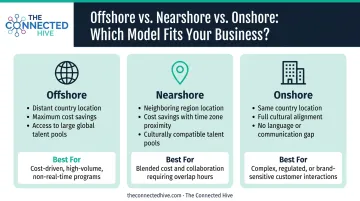
Offshore vs. Nearshore vs. Onshore
Understanding the model differences matters before choosing a path:
| Model | Location | Primary Advantage |
|---|---|---|
| Offshore | Distant country (e.g., India, Philippines) | Maximum cost savings, large talent pools |
| Nearshore | Neighboring region (e.g., Latin America for US firms) | Cost savings with time zone proximity |
| Onshore | Same country | Cultural alignment, no language gap |
Offshore is typically chosen for high-volume functions where cost and talent access take priority. The Philippines and India remain the most established destinations for English-language customer support and BPO work — deep labor pools, strong English proficiency, and decades of institutional experience make them default choices for many US businesses.
That said, when real-time collaboration matters, nearshore options like Colombia or broader Latin America offer meaningful cost savings without the time zone gap. It's a tradeoff worth weighing based on your operational needs.
Either way, the trend is clear: businesses aren't just experimenting with offshore models — they're doubling down. Deloitte's research of over 500 global executives found that 80% plan to maintain or increase third-party outsourcing investment. This is now a mainstream strategy, not a fringe cost-cutting move.
Core Benefits of Building an Offshore Team
Cost Efficiency
The most immediate driver is cost. Offshore agent-hour pricing typically runs $8–$20 per hour, compared to $25–$65 per hour for US-based contact center operations. Across a team of any meaningful size, that differential compounds quickly.
From The Connected Hive's client experience, businesses transitioning from in-house to offshore operations typically achieve 20–30% cost savings. One documented retail case study showed a 30% cost reduction alongside a 20% increase in customer satisfaction — demonstrating that lower operating costs and stronger service delivery can coexist when the right partner is in place.
The cost efficiency isn't just about wages. It also comes from:
- Eliminating recruitment and HR overhead for each hired position
- Converting fixed labor costs to variable, per-hour expenses
- Shared BPO infrastructure (platforms, compliance tools, workforce management systems)
Access to Global Talent
Those infrastructure savings also free up budget to access talent that domestic hiring simply can't match at scale. The US faces consistent high-volume replacement demand in BPO-relevant roles — the Bureau of Labor Statistics projects an average of 341,700 customer service openings annually through 2034, driven largely by turnover rather than growth. Competing for that domestic talent pool is expensive and time-consuming.
Offshore locations like India and the Philippines have built extensive, English-proficient workforces developed specifically around BPO demand. For businesses needing specialized skills in customer support, technical help desk, or finance operations, the global talent pool offers depth that most local markets can't match at scale.
Scalability and Flexibility
Offshore partners can ramp headcount faster than in-house hiring cycles allow. During peak seasons or rapid growth phases, BPO partners can flex team size quickly. There are no lead times for recruiting, training, and onboarding — the infrastructure is already in place.
That flexibility shows up in a few concrete ways:
- Scaling up for seasonal volume spikes without permanent headcount commitments
- Reducing team size after peak periods without layoffs or severance costs
- Accessing pre-trained agent pools for faster ramp-up on new programs
Top Challenges to Anticipate When Managing Offshore Teams
Communication Barriers
Language proficiency differences, indirect communication styles, and the absence of in-person interaction create friction that's easy to underestimate. A misunderstood instruction in a face-to-face meeting is corrected in seconds. The same misunderstanding across time zones and written channels can compound for days before anyone notices.
This is especially pronounced when offshore teams handle nuanced customer conversations requiring judgment, empathy, and brand voice — not just script adherence.
Cultural Differences
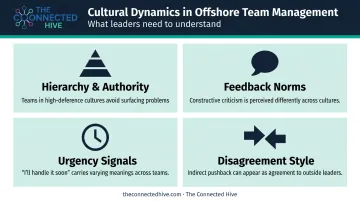
Work norms vary widely across regions. Several culturally shaped dynamics catch managers off guard:
- Hierarchy and authority: Teams in high-deference cultures may avoid flagging problems a manager needs to hear about immediately
- Feedback norms: What reads as constructive criticism in one culture lands as a personal rebuke in another
- Urgency signals: "I'll handle it soon" means something very different depending on where it's said
- Disagreement style: Indirect pushback often looks like agreement — until it isn't
HBR research spanning employees across 90 countries found that 89% of white-collar workers at some point participate in global virtual teams — and that cultural differences can help or hurt performance depending on whether they're actively managed. Left unaddressed, cultural mismatches erode trust and steadily erode productivity.
Time Zone Complexity and Compliance Risks
Beyond cultural friction, the structural realities of distance create their own pressure. Coordinating across time zones requires deliberate planning — not improvisation — and for regulated industries, the stakes are considerably higher. Offshore teams handling healthcare data must meet HIPAA standards; those processing payment information fall under PCI DSS.
The consequences of insufficient compliance vetting are concrete. Doctors' Management Services, a HIPAA business associate, paid HHS $100,000 following a ransomware attack affecting approximately 206,695 individuals — a direct reminder that outsourcing doesn't transfer data-control obligations. Compliance vetting cannot be an afterthought.
Key Strategies to Manage Your Offshore Team Effectively
Set Clear Expectations From Day One
Vagueness in onboarding becomes misalignment within weeks. From the start, define:
- Roles and responsibilities — who owns what, and who has authority to decide what
- KPIs and quality benchmarks — specific, measurable targets tied to function (CSAT, FCR, AHT, QA scores)
- Turnaround times and escalation paths — clear timelines with defined escalation channels
- Communication norms — expected response times, preferred channels, meeting cadence
Structural mismatches — where the offshore partner's capabilities, culture, or infrastructure don't fit the client's requirements — are far easier to prevent than correct. Working with a BPO consulting partner like The Connected Hive during the selection phase addresses this directly. Their needs assessment evaluates operational fit, cultural alignment, compliance readiness, and long-term scalability before any partnership begins.
Establish Structured Communication Rhythms
Both synchronous and asynchronous communication need deliberate structure. A useful baseline:
- Daily stand-ups (15 minutes) for active project teams
- Weekly syncs to review performance and surface blockers
- Monthly reviews tied to KPIs and strategic alignment
Define preferred platforms upfront — whether that's Slack, Microsoft Teams, or Zoom — and establish expected response windows. Without this, different team members fill communication gaps with different assumptions, which creates inconsistency at scale.
Develop a Documentation and SOP Framework
Standard Operating Procedures give offshore teams a reliable foundation. When recurring tasks are documented with clear steps, examples, and decision trees, teams can work independently — without constant questions to onshore managers and without guesswork.
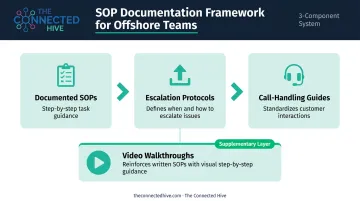
The ICMI identifies these as foundational components of a quality assurance program:
- Documented SOPs with step-by-step task guidance
- Escalation protocols defining when and how to escalate issues
- Call-handling guides standardizing customer interactions
Good documentation also reduces onboarding time for new offshore team members and limits dependency on any single person.
Supplement written SOPs with video walkthroughs and screen recordings for complex workflows. A 3-minute video walkthrough of a multi-step process is often clearer than three pages of written instructions — and easier for offshore teams to reference and self-correct.
Navigate Time Zone Differences Strategically
Don't fight time zones — design around them.
First, identify the genuine overlap window between onshore and offshore teams and protect it for decisions, escalations, and real-time problem-solving. During non-overlap hours, structure the workflow with clear handoff documentation so nothing waits unnecessarily.
Second, consider the follow-the-sun model. As CX Today defines it, a follow-the-sun operation uses teams in opposing time zones so at least one team is always active — enabling near-continuous coverage without extending shifts. When structured properly, time zone differences stop being a coordination burden and start functioning as a service delivery advantage, particularly for customer support operations that benefit from extended or 24/7 coverage.
Use the Right Tools for Visibility and Accountability
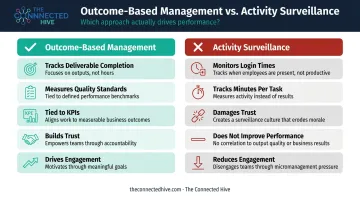
Project management platforms — Jira, Asana, Trello — give onshore managers visibility into offshore team progress without requiring constant check-ins. The goal is tracking outcomes, not monitoring activity.
There's an important distinction here: tracking whether deliverables are on schedule and meeting quality standards is management. Monitoring when someone logs on and how many minutes they spend on each task is surveillance — and it damages trust without improving performance. Offshore team engagement tends to be higher when accountability is tied to results rather than presence.
Building Trust and a Unified Team Culture Across Borders
Managing offshore teams well requires a shift from oversight to partnership. Trust is the operating system everything else runs on.
Shift From Surveillance to Outcomes
Outcome-based performance management — measuring results against defined KPIs rather than tracking hours and activity — consistently drives higher engagement in offshore teams. When people understand what success looks like and are trusted to reach it, they perform better than when they feel monitored.
Make Culture Inclusive, Not Transactional
Offshore team members should experience themselves as part of the company, not as a vendor relationship. That means:
- Including offshore staff in company-wide town halls and meetings
- Sharing company news, updates, and strategy as you would with any team
- Avoiding language that creates an "us vs. them" divide — "our offshore team" rather than "the offshore vendor"
Recognize Wins Publicly
Recognition is one of the strongest levers for retention. Gallup's longitudinal research from 2022 to 2024 found that employees receiving effective recognition were 45% less likely to have left their organization after two years. That finding applies across geographies — offshore team members respond to acknowledgment just as powerfully.
Acknowledge milestones, individual achievements, and team wins in shared forums where everyone can see them.
Invest in Cultural Awareness and Development
Cultural differences are factors to understand, not obstacles to manage. Invest in cultural awareness training for onshore managers, and encourage offshore team members to share their customs, communication preferences, and holidays.
Pair that with a structured development path. Offshore team members who see a future in the relationship stay longer and perform better:
- Set clear 30/60/90-day onboarding milestones
- Pair offshore staff with onshore mentors for cross-team connection
- Provide access to certifications and skill-building programs relevant to their role
Measuring Performance and Setting Your Offshore Team Up for Long-Term Success
Track the Right KPIs for the Function
Generic metrics won't tell you if the partnership is working. For contact center and BPO offshore teams, relevant benchmarks include:
| KPI | Industry Benchmark | What It Measures |
|---|---|---|
| CSAT | 78% top-box (SQM, 2024) | Customer satisfaction with the interaction |
| FCR | 70% industry average (SQM, 2024) | Percentage resolved on first contact |
| AHT | Varies by channel; measured by 84% of centers | Efficiency of interaction handling |
| QA Score | Evaluated against defined criteria | Process adherence and interaction quality |
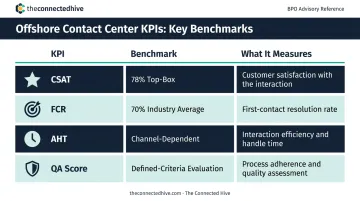
These are contextual benchmarks, not universal targets — the right baseline depends on your industry, volume, and complexity.
Build Feedback Loops in Both Directions
Performance feedback should flow both ways. Provide timely, data-driven feedback to the offshore team. Just as importantly, create formal channels for offshore team members to surface blockers, flag process inefficiencies, and suggest improvements.
Teams that can surface problems to management — without fear of blame — catch issues earlier and improve faster. Two-way feedback is the mechanism for continuous improvement.
Treat Compliance as Non-Negotiable
For regulated industries, compliance vetting belongs at partner selection — not after an incident. Offshore teams handling healthcare data must meet HIPAA standards; those processing payment data fall under PCI DSS. Under PCI DSS, organizations retaining third-party providers bear full responsibility for their own cardholder data environment — no exceptions.
Build compliance audits into the ongoing engagement, not just the onboarding phase.
Engage an Experienced Advisor for Long-Term Optimization
Offshore partnerships require active management over time. Partner performance evolves, business requirements shift, and what worked at launch may need refinement at scale. Companies that treat the initial vendor selection as the finish line often find performance plateau or drift over time.
That's where sustained advisory support makes a measurable difference. The Connected Hive — founded by Tim Austrums with 20 years of contact center and BPO executive experience — helps businesses keep offshore models aligned as goals and conditions evolve. From initial needs assessment and partner matching (at no cost to the buyer) through ongoing CX consulting and performance optimization, the engagement continues as long as your business needs it to.
Frequently Asked Questions
How do you manage offshore teams?
Effective offshore management rests on four pillars: setting clear expectations and KPIs during onboarding, establishing structured communication rhythms, using project management tools to track outcomes rather than activity, and building trust through transparency and recognition.
What does offshore management do?
Offshore management involves overseeing a remote team in another country — coordinating workflows, maintaining quality standards, aligning the offshore team with business objectives, and bridging communication and cultural gaps between locations. It's an ongoing operational function, not a one-time setup task.
What does "offshore team" mean?
An offshore team is a group of professionals located in a different country who work as an extension of your organization, supporting functions like customer service, IT helpdesk, or back-office operations. They operate under the company's direction but are employed through a partner organization in their home country.
What are the biggest challenges of managing an offshore team?
The core challenges are communication and language barriers, cultural differences in work norms, and time zone coordination. In regulated industries like healthcare and financial services, compliance and data security add a fourth layer that demands active, ongoing management.
What tools are best for managing offshore teams?
Most teams rely on three categories: communication platforms, project management software, and shared documentation tools. The right combination depends on your team's function and interaction volume — and for contact center operations in healthcare or financial services, compliance-grade platforms are required, not optional.
How do you build trust with an offshore team?
Use outcome-based metrics instead of activity surveillance, recognize achievements publicly in shared forums, involve offshore members in company culture and communications, and provide ongoing development opportunities. Consistent follow-through on those behaviors is what actually earns it.