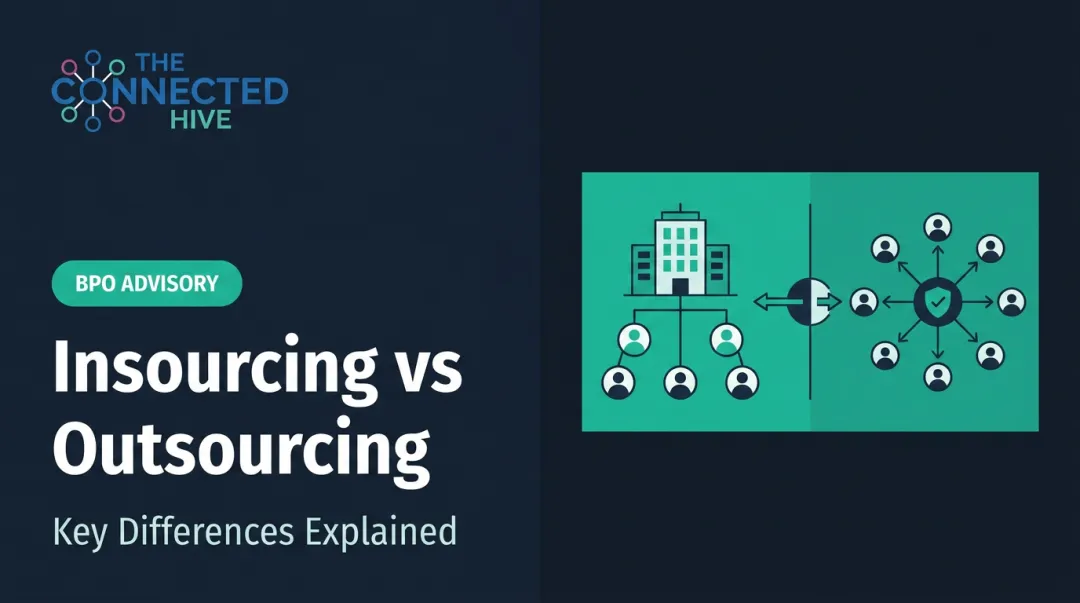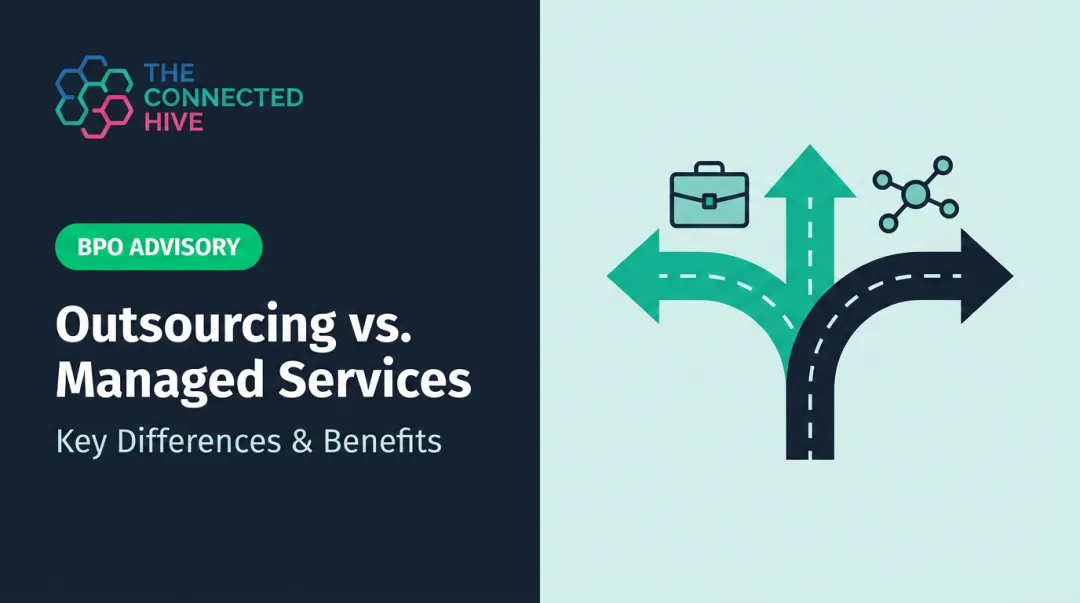
Confusing the two causes real problems. A company that needs operational flexibility might commit to a captive offshore center it can't manage. A company that needs sustained cost reduction might settle for a domestic third-party arrangement that won't deliver the savings they need. Choosing the wrong model erodes margins, introduces compliance exposure, and leaves leadership without the control they assumed they had.
This guide draws a clear line between outsourcing and offshoring, explains the hybrid model that combines both, and gives you a practical framework for choosing the right approach for your business.
Key Takeaways
- Outsourcing delegates specific functions to an external third party — the provider can be local, nearshore, or overseas.
- Offshoring relocates operations to another country — the company may retain direct ownership and control.
- Offshore outsourcing combines both: work goes to a third-party provider abroad, which cuts costs but increases operational complexity.
- Both models carry distinct risks — outsourcing reduces internal control; offshoring introduces compliance and communication challenges.
- The right choice depends on your goals, budget, compliance requirements, and how much control you want to retain.
What Is Outsourcing?
Outsourcing means contracting specific business functions or tasks to an external third-party provider rather than handling them in-house. Critically, outsourcing is geography-agnostic — the provider can be down the street or on the other side of the world.
Companies outsource to focus internal resources on what they do best, while transferring non-core functions — payroll processing, IT support, customer service — to specialists who can deliver them more efficiently.
Key Benefits of Outsourcing
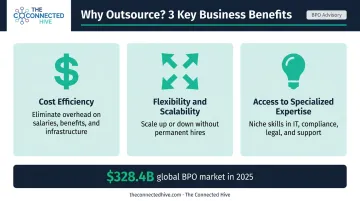
- Cost efficiency: Businesses eliminate overhead tied to salaries, benefits, training, and infrastructure. The global BPO market reached $328.4B in 2025 and is forecast to hit $695.8B by 2033. That trajectory reflects how many organizations are finding real cost advantages through outsourced delivery.
- Flexibility and scalability: Third-party arrangements scale up or down based on demand without the commitment of permanent hires — particularly useful during seasonal peaks or project-based needs.
- Access to specialized expertise: External providers bring niche skills and tools that would be cost-prohibitive to build in-house, whether in IT, compliance, legal, or customer support.
Common Use Cases for Outsourcing
The functions most commonly delegated to third-party providers include:
- Customer support and contact center operations — Variable demand, high interaction volume, and specialized CX technology requirements make this the most frequently outsourced function.
- Payroll and HR — Compliance complexity and administrative overhead favor external specialists.
- IT help desk — 24/7 coverage requirements and rapid technology changes are hard to sustain in-house.
- Finance and accounting — Deloitte's shared-services research found finance functions present in 94% of surveyed centers, with 65% of organizations relying on external outsourcers somewhere in the delivery model.
- Digital marketing and legal — Most organizations don't need these capabilities full-time, making project-based outsourcing the practical choice.
The BPO (Business Process Outsourcing) model is most prevalent in service-heavy industries like healthcare, insurance, and financial services — sectors where compliance failures carry real penalties. McKinsey estimates administration accounts for roughly 25% of more than $4 trillion in annual US healthcare spending. That scale is why organizations like Humana and Blue Cross/Blue Shield invest heavily in outsourced service operations.
What Is Offshoring?
Offshoring means relocating business operations or processes to another country — typically to take advantage of lower labor costs, a larger talent pool, or time zone coverage. Unlike outsourcing, offshoring doesn't necessarily involve a third party.
This is the distinction most articles gloss over: two separate offshoring models exist, and they're not the same thing.
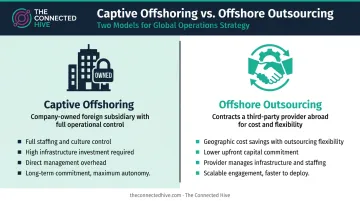
- Captive offshoring: The company owns and operates its own foreign delivery center — a subsidiary or division in another country — retaining full staffing, process, and culture control. Wells Fargo's India and Philippines operations, spanning over 5.6 million combined square feet per its 2025 filing, illustrate the operational scale this model requires.
- Offshore outsourcing: The company contracts a third-party provider that operates abroad. This combines the geographic cost advantage with the flexibility of outsourcing — and is the model most relevant to companies evaluating BPO.
Key Benefits of Offshoring
- Significant cost reduction: US customer service representatives earned a median of $20.59/hour in May 2024, per the Bureau of Labor Statistics. Offshore roles in the Philippines and India run substantially lower — the Philippines IT-BPM sector alone hit $40 billion in export revenue in 2025, driven largely by this cost differential.
- Access to a global talent pool: India and the Philippines have concentrated expertise in IT and BPO. Eastern Europe has deep software engineering capabilities. Offshoring gives companies access to talent that either doesn't exist locally or is prohibitively expensive domestically.
- 24/7 operational coverage: Time zone differences, often framed as a challenge, function as an operational advantage. Offshore teams can handle customer service and processing tasks outside US business hours — enabling round-the-clock coverage without overnight shift premiums.
Those benefits only hold when the right use case and risk controls are in place.
Common Use Cases and Risks of Offshoring
Primary industries leveraging offshoring include:
- Manufacturing — Cost-efficient production in lower-wage markets
- Technology — Software development, QA testing, and IT infrastructure management
- Customer service — Offshore contact centers serving North American clients (approximately 70% of the Philippines IT-BPM market is North American-oriented)
- Finance and back-office processing — Transaction processing, claims handling, and data entry at scale
The risks are real and require active management:
- Cultural and communication barriers — Differences in accent, idiom, and service style can erode customer experience quality, particularly in voice-based support roles.
- Regulatory compliance across borders — HHS confirms that storing ePHI outside the US is permissible only with applicable HIPAA safeguards — and that offshore geography may increase risk exposure requiring additional risk analysis. Similarly, PCI DSS applies to merchants even when all payment processing is outsourced — compliance responsibility cannot be contractually delegated.
- Geopolitical and climate risk — IMF assessments for both India and the Philippines identify geoeconomic fragmentation, extreme weather events, and regional instability as continuity risks worth planning for.
- Time zone management — Overlapping only 2-4 working hours with offshore teams requires deliberate scheduling. Without it, approvals stall, handoffs break, and projects slip a full day at a time.
Outsourcing vs. Offshoring: Key Differences
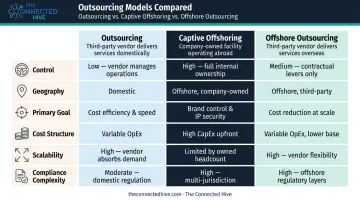
| Dimension | Outsourcing | Offshoring (Captive) | Offshore Outsourcing |
|---|---|---|---|
| Definition | Delegate tasks to a third party | Relocate operations to another country, company-owned | Contract a third party operating abroad |
| Control | Transferred to provider | Retained by parent company | Shared/contracted with vendor |
| Geography | Anywhere (local to global) | Specifically another country | Specifically another country |
| Primary Goal | Flexibility, expertise access | Long-term cost reduction, scale | Cost reduction + flexibility |
| Cost Structure | Service fee (retainer or per-outcome) | Infrastructure + direct headcount investment | Service fee, often lower than domestic |
| Scalability | High — adjust contracts as needed | Lower — requires structural investment | High — provider absorbs capacity risk |
| Compliance Complexity | Moderate | High (cross-border regulations) | High (cross-border + third-party risk) |
| Best For | Non-core functions, variable demand | Long-term, high-volume operations at scale | Cost savings without setting up operations abroad |
Understanding the Control Dimension
Outsourcing transfers operational responsibility to a third party: the provider manages staffing, quality, and day-to-day delivery. You govern outcomes through contracts and SLAs.
Captive offshoring keeps control with the parent company. You hire directly, set the culture, and manage performance. The tradeoff: you also carry the infrastructure investment, local employment obligations, and management overhead.
For industries where compliance can't be delegated — healthcare, financial services, insurance — the control question carries real risk. Under HIPAA, covered entities must obtain satisfactory assurances from business associates and require those associates to impose the same obligations on their subcontractors.
That means your vendor's compliance posture becomes your exposure. Choosing the right model isn't just a cost decision; it directly determines who owns accountability when something goes wrong.
Cost Structure: When Each Model Makes Sense
- Outsourcing runs on a service fee model: per outcome, per hour, or via retainer. Lower upfront commitment, predictable variable cost, and well-suited for companies that need flexibility or aren't ready to build foreign operations.
- Captive offshoring requires direct investment in facilities, local hiring, and management infrastructure. The payoff comes at scale and over time, which is why this model favors large enterprises with long-term, high-volume needs.
- Offshore outsourcing (BPO) combines the geographic cost advantage with a provider's existing infrastructure. Through The Connected Hive's network, businesses can access agent-hour pricing from $8 to $35 per hour depending on location, complexity, and volume, with no need to build or manage operations abroad.
Which Model Is Right for Your Business?
There's no universal answer. The right model depends on your specific goals, budget, compliance context, and operational maturity.
A Practical Decision Framework
Choose outsourcing when:
- You need flexibility to scale without long-term geographic commitments
- The function isn't a core competency and benefits from specialist delivery
- You want to redirect internal resources toward growth-driving activities
- Budget predictability matters more than maximum cost reduction
Choose captive offshoring when:
- You need sustained, long-term cost reduction at significant scale
- Maintaining direct control over staffing, culture, and process is a strategic requirement
- You have the management capacity and capital to build and run a foreign operation
- Long-term volume justifies the infrastructure investment
Choose offshore outsourcing (BPO) when:
- You want the cost benefits of offshoring without building a foreign entity
- You need 24/7 coverage and rapid scalability
- Compliance management will be handled through vendor contracts and audits
- You want access to an established provider's existing infrastructure, talent, and technology
Questions Every Business Should Ask First
Before committing to a model, work through these:
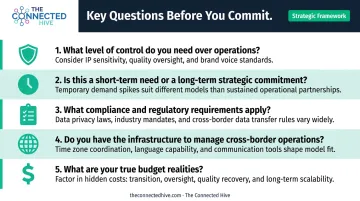
- What level of control do I need? If quality, compliance, or brand voice require hands-on oversight, a third-party arrangement needs strong governance to compensate.
- Is this a short-term project or a long-term operational need? Project-based needs favor outsourcing; sustained operational volume may justify more permanent structures.
- What compliance requirements apply? HIPAA, PCI DSS, and data residency regulations don't disappear when operations move offshore — they require active management regardless of model.
- Do I have the infrastructure to manage cross-border operations? Captive offshoring demands local HR, legal, and management capacity that many companies underestimate.
- What does my budget realistically support? Offshore outsourcing typically offers the most accessible entry point; captive offshoring requires capital investment upfront.
For businesses in healthcare, insurance, or financial services, getting this decision right carries more weight than the cost savings alone — compliance requirements don't allow for trial and error.
The Connected Hive helps US companies work through this kind of operational assessment — evaluating needs, vetting onshore, nearshore, and offshore partners across a network of over 3,500 domestic and 8,000+ global contact centers, and structuring the right model for each client's industry, compliance requirements, and budget.
Founder Tim Austrums brings over 20 years of executive experience in BPO and contact center operations, with direct expertise in HIPAA and PCI compliance. The consultancy works at no cost to the buyer.
Conclusion
Outsourcing and offshoring are not interchangeable — they're separate decisions about who does the work and where it gets done. Outsourcing gives you flexibility and specialized expertise. Offshoring delivers sustained cost reduction and global scale. Offshore outsourcing combines both, but it also adds meaningful management complexity that many companies underestimate.
That complexity is only growing. As AI reshapes service delivery, providers increasingly use automation to eliminate work outright — not just cover it with lower-cost labor. Deloitte's 2024 survey found 83% of executives were already leveraging AI in outsourced services, meaning evaluation criteria now extend well beyond geography and wage rates to automation capability, data governance, and outcome-based contracting.
Through all of it, the core question stays the same: does this model actually fit your business — its goals, its risk tolerance, and its customers? Getting that answer right before you commit is far less costly than unwinding a misaligned model afterward. That's where working with an experienced advisor, like The Connected Hive, pays for itself.
Frequently Asked Questions
What is the difference between outsourcing and offshoring?
Outsourcing means delegating work to an external third party regardless of where that provider is located. Offshoring means relocating operations to another country — and the company may still own and manage those operations directly. A business can outsource without offshoring, offshore without outsourcing, or do both simultaneously.
What are examples of outsourcing and offshoring?
Outsourcing examples include hiring a BPO firm to handle customer support, or contracting an external firm for payroll processing. Offshoring examples include a US bank establishing its own operations center in Bangalore (captive offshoring) or a retailer contracting a Philippine contact center for after-hours customer service (offshore outsourcing).
What is offshore outsourcing, and how is it different from outsourcing or offshoring alone?
Offshore outsourcing combines both: contracting a third-party vendor that operates in another country. It delivers the cost advantages of offshoring alongside the flexibility of outsourcing, but introduces additional complexity around communication, compliance, and vendor governance that each model avoids on its own.
Which model is better for a small or mid-sized business?
Outsourcing — particularly BPO — is typically more accessible for SMBs because it requires no foreign infrastructure investment, provides immediate scalability, and converts fixed costs to variable ones. Captive offshoring generally makes financial sense only for larger organizations with long-term, high-volume operational needs that justify the upfront capital investment.
What industries benefit most from outsourcing contact center operations?
Healthcare, insurance, financial services, and retail are the strongest candidates. These sectors combine high customer interaction volumes, strict compliance requirements (HIPAA, PCI DSS), and seasonal demand fluctuations that make specialized BPO providers particularly valuable — both for operational efficiency and regulatory risk management.
What are the main risks of offshoring that businesses should plan for?
The primary risks include communication and cultural barriers, time zone coordination challenges, geopolitical or climate-related continuity concerns, and cross-border regulatory compliance — particularly HIPAA and PCI DSS for US companies in regulated industries. None of these are disqualifying, but all require active planning and governance.