This article breaks down exactly what each model does, how they differ across channels, technology, and data capabilities, and gives you a practical framework for deciding which fits your business.
Key Takeaways
- A call center handles voice calls only; a contact center manages interactions across phone, email, chat, SMS, social media, and more
- Beyond channel count, the real differentiator is data integration — contact centers create a unified customer view that call centers simply can't
- Call centers cost less to build and operate; contact centers require more technology investment but deliver richer service
- 76% of customers prefer different channels depending on context, making channel flexibility a competitive factor
- For healthcare, financial services, insurance, and government, compliance requirements add another dimension to this decision
Call Center vs. Contact Center: Quick Comparison
| Dimension | Call Center | Contact Center |
|---|---|---|
| Communication channels | Voice only (inbound, outbound, or blended) | Phone, email, live chat, SMS, social media, messaging apps |
| Technology requirements | ACD, IVR, call queuing, call recording, basic CRM | CRM platform, omnichannel routing, AI tools, analytics, knowledge base, WFM |
| Analytics capabilities | Call logs, recordings, handle time, queue metrics | Cross-channel behavioral data, 360° customer profiles, predictive analytics |
| Agent skill requirements | Strong verbal communication, product knowledge | Verbal + written communication, digital tool proficiency, channel-switching agility |
| Best-fit use case | High-volume voice support, outbound sales, phone-first customer base | Diverse customer demographics, complex service needs, regulated industries |
The sections below break down what each model looks like in practice — including how the differences in technology, data, and customer experience shape the decision for your business.
What Is a Call Center?
A call center is a centralized operation built to handle high volumes of voice calls. Inbound call centers field customer questions, complaints, and support requests. Outbound centers initiate calls for sales, collections, appointment reminders, or follow-up surveys. Blended models do both, routing agents between inbound queues and outbound campaigns based on demand.
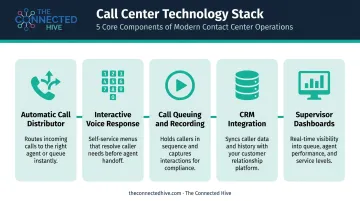
The core technology stack is straightforward:
- Automatic Call Distributor (ACD) — routes incoming calls to the right agent or queue based on configured rules
- Interactive Voice Response (IVR) — lets callers self-serve or get routed before reaching an agent
- Call queuing and recording — manages wait times and captures interactions for quality and compliance review
- CRM integration — pulls up customer account data when a call connects
- Supervisor dashboards — gives managers real-time visibility into queue volumes, agent availability, and handle times
Where Call Centers Still Make Sense
The data makes a clear case for voice. PwC's 2023 Global Service Study found that voice accounted for 43.7% of North American customer contacts, 52% in Europe, and 51% in Australia — with customers consistently rating phone as more effective for complex or sensitive conversations.
Call centers remain the right model for:
- High-volume inbound support in utilities, telecom, or insurance
- Outbound sales and appointment-setting programs
- Businesses whose customers are predominantly phone-first
- Outsourced customer service functions where voice is the primary channel
For many businesses, voice is still the dominant channel. The call center model is designed specifically to serve that reality — efficiently and at scale. Where it falls short is when customers expect to reach you through email, chat, or social media alongside the phone.
What Is a Contact Center?
A contact center is a multichannel (or omnichannel) customer service operation that handles interactions across phone, email, live chat, SMS, social media, messaging apps, and sometimes video. The distinction between multichannel and omnichannel matters: multichannel means these channels exist as separate silos, while omnichannel means they're integrated — agents see a unified view of every interaction a customer has had, regardless of channel.
The technology footprint is much broader than a call center:
- CRM platform — the backbone that connects customer history across all channels
- Omnichannel routing — directs interactions to the right agent based on channel, skill, and context
- AI-driven chatbots and virtual agents — handle routine inquiries before escalating to humans
- Speech and text analytics — analyzes interactions for quality, compliance, and customer sentiment
- Knowledge bases — give agents and customers quick access to accurate information
- Workforce management (WFM) tools — forecast demand and schedule agents across multiple channels simultaneously
Because every channel feeds into a shared system, contact centers build complete customer profiles that voice-only operations can't replicate at scale. That data shifts the model from reactive support (answering problems as they arrive) toward proactive service, where patterns in customer behavior shape self-service content, agent training, and product decisions.
AI's Role in Agent Productivity
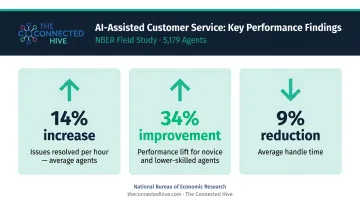
Contact centers are also where AI-assisted tools show the clearest operational benefit. A field study of 5,179 support agents published by the National Bureau of Economic Research found that a generative AI conversational assistant increased issues resolved per hour by 14% on average, with novice and lower-skilled agents improving by 34%. Average handle time dropped 9%. AI tools don't replace agents — they make agents, especially newer ones, measurably more productive.
Where Contact Centers Fit Best
- Companies with customers who regularly switch channels depending on their need
- Businesses with complex service journeys requiring personalized history (healthcare enrollment, financial account management, retail order resolution)
- Organizations in industries where long-term customer relationships and cross-channel continuity are core to the service model
- Regulated industries where data capture and auditability across touchpoints matter for compliance
Call Center vs. Contact Center: Key Differences
Channels and What That Actually Changes
A call center manages one channel. A contact center manages many — and that single difference creates ripple effects across every other operational dimension. You can't simply add a chat widget to a call center and call it a contact center. Each new channel requires routing logic, agent training, quality monitoring, and integration with the systems that track customer history.
Salesforce research found that 76% of customers prefer different channels depending on context — meaning most customers don't want to be locked into phone. But that same research found 65% often have to repeat or re-explain information to different representatives, a direct consequence of siloed channel management.
Technology and Integration
The technology gap between a call center and a contact center is meaningful, not just in cost but in complexity. Call centers run on telephony: ACD, IVR, recording, and a CRM connection. That stack is well-understood, well-supported by vendors, and relatively straightforward to operate.
Contact centers require those same tools plus omnichannel routing, analytics platforms, AI tools, knowledge bases, and workforce management software — all integrated. When those integrations break down or aren't built correctly, agents lose context. Customers end up explaining their situation from scratch every time they switch channels, which undermines the entire point of having a contact center.
Only 26% of organizations currently offer multiple interaction channels with integrated technology and connected data, according to Genesys research — despite 71% saying an integrated CX platform is a top priority. The gap between aspiration and execution is where most contact center implementations run into trouble.
Analytics and Customer Insight
Call centers generate valuable data: call volume, handle time, first-call resolution, and transcripts. That's useful for managing operations but limited for understanding customer behavior.
Contact centers aggregate behavioral data across every channel. The result is a customer profile that reflects the full journey — not just the calls. This is what enables proactive service:
- Identifying customers likely to have a problem before they call
- Surfacing self-service content that actually resolves issues
- Giving agents context that makes every interaction feel informed, not generic
Agent Skills and Workforce Complexity
Both models require strong communication skills and the composure to handle frustrated customers. Contact centers add complexity: agents need proficiency with multiple digital tools and the ability to shift tone and pacing between channels.
Those channels demand genuinely different skills:
- Live chat: concise written responses, faster-paced multitasking, brevity under pressure
- Phone: vocal warmth, tone-reading, the ability to carry silence without losing rapport
Treating these as interchangeable leads to poor customer experiences and higher agent turnover.
That difference affects hiring profiles, training programs, quality monitoring processes, and how workforce management tools are configured — all of which add cost and management complexity.
Customer Experience and Business Stakes
The business case for getting channel strategy right is concrete. According to Salesforce and Genesys data:
- 91% of customers are more likely to repurchase after a positive service experience
- 31% switched brands after a single poor experience
- 77% would switch after five or fewer negative interactions
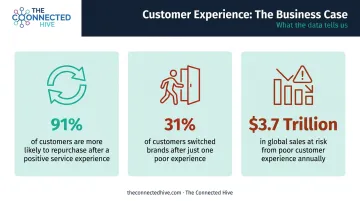
Qualtrics estimates $3.7 trillion in global sales are at risk annually from poor customer experiences. Channel flexibility alone won't guarantee great CX — but the decision between a call center and a contact center is where the exposure starts.
Which Is Right for Your Business?
The honest answer is that most businesses don't sit cleanly at either end of this spectrum. They operate somewhere between a pure call center and a fully integrated contact center, and the right model depends on their industry, customer base, growth stage, and compliance environment.
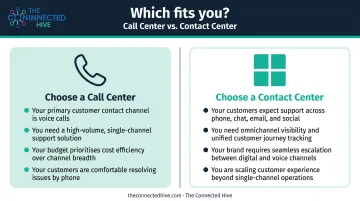
A call center is likely the better fit when:
- Your customer base is predominantly phone-first
- Your service interactions are high-volume and relatively straightforward
- Budget constraints make a full omnichannel stack impractical right now
- Your model is purely inbound or outbound voice (including outsourced call handling)
A contact center makes more sense when:
- Your customers regularly use multiple channels and expect continuity between them
- Your service needs are complex, personalized, and require customer history
- You need cross-channel data visibility to improve service quality over time
- You serve industries — healthcare, financial services, insurance, government — where long-term customer relationships and data-rich service models are the norm
Compliance adds another layer for regulated industries. HIPAA obligations in healthcare apply to every system, transmission path, agent endpoint, and stored recording that touches protected health information. PCI DSS for financial services governs how payment card data flows through voice recordings and digital channels alike.
These requirements don't change based on what you call your operation. A contact center's broader channel footprint simply means more surfaces to account for in your compliance scope.
Where The Connected Hive Comes In
Navigating this decision well requires more than a checklist. It requires an honest read of your operational reality, your customer behavior, and the compliance landscape you operate in — before you commit to a vendor or a model.
The Connected Hive is a contact center consultancy founded by Tim Austrums, whose 20 years of executive experience in the BPO and contact center industry spans clients like Humana, Blue Cross/Blue Shield, Discover, Ameriprise, and FEMA. The firm conducts a holistic business assessment that covers your service model, channel needs, technology gaps, and compliance requirements, then matches you with vetted partners from a network of 3,500+ domestic and 8,000+ global contact centers.

The partner selection service is typically provided at no cost to the client. If you're evaluating what model fits your business, a consultation is a straightforward way to get an expert read on your options.
Conclusion
Neither model is universally better. A call center delivers focused, efficient, voice-based service for businesses where that's what customers need. A contact center enables a more complete, personalized customer experience for businesses with more complex service demands and more diverse customer bases.
The decision comes down to who your customers are, how they want to reach you, and what your business needs to deliver consistently at scale. Getting that right from the start affects customer retention, operational costs, compliance exposure, and your ability to scale without rebuilding your service infrastructure from scratch.
If you're weighing that decision now, The Connected Hive helps businesses cut through the complexity — matching you with the right contact center model and vetted partners based on your actual operational needs, not a vendor's pitch.
Frequently Asked Questions
What does a contact center do?
A contact center manages inbound and outbound customer interactions across multiple channels — phone, email, chat, SMS, and social media — using integrated technology and CRM data. Agents get a unified view of each customer regardless of which channel the conversation happens on.
What is another name for a contact center?
Contact centers are sometimes called customer engagement centers, customer experience hubs, or omnichannel service centers. The terminology evolved as digital channels multiplied and voice-only operations could no longer cover the full scope of how customers wanted to connect.
Can a call center become a contact center?
Yes, though it requires deliberate planning. The path typically involves adding digital channels, integrating a CRM platform, training agents on new communication tools, and adopting omnichannel routing logic. Most organizations approach this in phases rather than converting all at once.
Is a contact center more expensive than a call center?
Upfront technology and training costs are higher for a contact center. Digital channels, though, handle lower-complexity interactions at a lower cost per interaction than voice. When self-service and automation are working well, the overall unit economics can improve significantly at scale.
What types of businesses benefit most from a contact center?
Businesses with large, diverse customer bases in healthcare, financial services, insurance, retail, and government tend to benefit most. These sectors share a common profile: complex service needs, long-term customer relationships, and compliance requirements where cross-channel data visibility and auditability directly reduce risk.