It sounds like a cost question. It's actually a strategic one. Get it wrong and you're either burning budget on fixed overhead you can't scale, or losing control of customer experiences that define your brand. For contact centers and BPO functions specifically, the stakes include compliance exposure (HIPAA, PCI), customer satisfaction, and operational continuity — not just headcount costs.
This guide breaks down exactly how insourcing and outsourcing differ, where each model performs best, and how to think through the decision for your specific situation.
Key Takeaways
- Insourcing keeps operations in-house; outsourcing contracts an external provider to manage them
- Outsourcing delivers average cost savings of 15%+ versus in-house operations, per ISG's 2024 research
- The contact center outsourcing market is projected to hit $163.86 billion by 2030, reflecting mainstream adoption
- Compliance obligations (HIPAA, PCI) follow the work — active governance is required regardless of which model you choose
- A hybrid approach is common — keeping sensitive functions in-house while outsourcing high-volume operations
Insourcing vs Outsourcing: Quick Comparison
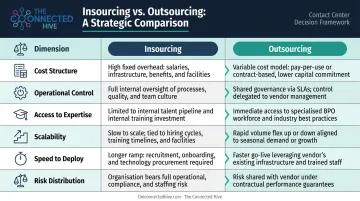
The six dimensions below capture where insourcing and outsourcing diverge most — and where your decision will likely hinge.
| Dimension | Insourcing | Outsourcing |
|---|---|---|
| Cost Structure | High fixed costs: recruiting, training, benefits, facilities, technology | Variable costs pooled across clients; lower per-unit overhead |
| Operational Control | Direct oversight of hiring, coaching, brand voice, escalations | Control through contracts, SLAs, and governance frameworks |
| Access to Expertise | Limited to what you can hire and retain internally | Immediate access to specialized skills and compliance infrastructure |
| Scalability | Requires internal hiring, training, and scheduling capacity | Provider supplies variable capacity on demand |
| Speed to Deploy | Slower — hiring and onboarding takes months | Faster — providers have trained workforces ready to activate |
| Risk Distribution | Organization absorbs all operational, turnover, and compliance risk | Risk shared with provider per contractual obligations |
ISG's 2024 study of 368 BPO executives found average savings of more than 15% compared to in-house operations, alongside an 11% average quality improvement. Your numbers will vary — run a full cost comparison against your operation's specific headcount, volume, and compliance requirements before drawing conclusions.
What Is Insourcing?
Insourcing means handling tasks, projects, or entire functions using your own employees, infrastructure, and management. For contact centers, that means building and maintaining an internal team to handle customer calls, support tickets, member services, or back-office functions.
Core Benefits of Insourcing
The appeal is straightforward:
- Direct quality oversight — you hire, coach, and manage every agent yourself
- Faster internal decisions — no vendor approvals or contract amendments needed
- Tight brand alignment — your team lives your culture, not a vendor's
- Proprietary knowledge stays internal — sensitive customer data and processes never leave the building
For industries where customer experience is the product — healthcare member services, financial advisory support, premium retail — that alignment matters.
Where Insourcing Gets Expensive
The real cost of insourcing extends well beyond agent salaries. A complete picture includes:
- Recruiting, background checks, and onboarding
- Training, nesting, and ongoing coaching
- Supervisors, QA staff, workforce management, and HR
- Facilities (or home-agent support infrastructure)
- Technology: CCaaS, CRM, recording, analytics, and licensing
- Turnover costs — replacing one contact center agent can exceed $35,000 when recruiting, onboarding, and training are fully loaded, according to a 2025 ICMI analysis
Scaling during peak periods adds another layer of complexity. Hiring 50 agents for open enrollment season, then managing attrition when it ends, is operationally costly regardless of how well you execute it.
Use Cases for Insourcing
Insourcing tends to be the stronger choice when:
- The function is mission-critical and tied directly to your core product or IP
- Regulatory sensitivity requires full internal control over data and processes
- You have the budget, infrastructure, and management capacity to build at scale
- Customer relationships are so central to brand differentiation that external handling is a genuine risk
T-Mobile's Team of Experts model is a well-documented example of insourcing done right. Rather than optimizing for minimum handle time, T-Mobile assigned small teams to defined customer groups with end-to-end ownership. Harvard Business Review reported that the model delivered a 7% lower cost to serve, NPS growth of more than 50%, and a 58% reduction in internal escalations.
The results came from accountability and process design — not just internal ownership. Insourcing can absolutely deliver those outcomes, but only when the structural conditions are in place to support them.
What Is Outsourcing?
Outsourcing contracts an external provider — domestic or international — to handle functions that could otherwise be managed internally. In the contact center and BPO space, this covers customer support, claims processing, enrollment services, technical helpdesks, and back-office operations.
The Four Types of Outsourcing
| Type | Definition | Key Trade-Off |
|---|---|---|
| Onshore | Provider in the same country | Higher cost, strong brand and compliance familiarity |
| Nearshore | Provider in adjacent time zone | Cost savings with manageable language and cultural overlap |
| Offshore | Provider in distant country with lower labor costs | Maximum cost reduction; more governance and quality management required |
| BPO | Entire process functions delegated to a specialized external firm | Broadest scope; most suited to high-volume, complex, or compliance-heavy operations |
Core Benefits of Outsourcing
- Brings trained workforces, compliance infrastructure, and technology stacks your internal team would take years to build
- Scales capacity with volume, not headcount cycles — no hiring lag when demand spikes
- Includes omnichannel platforms, AI tools, and workforce management systems out of the box
- Replaces fixed overhead with a variable cost model tied to actual usage
The market reflects the demand. Grand View Research projects the global call and contact center outsourcing market to reach $163.86 billion by 2030, growing at a 9.8% CAGR from 2025 through 2030. McKinsey's 2024 survey found **55% of customer-care leaders already outsource part of their customer care function** — and nearly half expected to increase that volume.
Real Risks to Manage
Outsourcing isn't without friction. Common concerns include:
- Reduced direct control over individual customer interactions
- Potential quality inconsistencies if SLAs aren't clearly defined and enforced
- Communication or cultural challenges, particularly with offshore providers
- Vendor dependency if exit provisions aren't built into contracts upfront
Structured governance — clear SLAs, defined escalation paths, and regular performance reviews — keeps these risks from compounding over time.
Use Cases for Outsourcing
Outsourcing delivers the strongest ROI when:
- Volume fluctuates seasonally or unpredictably — open enrollment surges, disaster response, campaign peaks
- Speed to market matters more than building internal capacity — new regions, new products, fast launches
- Compliance infrastructure is non-negotiable — a qualified BPO partner in healthcare or financial services already operates within HIPAA/PCI frameworks
Blue Cross Blue Shield of North Dakota's engagement with Noridian Healthcare Solutions illustrates what well-executed outsourcing looks like in a regulated environment. The program handled more than 80,000 member and provider calls, achieved customer-service quality above 99%, and met 100% of SLAs since May 2022. The results held because Noridian came in with established HIPAA compliance, trained staff, and accountability baked into the contract structure — not built after the fact.
Which Model Is Right for Your Business?
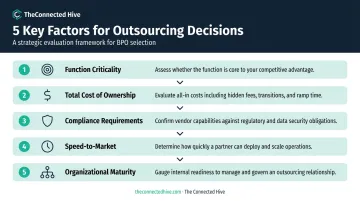
The honest answer: there's no universal default. The right model depends on five variables.
The Decision Framework
1. Function criticality — Is this core to your product, or a scalable support function? Proprietary processes and high-value customer relationships favor insourcing. High-volume, standardized transactions favor outsourcing.
2. Total cost of ownership — Compare fully loaded insourcing costs (see the list above) against outsourced proposals normalized to cost per productive hour. Don't compare agent wages to per-agent-hour vendor quotes — that's an apples-to-oranges analysis.
3. Compliance requirements — HIPAA and PCI obligations don't transfer with outsourcing. Whether you insource or outsource, you retain governance responsibility. HHS is explicit: Business Associate Agreements must define permitted uses, require safeguards, and allocate subcontractor obligations. PCI SSC confirms that merchants retain compliance responsibility even when all payment processing is outsourced. The question isn't whether to manage compliance — it's who operates the controls.
4. Speed-to-market — If you need operational capacity in 60 days, an internal build isn't realistic. Outsourcing wins on deployment speed.
5. Organizational maturity — Can you effectively manage a vendor relationship, including governance, QA, and SLA enforcement? If not, insourcing may be less risky despite higher cost.
The Hybrid Model
Many mature organizations don't choose one model exclusively. A hybrid approach keeps strategic, brand-sensitive, or compliance-critical interactions internal while outsourcing high-volume, overflow, or specialized queues to vetted BPO partners.
A 2024 survey of healthcare contact center leaders found 15% already operate hybrid delivery models — retaining complex member interactions in-house while outsourcing enrollment surges or after-hours support. It's a practical middle ground for organizations that need both control and scale.
Where a Consultant Adds Value
Choosing between these models involves more variables than most internal teams have bandwidth to evaluate — hidden cost structures, compliance allocation, vendor quality signals, and geographic sourcing all interact in ways that aren't obvious from the outside.
That's where an advisor with direct industry experience makes a difference. Tim Austrums, Founder of The Connected Hive, brings 20+ years of executive BPO experience and relationships across 3,500+ domestic contact centers. His team assesses each client's goals, culture, and compliance requirements before recommending a model or sourcing partners — and the advisory engagement typically comes at no cost to the buyer.
Real-World Example: Outsourcing in Healthcare
Consider a health plan managing Medicaid Expansion member services. Volume is high, interactions are complex — covering benefits, claims, transportation, and housing navigation — and compliance obligations are non-negotiable.
Building an in-house team capable of meeting those standards requires significant infrastructure investment. It also exposes the organization to turnover risk in a function that demands trained, specialized agents.
The BCBSND and Noridian engagement described earlier is a concrete example of what successful outsourcing looks like in this scenario: 80,000+ calls handled, 99%+ quality scores, 100% SLA attainment. Those outcomes came from a provider that already had the operational and compliance infrastructure to support a regulated managed-care program — built over years before BCBSND ever signed a contract.
For healthcare insurers, financial services firms, or insurance companies managing peak demand with compliance-heavy interactions, outsourcing offers a practical advantage:
- Lower fixed overhead compared to staffing a permanent in-house team
- Faster scalability during enrollment periods or volume surges
- Access to compliance expertise — HIPAA, managed-care regulations — that takes years to build internally

When volume is unpredictable and compliance expertise is non-negotiable, the right outsourcing partner can outperform an in-house team on both cost and quality.
The Connected Hive helps healthcare and financial services organizations evaluate exactly this decision — matching them with vetted, compliance-ready partners at no cost to the client.
Conclusion
Neither insourcing nor outsourcing wins universally. The right model depends on what the function requires, what your organization can realistically manage, and what your customers actually need.
For organizations handling high customer interaction volumes with compliance obligations and seasonal demand swings — particularly in healthcare, insurance, and financial services — outsourcing to a vetted contact center partner frequently delivers cost savings, scalability, and specialized expertise that in-house teams struggle to replicate at the same investment level.
The decision is worth getting right. A systematic assessment of total cost, function criticality, compliance requirements, and vendor quality will get you there faster than any default assumption. If you're evaluating outsourcing options for customer service or contact center operations, The Connected Hive offers no-cost advisory services to help match your organization with the right partner.
Frequently Asked Questions
What is the difference between insourcing and outsourcing?
Insourcing uses your own employees and company resources to complete tasks, while outsourcing contracts an external provider to manage those functions. The core distinction is who controls the people, processes, and infrastructure delivering the work.
What is an example of insourcing?
A healthcare organization that manages its own member enrollment team rather than contracting a BPO is insourcing. The same logic applies any time a company builds or retains an internal team for work that could be delegated externally.
What are the four types of outsourcing?
The four main types are:
- Onshore — domestic provider, same country
- Nearshore — nearby country with a similar time zone
- Offshore — distant country, typically with lower labor costs
- BPO (Business Process Outsourcing) — an external firm manages entire process functions end-to-end
Can a company use both insourcing and outsourcing at the same time?
Yes. A hybrid model is common, particularly in regulated industries. Companies typically keep complex or brand-sensitive interactions in-house while outsourcing high-volume, overflow, or specialized operations to external partners.
What contact center functions are most commonly outsourced?
Commonly outsourced functions include inbound customer support, outbound enrollment and sales calls, member services, technical helpdesks, back-office processing, and compliance-heavy interactions in healthcare and financial services.
How do I choose the right outsourcing partner for my contact center?
Evaluate partners on industry expertise, compliance certifications (HIPAA, PCI), references from similar clients, SLA transparency, and cultural fit. Working with a specialized BPO consultant reduces the risk of a poor vendor match. Advisory services like those offered by The Connected Hive are typically available at no cost to the buyer.