Introduction
Most outbound calls don't fail because the product is weak or the rep is inexperienced. They fail because there's no clear framework guiding the conversation — no structure telling the agent how to open, what to say next, or where to take the call when a prospect pushes back. A well-crafted outbound call script solves that problem directly.
According to Cognism's 2026 outbound research, cold-call success rates have hovered between 2–5% in recent years. That's a low ceiling — but teams with structured, targeted outreach consistently outperform it. The difference is rarely talent. It's preparation.
This guide covers what you need to build or sharpen your outbound calling process:
- Core components of an effective script
- Best practices for writing and delivering them
- Real-world examples across five common scenarios
- How to handle the objections that derail most calls
Key Takeaways
- A script is a conversation guide, not a monologue — it should create space for listening
- The first 15 seconds determine whether the call continues; your opener must signal relevance immediately
- Different call types (cold, referral, follow-up) require different scripts with different tones and objectives
- Objections are signals the prospect is still engaged, not a reason to disengage
- Scripts improve through iteration — real call data, not instinct, shows what to change
Why Outbound Call Scripts Matter More Than You Think
What a Script Actually Is
An outbound call script is a structured conversation guide — not a word-for-word monologue. Its job is to help agents stay on message and move the prospect toward a clear next step. A good script is a framework, not a performance.
The best scripts feel like natural conversation because they're written the way people actually talk. They leave room for the agent to listen, adapt, and respond to what the prospect actually says — rather than barreling through pre-written paragraphs regardless of what's happening on the other end of the line.
The "Robotic Script" Misconception
Scripts don't make calls sound robotic. A poorly used script does. When agents recite lines without internalization, the call feels like a telemarketing pitch from 2003. When agents understand the purpose behind each section and use the script as scaffolding, the conversation sounds natural — because it is.
Why Structure Matters Now More Than Ever
RAIN Group research found that 82% of B2B buyers accept meetings with sellers who proactively reach out — at least sometimes. The opportunity is real. But connection rates on cold calls average around 6.71% according to Outreach platform data, with only top-performing teams reaching 9%.
That gap between buyer openness and actual connection is largely a script and targeting problem. Structured, relevant outreach closes that gap. It improves conversion rates, respects the prospect's time, and signals that your outreach was deliberate — not a numbers game.
When a script is built around the right message for the right audience, it shows. Prospects can tell the difference between a rep who's prepared and one who's reading off a page.
The Core Elements of an Effective Outbound Call Script
Opening Line
The first 10–15 seconds decide whether the conversation continues. Your opener must answer three questions immediately:
- Who are you?
- Why are you calling?
- Why should this prospect care?
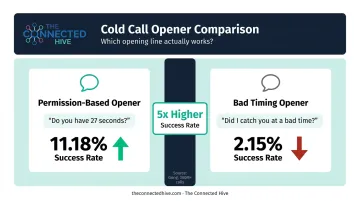
Skip the pleasantries and get to relevance fast. Gong's analysis of 300M+ cold calls found that permission-based openers ("Do you have 27 seconds for me to tell you why I called?") achieved an 11.18% success rate — nearly 5x higher than "Did I catch you at a bad time?" which landed at just 2.15%.
Value Proposition
After the opener, you have one or two sentences to state your core benefit. The key: frame it around the prospect's likely pain point, not your product's features.
- ❌ "We offer an AI-powered CRM with 40+ integrations."
- ✅ "We help mid-size sales teams cut their admin time in half so reps spend more time actually selling."
Once you've landed your value statement, the next move is to ask — not tell. Good qualifying questions turn a pitch into a conversation.
Qualifying Questions
Open-ended questions serve two purposes: they gather intel on the prospect's actual situation, and they make the prospect feel heard — which keeps them engaged. Good qualifying questions sound like genuine curiosity, not a checklist.
Examples:
- "How are you currently handling [relevant challenge]?"
- "What would need to change for that to look different in six months?"
- "What's driving that as a priority right now?"
Objection Handling Blocks
Every script should anticipate the 3–4 most common objections and include brief, empathetic responses. The goal is to acknowledge and redirect — not argue or bulldoze.
Common examples:
- "We already have a solution." → "Totally fair — most of our clients did too. What made you start looking at alternatives?"
- "Now isn't a good time." → "Understood. When would be a better window — is Q2 typically quieter for your team?"
- "Send me some information." → "Happy to. To make sure I send the right thing — what's the biggest challenge you're trying to solve right now?"
Clear Call to Action
Your CTA should propose a specific, low-friction next step. "Can we connect sometime?" is not a CTA — it's an invitation to say no. Instead:
- "Would a 15-minute call next Thursday work for you?"
- "I'll send over a one-pager and follow up Friday — does that work?"
If the prospect declines, close gracefully: "Totally understand — is it alright if I check back in next quarter?"
Outbound Call Script Best Practices
Write the Way People Talk
Scripts should use short sentences, contractions, and natural pauses. Read every script aloud before it goes live. If it sounds stiff when you read it, it'll sound worse when someone else delivers it under pressure.
Know It, Don't Memorize It
There's a big difference between internalizing a script and reciting it. Agents who understand why each section exists can adapt in real time. They can handle an unexpected question without losing their place and stay present in the conversation. Agents who memorize word-for-word go on autopilot — and that kills active listening.
Use Different Scripts for Different Scenarios
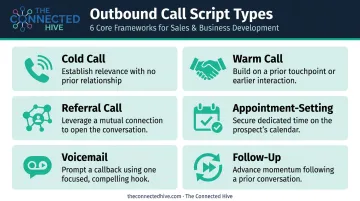
A single universal script fails because each call type requires a different tone, level of familiarity, and objective. Scripts you need:
- Cold call (no prior relationship)
- Warm call (prior email, event, or content touchpoint)
- Referral call (named mutual connection)
- Appointment-setting call
- Voicemail
- Post-demo or follow-up call
Lead with the Prospect's World
Reference something specific about the prospect's company, role, or recent activity before launching into a pitch. An older Gong analysis found that stating "The reason for my call is..." was associated with a 2.1x higher meeting-booking rate — because it signals intentionality. Specificity amplifies that effect.
Always End with a Clear Next Step
Every call — whether it went well or not — should close with a defined action. Ambiguous endings ("I'll be in touch!") lead to lost leads. Make the next step explicit before you hang up:
- Confirming an appointment or demo time
- Sending materials or a follow-up email
- Scheduling a callback with a specific date
- Professionally closing the door if it's not a fit
Outbound Call Script Examples by Scenario
Different outbound call objectives require different script structures. Treat each example below as a starting template, adjusting the language to fit your industry, offer, and prospect profile.
Cold Call Script
You: "Hi [Name], this is [Your Name] from [Company]. I'll be quick — I noticed [Company] recently [relevant trigger, e.g., expanded into a new market / grew your sales team]. We work with teams like yours to [one-sentence value prop, e.g., shorten the time it takes new reps to book their first meeting].
Quick question — how are you currently handling [relevant challenge]?
(If they respond with interest, continue. If they say "not interested":)
Totally fair. Can I ask — is it timing, or is [challenge] just not on the radar right now?
(If they're open:) Would a 15-minute call next week make sense to see if there's a fit?"
Appointment-Setting Script
You: "Hi [Name], this is [Your Name] from [Company]. Reason I'm calling — we've been helping [industry] teams [specific benefit, e.g., cut their lead response time by 30%], and based on what I know about [Company], I thought it might be worth a quick conversation.
I'm only asking for 15 minutes — I can work around your calendar.
(If they say "I'm too busy":)
I get it — that's exactly why I'm only asking for 15 minutes. If it's not relevant, I'll say so myself. Would [specific date/time] work, or is [alternative] better?"
Voicemail Script
"Hi [Name], this is [Your Name] from [Company]. I'm reaching out because [one specific reason tied to their business — e.g., we just helped a company in your space reduce customer churn by 18%]. I'd love to connect for a quick chat. You can reach me at [phone number]. I'll also follow up with a short email. Thanks, [Name]."
Keep voicemails under 30 seconds. Research from InsideSales suggests each second beyond 30 seconds reduces response rates by roughly 2%. A focused message with one concrete reason to call back will outperform a thorough pitch that loses the listener by second 25.
Referral Script
You: "Hi [Name], this is [Your Name] from [Company]. [Referrer's Name] suggested I reach out — they thought what we're doing might be relevant to some of the challenges you're working through right now.
We help [type of company] [specific outcome]. [Referrer] felt like that could map to your situation.
Would it make sense to grab 15 minutes to see if there's anything there?"
Always get the referrer's permission before using their name. A dropped name without consent can backfire immediately.
Follow-Up / Post-Conversation Script
You: "Hi [Name], this is [Your Name] — we spoke [last week / at the demo on Tuesday]. I wanted to follow up on what we discussed, specifically around [the challenge they mentioned, e.g., onboarding time for new reps].
You mentioned that [specific pain point they raised] was the biggest friction point right now. Based on that, I think [specific next step or solution element] could address it directly.
Would it make sense to get the right people in a room for 20 minutes to map that out?"
How to Handle Common Objections in Outbound Calls
Objections Are Engagement, Not Rejection
When a prospect objects, they haven't hung up. That means they're still in the conversation — they just have an unresolved concern. The right framework: empathy + acknowledgment + redirect. Not a debate, and not a harder pitch.
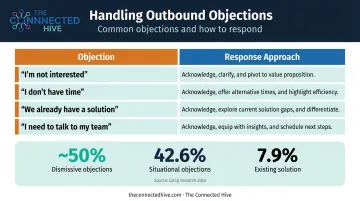
Gong's analysis of 300M+ cold calls found that dismissive objections (attempts to end the call) account for nearly 50% of all objections, while situational objections (timing, priorities) make up another 42.6%. Existing solution objections are actually the least common at just 7.9%. That means most objections are about engagement and timing — not a competitor being better than you.
The Four Most Common Objections
| Objection | Response Approach |
|---|---|
| "I'm not interested." | "That's fair — can I ask what's driving that? Is it timing, or does this just not fit what you're focused on?" |
| "I don't have time." | "I'll keep it to 60 seconds. If it's not relevant, I'll let you go immediately." Or: "Can I call you back Thursday at 2pm?" |
| "We already have a solution." | "Good to know. If you could change one thing about how it's working, what would it be?" |
| "I need to talk to my team." | "Makes sense. Would it help if I put together something you could share with them? Or we could set up a short call with whoever needs to be included." |
How Agents Deliver Responses Matters Too
Gong's research found that successful cold calls had 77% more speaker switches per minute than unsuccessful ones — meaning real dialogue moves calls forward, not a steady monologue. Three behaviors drive that outcome:
- Stay calm and measured, even when the prospect sounds dismissive
- Avoid interrupting — let the objection land before responding
- Match the prospect's energy and pace to keep the exchange human
The words matter less than the delivery. A sharp response delivered defensively will lose the call that a softer answer delivered with genuine curiosity would have saved.
Testing, Refining, and Scaling Your Scripts
No script is finished on its first call. Treat every new script as a starting hypothesis, not a finished product.
A Simple Iteration Process
- Run the script across a defined set of calls (50–100 minimum for meaningful signal)
- Track specific metrics: connection rate, conversion to next step, where prospects disengage
- Identify patterns: Are you losing people at the opener? After the value prop? When you ask for the meeting?
- Revise one element at a time — don't overhaul the whole script if only one section is underperforming
- Repeat with the revised version
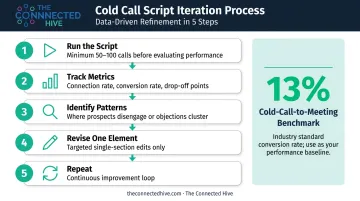
According to Outreach's 2026 cold outreach data, only 13% of connected cold calls convert to meetings. That benchmark gives you a target to beat — and a baseline for knowing when a script change is actually working.
The Role of Call Recording
Call recordings reveal what data alone can't. They show exactly where prospects disengage, where agents go off-script unnecessarily, and which objection responses land versus which ones create friction. Even reviewing 5–10 calls per week per rep generates enough insight to drive real script improvements.
Scaling Consistently Across Teams
Those call recording reviews become even more critical when you're managing a larger team. As outbound programs scale (whether through an expanded internal team or an outsourced contact center), script consistency becomes a real operational challenge. When scripts change hands, training gaps open, language drifts, and performance variation grows.
Experienced contact center consultants, like The Connected Hive, help companies navigate this directly. With 20+ years of BPO industry experience, they identify vetted outbound-capable partners and ensure the right foundations — script training, quality monitoring, and performance accountability — are in place before a program launches.
Frequently Asked Questions
What is an example of an outbound call script?
A basic outbound script looks like this: "Hi [Name], this is [Your Name] from [Company] — I'll be quick. We help [type of company] solve [specific problem], and I thought it might be relevant to what you're working on. Do you have 15 minutes next week to see if there's a fit?" That's all you need to start — a relevant hook, a clear benefit, and a low-friction ask.
What are good closing lines for an outbound call script?
The best closings are specific and low-pressure. Examples: "Would a 15-minute call next Tuesday work for you?" or "I'll send over a quick summary and follow up Thursday — does that work?" Avoid vague closings like "I'll be in touch" — they rarely lead anywhere.
How do you write an outbound call script from scratch?
Start with these five steps:
- Identify your target audience and call objective
- Draft an opener that leads with relevance
- Write a one-sentence value statement focused on prospect pain
- Prepare brief responses for your top 3–4 objections
- Close with a specific CTA
Then run it on real calls and refine from there.
What are the key components of an effective outbound call script?
Five essentials: a personalized opening that signals relevance, a clear value proposition framed around the prospect's pain point, open-ended qualifying questions, prepared objection responses, and a specific call to action.
How do you handle objections in an outbound call?
Use acknowledge-empathize-redirect: acknowledge the concern without arguing, show genuine empathy to keep the conversation open, then redirect with a question or alternative offer. "That's fair — can I ask what's driving that?" is more effective than any counter-argument.
What is the difference between a cold call script and a warm call script?
A cold call script introduces you to someone with no prior relationship and focuses on quickly establishing relevance. A warm call script references a prior touchpoint — an email, event, or referral — to build on existing familiarity and move faster toward a next step.