Introduction
Most call centers are reactive by default — agents answer phones, handle whatever comes in, and move on. The problem is that reactive call handling rarely moves the needle on revenue or retention. Without a defined campaign structure, thousands of conversations each week become missed opportunities.
Structured call center campaigns change that equation. Instead of handling calls in isolation, campaigns give agents a clear objective, a measurable target, and the right tools to act on it — recovering a lapsed customer, qualifying a warm lead, or turning inbound marketing traffic into closed revenue.
When Entel analyzed more than 600,000 monthly calls and targeted specific agent practices, McKinsey reported a 40% increase in inbound service sales within 10 weeks. A goal-driven structure is what separates high-performing call centers from ones that simply stay busy.
This article covers the 7 essential campaign types: what each one is, when to deploy it, and the KPIs that tell you if it's working.
Key Takeaways
- Call center campaigns are structured, goal-specific programs — outbound or inbound — built around defined KPIs and timelines.
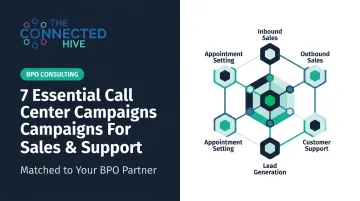
- The 7 essential types: cold lead outreach, warm lead qualification, customer referral/win-back, telemarketing, customer service, technical support, and inbound sales.
- Choosing the wrong campaign type wastes budget and burns agents out; always start with a clear business objective.
- Regulated industries like healthcare and financial services face compliance constraints that shape campaign design.
- Businesses outsourcing campaigns benefit from specialized expertise and cost savings without building in-house teams.
What Is a Call Center Campaign?
A call center campaign is a targeted, time-bound initiative where agents make or receive calls to achieve a specific business goal (lead generation, sales, support resolution, or retention). What separates a campaign from routine call handling is structure: preset KPIs, defined timelines, targeted scripts, and agents trained for one specific objective.
There are two primary categories:
- Outbound campaigns — agents initiate contact with prospects or existing customers for sales, surveys, follow-ups, or re-engagement
- Inbound campaigns — agents receive calls driven by customer need, advertising, or referrals, and are equipped to resolve or convert
Each type runs on different staffing models, workflows, and KPIs. A customer service campaign and a telemarketing campaign share almost nothing operationally — the agents, scripts, success metrics, and compliance requirements are built from the ground up for different purposes. The seven campaign types below reflect those distinctions.
Outbound Call Center Campaigns
Outbound campaigns are proactive. Agents reach out to leads or customers with a defined purpose, ranging from generating new business to re-engaging lapsed relationships. Success depends on list quality, agent preparation, and how clearly the campaign goal maps to the right audience.
Cold Lead Outreach
Cold lead outreach targets prospects with no prior interaction with the business — sourced from purchased lists, trade shows, or demographic data. The ceiling on results here is directly tied to list quality. Salesforce reports that 42% of sales professionals identify low-quality leads as a top challenge, and validated lists are the most important investment before the first dial goes out.
Key success factors:
- List validation against public records or firmographic data before dialing
- Strong objection-handling scripts — agents will hit resistance early and often
- Realistic expectations — among daily cold callers in HubSpot's 2025 survey, 35% reported appointment conversion rates of 2%–5%
- Defined KPIs: contact rate, conversion-to-appointment rate, and cost per lead
Cold outreach fits market expansion plays where no existing prospect database exists. If warm leads are already in the pipeline, those should be worked first — cold campaigns require significantly more dials per conversion and rarely justify shared resources with mid-funnel activity.
Warm Lead Qualification
Warm leads have already shown interest — downloaded content, attended a webinar, requested a demo. The campaign's goal isn't to close the sale; it's to confirm needs, update contact information, identify buying obstacles, and determine whether the lead is ready for sales handoff.
Agents on warm lead campaigns need listening skills and diagnostic questions more than hard-close tactics. Each conversation should end with documented CRM data — confirmed budget range, decision timeline, key objections — so the eventual sales handoff starts with context, not cold introductions.
Track these KPIs:
- Qualification rate (percentage of contacts confirmed as viable opportunities)
- Lead-to-opportunity conversion rate
- Average handle time (longer isn't always better — quality of qualification matters more)
Customer Referral and Win-Back Campaigns
Referral campaigns involve outbound calls to satisfied customers — gauging loyalty, identifying upsell or cross-sell opportunities, and asking for introductions to peers. These are relationship-first interactions, not sales calls. According to foundational Wharton research, referred customers carry an average 16% higher lifetime value over six years compared to non-referred customers. Bain further notes that 80%–90% of positive referrals come from the highest-value, most loyal customers — meaning your targeting list for referral campaigns writes itself.
Win-back campaigns are a distinct variation focused on lapsed or churned customers. The economics are compelling: HBR reports that acquiring a new customer costs 5–25x more than retaining an existing one, and a 5% retention increase can raise profits by 25%–95%. Win-back campaigns work best when targeting customers who left within a defined window and still fit the ideal customer profile — personalized incentives outperform generic "we miss you" scripts.
Telemarketing and Sales Campaigns
Telemarketing campaigns are the most sales-focused outbound type — scripted outreach to a defined audience designed to educate, persuade, and close, typically tied to a specific product, promotion, or seasonal event.
Legal exposure in telemarketing is substantial, and compliance systems must be in place before campaigns launch:
- TCPA violations carry statutory damages of $500 per call, trebled to $1,500 for knowing or willful violations under 47 U.S.C. § 227
- FTC Telemarketing Sales Rule penalties can reach $53,088 per violation, with each call potentially counting separately
- In 2023, the FCC imposed a record $299,997,000 forfeiture against a robocall operation — a clear signal that enforcement is active
Regulated industries carry additional requirements on top of standard telemarketing rules:
- Healthcare: Campaigns involving protected health information require Business Associate Agreements with any vendor processing that data (HIPAA)
- Financial services: Campaigns handling card data must follow PCI DSS storage and recording restrictions
Inbound Call Center Campaigns
Inbound campaigns are demand-driven : customers or prospects initiate contact in response to marketing, a support need, or a referral. Campaign success depends on routing accuracy, agent readiness, and speed to resolution. The difference between a well-designed inbound campaign and a reactive call queue is preparation.
Customer Service Campaigns
Customer service campaigns structure how inbound support calls are handled — using segmentation (high-value customers, new customers, customers with specific issue types) to route calls appropriately and deliver differentiated service levels. A high-value customer calling with a billing dispute should not reach the same queue as a first-time caller with a basic question.
Core KPIs for customer service campaigns:
| KPI | Industry Benchmark |
|---|---|
| First-Call Resolution (FCR) | 69% average; 80%+ is world-class (SQM, 2024) |
| Call Abandonment Rate | 5% average; below 5% is good |
| Wait Time / Speed of Answer | 80% of calls answered within 20 seconds (common standard) |
| CSAT Score | Measured via post-call surveys; varies by industry |
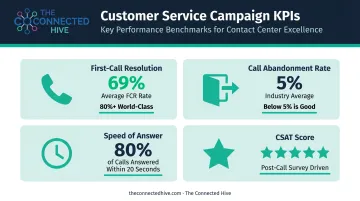
SQM's 2024 study across 500+ North American contact centers found that each 1-percentage-point FCR improvement can save a typical midsize center approximately $286,000 annually — making FCR one of the highest-ROI metrics to optimize.
Technical Support Campaigns
Technical support campaigns are specialized inbound programs where agents are trained on specific product or service troubleshooting workflows. The goal is structured issue resolution that reduces customer frustration, minimizes returns, and limits escalations.
These campaigns typically rely on tiered support structures:
- Level 1 triage — handles common, resolvable issues using scripted workflows and knowledge base tools
- Level 2 specialist — receives escalated tickets requiring deeper technical expertise
The cost difference between tiers is significant. HDI/MetricNet research benchmarks Level 1 resolution at $22 per ticket, compared to $84 total when a ticket escalates to desktop support. That's a nearly 4x cost multiplier for every unnecessary escalation — making first-level resolution rate a critical financial metric, not just an operational one.
A well-maintained knowledge base keeps Level 1 resolution rates high and average handle times in check.
Inbound Sales Campaigns
Inbound sales campaigns convert marketing spend into revenue. Agents handle calls from prospects already motivated by advertising (TV, PPC, social media, direct mail) and close that interest using consultative scripts and targeted offers.
The ROI gap between a well-executed inbound sales campaign and a poorly staffed one is substantial. HBR's study of 2,241 US companies found that firms responding to inbound leads within one hour were nearly 7x more likely to qualify the lead than those responding after one hour.
Firms waiting 24+ hours were more than 60x less likely to convert. Speed to answer is a revenue variable, not just a service metric.
Speed alone doesn't close deals. Conversion also depends on agent preparation:
- Pre-built objection-handling scripts specific to the promotion or product
- Upsell and cross-sell pathways integrated into the call flow
- Clear closing tactics rehearsed before the campaign launches
Matching agent readiness to campaign launch timelines is how inbound programs protect their marketing ROI.
How to Choose the Right Campaign for Your Business
Campaign selection starts with a clear business objective — and that objective must drive every other decision. Choosing campaign type before defining the goal is one of the most common misalignments in contact center planning.
Match campaign type to objective:
| Business Goal | Most Appropriate Campaign Type |
|---|---|
| Enter new markets with no existing prospects | Cold lead outreach |
| Nurture existing marketing-generated leads | Warm lead qualification |
| Improve retention and reduce churn | Customer referral / win-back |
| Drive sales for a specific product or promotion | Telemarketing / outbound sales |
| Handle rising inbound inquiry volume | Customer service campaign |
| Reduce returns and escalations | Technical support campaign |
| Convert advertising traffic into closed sales | Inbound sales campaign |
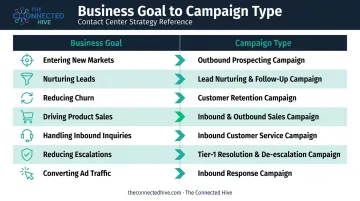
Once you've matched your goal to a campaign type, four factors determine whether that choice will actually work for your business:
- Warm campaigns require a usable prospect database; cold campaigns require rigorous list validation before launch
- Acquisition and retention campaigns have fundamentally different structures — using the wrong one for an existing customer base is a common and costly mistake
- Healthcare, insurance, and financial services face HIPAA, PCI, and state telemarketing laws that directly constrain campaign design
- Inbound sales and warm qualification campaigns typically deliver faster ROI than cold outreach, which requires higher volume to produce equivalent results
For businesses in regulated industries, compliance requirements alone can eliminate several campaign options before planning even begins. The Connected Hive works with companies to assess these constraints upfront, then connects them with contact center partners who already have documented experience in that specific campaign type and industry — at no cost to the client.
Best Practices to Create a Successful Call Center Campaign
Build the Foundation Before You Launch
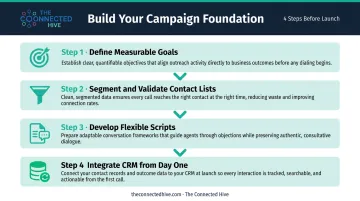
Four steps that determine whether a campaign succeeds or stalls:
- Define measurable goals first — not "improve sales" but "achieve a 4% conversion rate on 10,000 dials over 8 weeks"
- Segment and validate contact lists — wasted dials are a cost center, not a strategy
- Develop scripts with flexibility built in — rigid scripts fail at objection-handling; give agents structure with room to adapt
- Integrate your CRM from day one — every interaction needs to be documented and actionable for the next touchpoint
Technology and Tracking
Every campaign needs a baseline technology stack in place before launch:
- Reliable dialer system
- Call recording
- IVR (interactive voice response)
- ACD routing
How managers actually use that data is where campaigns separate. McKinsey notes that manual QA typically reviews less than 5% of calls — a gap that voice analytics can close by surfacing patterns across the full call population rather than a thin sample. Real-time KPI monitoring and call recording reviews should drive agent coaching decisions, not intuition.
Launch and Iterate
That data becomes most valuable in the first two weeks after launch — before bad patterns calcify. Use it to drive:
- Script refinements based on where calls stall or convert
- List adjustments based on contact rates and quality
- Agent coaching based on recorded call reviews
Campaigns with regular performance reviews consistently outperform those that run unchanged from launch. Set a weekly review cadence before the campaign begins, not after the first month of underperformance.
Conclusion
Each of the seven campaign types covered here serves a distinct purpose. None is universally best. The right choice depends on honest alignment between your business goals, your customer data quality, and your operational readiness.
Picking the wrong campaign type doesn't just miss targets — it burns budget and agent capacity solving the wrong problem entirely.
If you're not sure which campaign type fits your objectives, or you need a vetted contact center partner with proven experience in your industry, The Connected Hive can help. The firm acts as a no-cost strategic intermediary, matching businesses with vetted contact center partners from a network of 3,500+ US-based and 8,000+ global providers — backed by 20 years of BPO industry relationships. Reach out directly at +1 952-500-0806 or visit theconnectedhive.com to get matched with the right solution.
Frequently Asked Questions
What are call center campaigns?
Call center campaigns are structured, goal-specific programs where agents make or receive calls to achieve a defined business outcome, such as generating leads, closing sales, resolving support issues, or retaining customers. They differ from routine call handling through defined timelines, targeted scripts, and measurable KPIs.
What are some examples of call center campaigns?
Common examples include cold lead outreach, warm lead qualification, customer win-back programs, inbound customer service campaigns, and technical support campaigns — plus industry-specific programs like open enrollment in healthcare and compliance-driven telemarketing in financial services.
Which campaign is best for call centers?
The right campaign depends on your business goals, industry, and where customers are in their lifecycle. Outbound telemarketing suits lead generation and product promotion; inbound sales campaigns work best when marketing is already driving motivated traffic.
What is the 80/20 rule in a call center?
The 80/20 rule refers to the service level standard of answering 80% of inbound calls within 20 seconds — a widely used benchmark for measuring responsiveness and staffing adequacy. Some organizations use stricter targets (90/10), and the right standard varies by contact type and business objective.
What is the difference between inbound and outbound call center campaigns?
Outbound campaigns involve agents initiating calls to prospects or customers for sales, surveys, or follow-ups. Inbound campaigns involve agents receiving calls driven by customer need or marketing activity. Each requires different staffing models, technology setups, and success metrics.
How do you measure the success of a call center campaign?
KPIs depend on campaign type — and must be defined before launch to enable meaningful optimization:
- Outbound sales: conversion rate, cost per lead
- Customer service: first-call resolution, CSAT
- Inbound support: abandon rate, average handle time