This article cuts through the noise. Whether you're scaling a contact center for the first time or replacing a partner that isn't delivering, these are the concrete, operational reasons why businesses choose to outsource — and what separates a partnership that compounds value from one that quietly costs more than it saves.
Key Takeaways
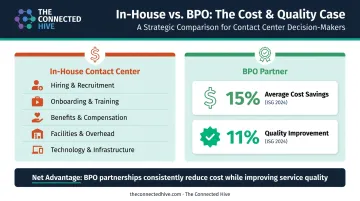
- ISG's 2024 study found BPO delivers 15% average cost savings and 11% quality improvement over in-house operations
- 92% of C-suite leaders cite access to specialized expertise as a key outsourcing motivator (Wipfli 2024)
- Outsourcing enables rapid scaling during peak demand without permanent headcount changes
- Unstructured partner selection creates compliance gaps, service inconsistency, and costs that quietly outpace any savings
- A vetted BPO consultant shortens the selection process and increases the odds of landing the right partner on the first attempt
What Is an Outsourcing Partner?
An outsourcing partner is a third-party organization contracted to handle specific business functions — contact center operations, customer support, claims processing, back-office tasks — on behalf of your company. These are typically functions that are operationally intensive but not central to your primary revenue activity.
Unlike a transactional vendor, a true outsourcing partner operates under shared accountability — with defined service standards and outcomes tied directly to your business goals. The relationship is built to last, not to be set and forgotten.
At The Connected Hive, founder Tim Austrums describes the engagement philosophy as network expansion, not traditional outsourcing — meaning clients gain access to a curated network of vetted partners rather than a single contracted vendor. Cultural fit, shared values, and measurable performance are part of the evaluation from the start.
Top 10 Reasons to Choose an Outsourcing Partner
Each reason below ties directly to cost, quality, risk, or growth. These are operational outcomes backed by research and industry practice — not aspirational talking points.
Reason 1: Significant Cost Savings Without Sacrificing Quality
Maintaining an in-house contact center means absorbing the full cost of hiring, onboarding, benefits, facilities, and technology — costs that compound quickly at scale.
According to ISG's 2024 study of 368 BPO decision-makers, enterprises save an average of 15% with BPO compared to in-house operations — while also achieving an 11% improvement in quality performance. Savings come not from cutting corners, but from specialization, economies of scale, and purpose-built processes.
KPIs most impacted:
- Cost per contact
- Cost per hire
- Total cost of ownership
- Labor spend as a percentage of revenue
- Agent attrition costs
Cost impact is highest when businesses are scaling customer support, entering new markets, or managing predictable high-volume seasonal demand — exactly the scenarios where in-house teams buckle under overhead.
Reason 2: Access to Specialized Expertise and Industry Knowledge
Building genuine domain expertise in healthcare enrollment, insurance claims, financial services compliance, or government program support takes years. An experienced outsourcing partner brings it pre-built.
Wipfli's 2024 survey of 360 C-suite leaders found that 92% rated access to expertise as an important factor in their outsourcing decision. In regulated industries, that expertise gap isn't just a service quality issue — it's a compliance and reputational risk.
KPIs most impacted:
- First call resolution (FCR) rate
- Average handle time (AHT)
- Customer satisfaction score (CSAT)
- Net promoter score (NPS)
- Agent quality scores
The expertise advantage is most pronounced in healthcare, insurance, and financial services, where knowledge gaps directly affect resolution quality and regulatory standing. The Connected Hive holds active membership in HIMSS and PACE — industry associations that keep its partner vetting current with healthcare and contact center standards.
Reason 3: Regulatory Compliance and Risk Management
Contact center environments routinely handle protected health information (PHI), financial records, and payment data. Compliance with HIPAA, PCI DSS, and related frameworks isn't optional — and building that compliance infrastructure in-house is costly and complex.
A qualified outsourcing partner maintains trained agents, secure systems, documented protocols, and audit-ready processes. The alternative carries serious financial exposure: IBM's 2025 Cost of a Data Breach report puts the average healthcare industry breach cost at $7.42 million — the highest of any industry for the 14th consecutive year.
KPIs most impacted:
- Compliance audit pass rates
- Data breach incident rates
- Regulatory penalty exposure
- SLA adherence
- Security incident response time
For healthcare, insurance, and financial services — the sectors where contact centers handle the most sensitive data — compliance risk is the reason partner vetting cannot be informal. The Connected Hive's evaluation process includes HIPAA and PCI DSS compliance assessment for every partner in its network, drawing on Tim Austrums' two decades of regulated-industry experience.
Reason 4: Scalability to Meet Changing Business Demands
One of the most persistent frustrations in in-house contact center management: you can't hire fast enough for a surge, and you can't justify the headcount when volume drops.
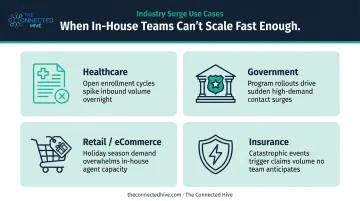
Outsourcing partners solve this structurally. They maintain trained agent pools and flexible staffing models that allow rapid ramp-up — particularly valuable for:
- Healthcare open enrollment cycles
- Government program rollouts
- Retail and eCommerce holiday seasons
- Insurance claims surges following catastrophic events
The 1-800-MEDICARE contact center — operated by a contracted provider — handled more than 640,000 calls on a single day in May 2006, 58% more than any previous operational period. That kind of surge absorption isn't possible without a partner infrastructure built for it.
Reason 5: Freedom to Focus on Core Business Functions
Every hour your internal leadership spends managing contact center operations is an hour not spent on product development, client relationships, or growth strategy.
The Wipfli 2024 survey found that 86% of C-suite leaders cited "allows us to focus on core functions" as an important outsourcing motivator. That reallocation of leadership attention is a real competitive input, not a soft benefit.
For businesses where customer support is genuinely operationally intensive but not a core revenue driver, outsourcing creates the bandwidth to compete where it actually matters.
Reason 6: Business Continuity and Operational Stability
What happens when three agents call out sick during peak volume? Or when your contact center building loses power for 48 hours? For in-house operations, those scenarios become crises.
An outsourcing partner absorbs that operational pressure as part of the service relationship. Their staffing pipeline, redundant infrastructure, and geographic distribution mean your customers' experience doesn't degrade when your internal situation deteriorates.
Agent attrition is a particular concern in contact centers. When you outsource, the partner manages recruiting, onboarding, and retention — you're insulated from the daily volatility of turnover.
Continuity risks managed by outsourcing partners:
- Unplanned agent absences during peak periods
- Facility outages and technology failures
- High-turnover disruption to service quality
- Geographic concentration risk
Reason 7: Enhanced Customer Experience and Satisfaction
Specialized contact center partners invest in agent training, quality assurance frameworks, and customer experience tools as their core business — not a secondary function. That creates a higher baseline of service quality than most in-house generalist teams achieve.
The ISG 2024 study found an 11% average improvement in quality performance under BPO versus in-house operations. The downstream benefits are measurable:
- Higher CSAT scores
- Lower repeat contact rates
- Stronger brand perception
- Reduced escalation volume
When customer experience is managed by a team whose entire operation is optimized around it, the outcomes reflect that focus.
Reason 8: Access to Advanced Technology Without Capital Investment
Building a modern contact center technology stack — omnichannel platforms, AI-assisted agent tools, workforce management systems, CRM integrations — requires significant capital and ongoing maintenance. Most businesses aren't positioned to do it well independently.
Established BPO partners operate with purpose-built technology infrastructure as part of their service model. Clients access it without the upfront investment.
Gartner's 2024 research found that 85% of customer service leaders planned to explore or pilot customer-facing conversational GenAI in 2025. Partners who are already operating at that technology level give clients immediate access to capabilities that would take months and significant spend to replicate in-house.
The Connected Hive evaluates technology stack depth as part of its partner matching process — including CCaaS platforms, IVR systems, AI tooling, and WFM compatibility — to ensure partners can meet each client's specific infrastructure needs.
Reason 9: Operational Efficiency Through Process Specialization
Outsourcing partners have refined their workflows through handling high interaction volumes across multiple clients. The result: documented, repeatable processes that reduce error rates, improve consistency, and eliminate inefficiencies that build up in internal operations over time.
This operational maturity translates directly to:
- Faster onboarding for new programs
- Reduced agent ramp time
- More predictable service delivery from day one
- Lower defect rates in back-office processing
An in-house team builds process knowledge slowly and often informally. A specialized partner arrives with it already systematized.
Reason 10: Competitive Agility and Market Responsiveness
Businesses with established outsourcing partnerships can respond to market changes faster — launching new programs, expanding support hours, entering new service lines — without the lead time required to build internal capacity from scratch.
That speed translates to competitive positioning. Companies that can scale and adapt their customer-facing operations quickly are better positioned to capture market opportunities and respond to disruption before competitors do.
ISG's 2024 research confirms that companies are actively accelerating contact center outsourcing contracts and GenAI adoption specifically to improve customer experience and competitive responsiveness. The infrastructure to move fast doesn't appear when you need it — it has to already be in place.
What Happens When You Skip Structured Partner Selection
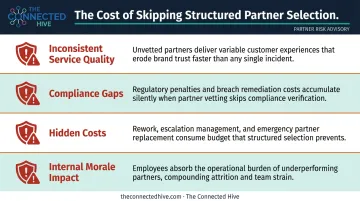
Choosing an outsourcing partner without a structured evaluation process consistently produces the same categories of failure: the partner lacks the specific expertise, compliance posture, or scalability your industry and volume require.
When that mismatch surfaces, the fallout is rarely contained to one area:
- Inconsistent service quality erodes customer trust and brand reputation before you've had a chance to course-correct
- Compliance gaps create regulatory exposure — particularly costly in healthcare, insurance, and financial services where penalties and breach costs run into the millions
- Hidden costs from rework, escalations, and partner replacement offset the original cost savings rationale — sometimes entirely
- Internal team morale suffers when employees are asked to compensate for an underperforming partner
Gartner's research on outsourcing exit strategies confirms that a poorly executed outsourcing relationship harms customer experience, budget, yield, and business continuity simultaneously. The damage extends beyond budget exposure to client retention and regulatory standing.
That outcome profile makes the Wipfli 2024 data on selection criteria worth examining: 89% of leaders prioritized industry experience, and 84% prioritized data privacy and security practices when choosing a partner. Neither criterion can be verified through a vendor's marketing materials alone — both require a structured evaluation with defined criteria, site audits, and documented evidence.
How to Get the Most Value from Your Outsourcing Partner
Outsourcing delivers compounding value when it's treated as a strategic partnership — not a vendor transaction you set up and step back from.
The foundational elements:
- Define KPIs before you sign — cost per contact, FCR targets, CSAT benchmarks, SLA thresholds. If it isn't measured, it won't be managed
- Run a structured pilot phase before full program rollout — route a defined subset of volume to the partner, monitor against pre-agreed metrics, and adjust before scaling
- Build in regular performance reviews — quarterly at minimum, with open two-way communication that allows the partner to adapt as your business evolves
- Align on culture and brand standards from the start — the best contact center partners function as an extension of your brand, not a separate operation
That last point — getting the selection right — is where many businesses struggle most. For companies evaluating multiple BPO options or navigating outsourcing for the first time, the complexity of the process is itself a significant risk.
That's the problem The Connected Hive was built to solve. Tim Austrums and his team conduct a full needs assessment covering volume, compliance requirements, geographic preferences, technology needs, and cultural fit, then draw on a network of 3,500+ domestic and 8,000+ global contact centers to identify the strongest-matched partners. The process includes RFP/RFI development, site visit audits, and pilot project structuring — and is typically provided at no cost to the client, as the placed partner covers the fee.

Frequently Asked Questions
What is an outsourcing partner?
An outsourcing partner is a third-party organization contracted to perform specific business functions — such as contact center operations, customer support, or back-office processing — on the client's behalf. This lets companies access specialized expertise without building those capabilities in-house.
How do I find outsourcing partners?
Businesses can identify partners through industry associations, referrals, B2B review platforms, and BPO consultants. Working with a consultant who maintains a vetted partner network — like The Connected Hive's 3,500+ domestic and 8,000+ global providers — reduces evaluation time and partner-match risk.
What is an example of outsourcing?
A healthcare insurance company outsourcing its member enrollment and customer service calls to a HIPAA-compliant contact center partner, enabling faster scaling during open enrollment while maintaining compliance and service quality.
Is outsourcing illegal in the US?
Outsourcing is entirely legal in the US, both domestically and internationally, and is widely practiced across healthcare, financial services, government, and retail. Specific compliance obligations — like HIPAA or PCI DSS — apply to the work being outsourced, not to outsourcing itself.
How much can a business save by outsourcing its contact center?
ISG's 2024 study found an average of 15% savings compared to in-house operations, with quality performance improving by 11%. Those savings come from lower labor overhead, eliminated technology capital costs, and the efficiencies that come from running high-volume operations daily.
What should I look for when choosing a contact center outsourcing partner?
Key criteria: proven industry experience in your sector, compliance certifications relevant to your data environment (HIPAA, PCI DSS), demonstrated scalability, transparent SLAs, and cultural alignment with your brand. A BPO consultant can evaluate these systematically and negotiate terms on your behalf.