Outsourcing has evolved well beyond a cost-cutting tactic. The global BPO market was valued at $328.4 billion in 2025 and is projected to nearly double by 2033, reflecting how deeply embedded this model has become across industries.
This post breaks down 15 real-world examples of companies that have outsourced key functions — and what any business can learn from their approach.
Key Takeaways
- Outsourcing works across industries and company sizes — from tech startups to global manufacturers
- The most commonly outsourced functions include IT, customer service, manufacturing, HR, and finance
- The biggest gains come from specialized expertise and operational flexibility, not cost savings alone
- Choosing a partner based on cost alone is the leading cause of outsourcing failures
What Is Business Outsourcing?
Outsourcing means contracting an external third party to handle business functions previously managed in-house — either on an ongoing basis or for a specific project.
Business Process Outsourcing (BPO) typically covers standardized, recurring processes like payroll, customer service, or claims handling. General outsourcing can also include specialized or project-based work, such as software development or manufacturing.
Three geographic models apply:
- Onshore — provider in the same country
- Nearshore — provider in a neighboring country
- Offshore — provider in a more distant country
Why Companies Choose to Outsource
According to Deloitte's 2024 Global Outsourcing Survey, 80% of executives planned to maintain or increase investment in third-party outsourcing — with skilled talent access and operational agility joining cost reduction as the primary drivers.
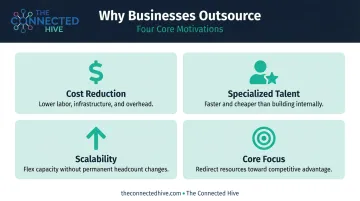
The four core motivations that drive outsourcing decisions across industries:
- Cost reduction — labor, infrastructure, and overhead
- Access to specialized talent — faster and cheaper than building internally
- Scalability — flex capacity without permanent headcount changes
- Core focus — redirect internal resources toward competitive advantage
Each of the 15 companies below made outsourcing work for a different reason — and the specifics reveal more than any general framework can.
15 Companies That Successfully Outsource
These companies span technology, financial services, healthcare, manufacturing, and retail. Each has used outsourcing strategically to grow — not just to cut costs.
Tech & IT Companies
As of March 2019, Google had approximately 121,000 contractors and temps versus 102,000 direct employees — a ratio of roughly 1.2 contractors for every employee. Verified outsourced functions include content moderation and software testing. This model allows Google to scale technical capacity globally without equivalent growth in permanent headcount, keeping internal teams focused on core product development.
Apple
Apple outsources the assembly of its core hardware products to large-scale contract manufacturers. Foxconn and Tata are among its primary partners, with Apple's supplier network spanning thousands of facilities across more than 60 countries — representing 98% of direct spending on materials, manufacturing, and assembly. This eliminates massive capital expenditure on factories while freeing Apple's internal teams to focus on product design, software, and user experience.
Before becoming a household name, WhatsApp's first iOS engineer started as a contractor in 2009. This lean, outsourced approach allowed a small founding team to build a globally scalable product quickly — laying the technical groundwork that supported its eventual acquisition by Facebook for approximately $19 billion.
Slack
Slack approached design firm MetaLab with a rough, working prototype. MetaLab transformed it into a polished, market-ready product — handling interface design, branding, and the marketing site. That single outsourcing decision helped Slack reach market far faster than an in-house build would have allowed.
Facebook / Meta
Meta outsources content moderation across its platforms to third-party firms. By 2019, approximately 15,000 content reviewers worldwide were working under this model, with named providers including Cognizant and Genpact. This allows Meta to manage enormous volumes of content without proportionally expanding its internal headcount, while keeping its core teams focused on platform development.
Financial Services Companies
Financial services companies outsource extensively — high volumes of recurring, compliance-heavy processes make them well-suited to specialized third-party providers.
American Express
American Express maintains significant operations in New Delhi, handling financial processing and customer service functions. The model demonstrates how long-term, strategically managed outsourcing partnerships can deliver sustained operational value across a global financial services business.
Wells Fargo
Wells Fargo has moved portions of its operations offshore, including work in its institutional retirement division outsourced to India and the Philippines. The company describes these markets as part of its global delivery strategy spanning business operations, corporate functions, technology, and customer service — enabling broad coverage at competitive cost structures.
Procter & Gamble
In 2003, P&G entered outsourcing partnerships totaling approximately $4.2 billion, delegating IT infrastructure, finance and accounting, HR, and facilities management to major service providers. Key components included a reported $3 billion IT agreement with HP and a $400 million HR agreement with IBM. The result was a leaner global business services structure with reduced overhead across its international operations.
Healthcare & Pharma Companies
Healthcare and pharma companies face both high operational complexity and strict regulatory requirements — making outsourcing a strategic tool for managing scale and compliance without overextending internal teams.
Partner vetting matters here more than in most sectors — HIPAA and PCI compliance requirements add a layer of scrutiny that goes well beyond standard vendor selection.
Pfizer
During the COVID-19 vaccine rollout, Pfizer outsourced manufacturing functions to more than 20 contract manufacturing organizations across four continents, producing over 3 billion doses in 2021. Shifting other drug production externally freed internal capacity for vaccine manufacturing — and the model built on Pfizer's existing practice of using contract manufacturing well before the pandemic.
UnitedHealth Group
UnitedHealth Group manages healthcare technology delivery through its Optum subsidiary, which handles electronic health records infrastructure, analytics, and digital health operations at enterprise scale. The structure shows how large healthcare organizations use dedicated specialized divisions to run complex technical functions that would otherwise require massive third-party coordination.
Manufacturing & Retail Companies
For manufacturing and retail companies, outsourcing production is often what makes a global footprint possible at all — eliminating the capital burden of owning facilities while enabling rapid scaling.
Nike
Nike contracts nearly all of its footwear and apparel manufacturing outside the United States through 15 primary footwear contract manufacturers. By not owning factories, Nike can shift production volume based on demand, minimize capital lock-in, and maintain competitive pricing — while concentrating all internal resources on brand, design, and distribution.
H&M
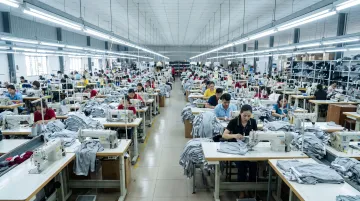
H&M does not own any of its production facilities. Instead, it works with independent manufacturers across 47 countries, with these disclosed factories accounting for 99% of products sold. This outsourced manufacturing model gives H&M the flexibility to respond rapidly to fashion trends and seasonal demand without the overhead of permanent factory infrastructure.
Enterprise Services & BPO Leaders
Some of the most prominent outsourcing examples come from companies that are themselves in the business of providing outsourced services — reflecting the depth and maturity of the BPO ecosystem.
IBM
IBM serves as a major IT outsourcing provider to enterprises globally — including a multi-year agreement to manage mainframe, storage, and related infrastructure for ACI Worldwide. IBM's role as a large-scale outsourcing provider reflects how embedded this model has become across enterprise technology operations.
Accenture
Accenture operates across 52 countries and serves clients in more than 120, providing supply chain outsourcing and IT consulting services globally. The firm builds outsourced solutions for clients across banking, healthcare, and government — a scale that shows just how institutionalized specialized outsourcing has become across regulated industries.
Alibaba
Alibaba routes customer service across its global marketplace through outsourced support operations, covering multilingual inquiries across dozens of time zones. Rather than staffing proportionally to transaction volume, the company uses third-party partners to maintain coverage without equivalent headcount growth — a model common among high-volume eCommerce platforms.
Why Do Successful Companies Outsource?
Four drivers appear consistently across all 15 examples:
| Driver | What It Means in Practice |
|---|---|
| Cost reduction | Lower labor, infrastructure, and overhead costs |
| Specialized talent | Access to expertise that's expensive or slow to build internally |
| Scalability | Flex capacity without permanent hiring or layoffs |
| Core focus | Free internal teams to work on what drives competitive advantage |
The most effective outsourcing decisions follow a clear pattern: the function being outsourced is non-core to competitive differentiation, and the external provider delivers it better — through deeper expertise, stronger infrastructure, or lower cost — than an internal team realistically could.
The risk rises when companies outsource functions central to their competitive identity — proprietary product development, high-touch customer strategy, or core IP. Apple outsources assembly but not design. Nike outsources manufacturing but not brand. Knowing which category a function falls into is the decision that separates successful outsourcing from costly mistakes.
What Can Your Business Learn From These Examples?
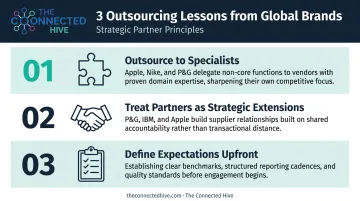
Three patterns emerge across all 15 cases:
Outsource to specialists what you cannot do as efficiently in-house — Apple, Nike, and P&G didn't outsource because they couldn't figure out manufacturing. They outsourced because external specialists could do it better, faster, and cheaper.
Treat outsourced partners as strategic extensions of your team. P&G's decade-long IBM relationship and Apple's supplier network both endure because they're built on genuine partnership, not transactional vendor management.
Define clear expectations before the engagement begins — Performance benchmarks, reporting schedules, and quality standards set upfront prevent the drift that derails outsourcing relationships over time.
How to Choose the Right Outsourcing Partner
This is where most outsourcing initiatives fail. Selecting a partner based on cost alone — without vetting expertise, cultural alignment, compliance capability, or track record — is a leading cause of poor outcomes. For businesses in regulated industries like healthcare or financial services, a partner that can't meet HIPAA or PCI-DSS requirements isn't a bargain at any price.
Before committing, due diligence should cover:
- Industry-specific expertise and certifications
- Compliance posture (HIPAA, PCI, GDPR where applicable)
- References from similar clients
- Cultural and communication alignment
- Clearly defined service level agreements
For businesses working through contact center or BPO outsourcing decisions, The Connected Hive offers advisory support — including partner vetting, needs assessment, and compliance alignment for HIPAA and PCI environments — typically at no cost to the client.
Conclusion
From Google to Nike to Pfizer, the 15 companies covered here share a common thread: they outsource functions that specialists can do better, so their internal teams can focus on what they do best. Done thoughtfully, outsourcing reduces costs, accelerates growth, and raises service quality — without sacrificing control over what matters most to your business.
If you're exploring outsourcing for your customer service or contact center operations — or simply want guidance on which functions to outsource and how to select the right partner — connect with The Connected Hive for a personalized consultation grounded in 20+ years of BPO industry expertise.
Frequently Asked Questions
What is outsourcing in simple words?
Outsourcing means hiring an external company or contractor to handle tasks that were previously managed in-house — typically to reduce costs, access specialized expertise, or improve efficiency where an outside provider can outperform an internal team.
What are the most commonly outsourced jobs?
The most frequently outsourced functions include IT support and software development, customer service and call center operations, payroll and HR administration, manufacturing, marketing and content creation, and accounting and bookkeeping.
What is the difference between outsourcing and offshoring?
Outsourcing refers to contracting any external provider, regardless of location. Offshoring specifically means relocating an operation to another country. A company can do both simultaneously — for example, outsourcing customer service to a third-party firm based overseas.
What should companies not outsource?
Functions core to competitive differentiation — strategic planning, proprietary product development, and high-touch customer relationships — are generally not suited to outsourcing. Functions involving sensitive data in regulated industries also require especially careful vetting of any external partner.
How do you choose the right outsourcing partner?
Evaluate partners on industry-specific expertise, compliance capability (HIPAA, PCI, and similar standards where relevant), proven track record with similar clients, cultural and communication alignment, and clearly defined service level agreements. Cost matters, but it should never be the deciding factor on its own.