The problem isn't just confusion. Without fluency in this vocabulary, you can't evaluate vendor proposals critically, negotiate SLA terms effectively, or spot gaps in a partner's compliance posture before signing anything.
This glossary is organized by category — roles, operations, metrics, technology, and outsourcing — rather than alphabetically, so you can focus on the areas most relevant to your current business needs. Whether you're evaluating your first BPO partner or renegotiating an existing contract, these definitions will help you engage as an informed buyer.
Key Takeaways
- A contact center manages multiple channels (phone, email, chat, SMS); a call center handles voice only — a critical distinction when evaluating vendor capabilities.
- AHT, FCR, CSAT, and ASA are the benchmarks vendors quote in proposals — know them well enough to negotiate, not just nod along.
- ACD, IVR, VoIP, and CRM are the core systems your outsourced partner runs on, and their integration quality shapes every caller's experience.
- HIPAA and PCI-DSS compliance are non-negotiable in healthcare and financial services — verify certifications before you sign any contract.
- BPO, SLA, and RFP govern every outsourcing relationship — understanding them is the difference between a well-structured deal and an expensive mistake.
People & Roles: Who Works in a Call Center
Customer-Facing Roles
Common customer-facing roles include:
- Agent / Customer Service Representative (CSR) — Frontline employee handling inbound and outbound contacts
- Blended Agent — Handles both inbound and outbound simultaneously, switching based on volume and availability
- Brand Specialist — An internal or marketing designation used by some organizations to signal a customer-advocacy mindset rather than a transactional one; not a standardized industry title
These titles are often used interchangeably across vendors. When evaluating a partner, ask how they define and train each role. The title is less telling than the actual job description and training model behind it.
Supervisory and Quality Roles
Three roles sit above the agent level in most centers:
- Call Center Manager — Oversees operations, staffing levels, and performance goals across the floor
- Coach or Team Lead — Provides real-time guidance, monitors live interactions, and delivers feedback
- Quality Assurance (QA) Analyst — Reviews recorded or live interactions against defined standards to identify coaching opportunities and flag compliance issues
Workforce Planning
The Workforce Management (WFM) Analyst handles forecasting, scheduling, and real-time staffing adjustments. In smaller centers, one person may cover all these functions. Larger BPO environments dedicate entire teams to WFM. Ask any vendor how their WFM function is resourced — it's one of the clearest indicators of how consistently they'll hit service level targets.
Call Flow & Operations Terms You Need to Know
Inbound vs. Outbound Call Terminology
Inbound calls are contacts initiated by the customer — seeking support, billing help, or product information. This is the primary model for customer service centers.
Outbound calls are initiated by agents, used for sales campaigns, follow-ups, surveys, or collections.
Call Blending is the practice of routing agents to handle both inbound and outbound contacts dynamically, based on live volume and availability. Blended operations can improve efficiency but require careful management to avoid degrading service on either channel.
Key inbound volume metrics to track:
- Abandoned Call — A call where the customer disconnects before reaching an agent, typically due to excessive wait times
- Abandonment Rate — Abandoned calls divided by total calls offered, expressed as a percentage. According to ContactBabel's 2024 US Contact Center Decision-Makers' Guide, the 2023 US average abandonment rate was 7.1%. High abandonment rates usually point to understaffing or poor IVR design.
Call Handling & Queue Management Terms
A Queue is the virtual waiting line holding calls until an agent is available. Most ACD systems allow queues to play hold music, estimated wait times, or informational messages while customers wait.
Callback lets customers leave their number and receive a return call rather than waiting on hold. ContactBabel found that 51% of US centers offered queue callback in 2023 — a feature callers now regularly expect.
Two time-based metrics that appear in nearly every vendor proposal:
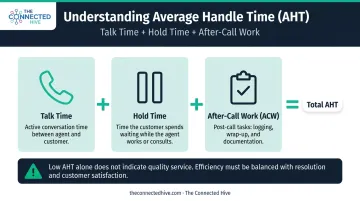
- Average Handle Time (AHT) — Total time per interaction: Talk Time + Hold Time + After-Call Work. A low AHT isn't automatically good — it can signal rushed or unresolved interactions.
- After-Call Work (ACW) — Also called wrap-up time, this is the time agents spend logging notes, updating CRM records, and submitting forms after a call ends. ACW is factored into scheduling and is a component of AHT.
Essential Performance Metrics & KPIs
Efficiency Metrics
Average Speed of Answer (ASA) measures the average time in seconds for an inbound call to be answered by an agent. The 2023 US average was 79 seconds, per ContactBabel's research.
Service Level (SL) is the industry-standard benchmark expressing the percentage of calls answered within a defined time threshold. The most cited target is 80/20 — 80% of calls answered within 20 seconds. This is a convention, not a universal standard. Some industries and contracts target tighter thresholds. ASA and Service Level are typically the first benchmarks specified in any SLA.
First Call Resolution (FCR) measures the percentage of contacts resolved without any follow-up required. SQM Group's 2024 benchmark research places the cross-industry average at 69%, with 80%+ considered world class.
FCR is a strong indicator of overall service quality: unresolved calls drive repeat contacts, increase costs, and depress satisfaction scores.
Shrinkage is the percentage of paid agent time unavailable for contact handling — covering breaks, training, meetings, and unplanned absences. Vendors use shrinkage to calculate how many agents to schedule above the base requirement. Always ask how a vendor accounts for shrinkage in their pricing model.
Efficiency metrics tell you how fast a center operates. Customer experience metrics tell you whether that speed is translating into actual satisfaction.
Customer Experience Metrics
| Metric | What It Measures | Scale |
|---|---|---|
| CSAT (Customer Satisfaction Score) | Satisfaction with a specific interaction | % of positive responses |
| NPS (Net Promoter Score) | Likelihood to recommend the brand | -100 to +100 |
| CES (Customer Effort Score) | How hard the customer had to work to resolve their issue | Transaction-level rating |
| VOC (Voice of the Customer) | Structured capture of customer feedback and sentiment across channels | Program/process, not a single number |
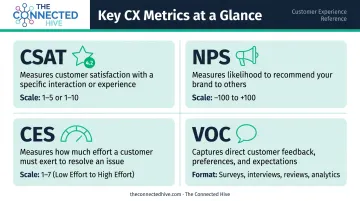
CES deserves particular attention. CEB's foundational research covering 97,000+ consumers found disloyalty among 96% of customers with high-effort interactions versus just 9% with low-effort ones. When evaluating contact center partners, ask how they measure and actively reduce customer effort — not just how often they resolve issues.
Technology & Systems Terminology
Core Infrastructure Terms
Automatic Call Distributor (ACD) — The telephony system that receives inbound calls and routes them to the appropriate agent or queue based on rules like skill set, availability, or call type. The ACD is the engine behind every queue and routing decision.
Interactive Voice Response (IVR) — The automated menu system callers interact with before reaching an agent, using keypad input or voice recognition to route calls and collect information. IVR design quality has a direct impact on abandonment rates and caller experience.
Voice over Internet Protocol (VoIP) — Transmits voice calls over the internet rather than traditional telephone lines, enabling flexibility and cost savings.
Private Branch Exchange (PBX) — A company's internal telephone switching system managing inbound and outbound call routing.
Computer Telephony Integration (CTI) — Connects phone systems with computer databases. The most visible application is the screen pop — caller information displayed to the agent before they answer. ContactBabel found screen pops in use at 48% of surveyed US centers.
CRM (Customer Relationship Management) System — The software platform storing customer interaction history, account details, and preferences. It's the agent's primary reference during a call. CRM-to-ACD/IVR integration directly determines how effectively agents can serve customers without switching systems — a critical factor when evaluating any outsourcing partner.
Automation & AI Terms
Three terms that dominate vendor conversations today:
- Chatbot — Automated text-based conversations using pre-programmed responses or AI, deployed as a first-line self-service tool
- Virtual Agent / Voicebot — AI-powered system allowing callers to interact using natural spoken language rather than keypad menus
- Natural Language Processing (NLP) — The AI field enabling computers to understand and interpret human language; the technology underlying modern voicebots and chatbots
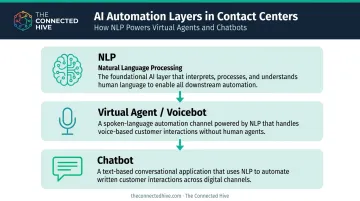
ContactBabel reports AI/ML deployed or actively being upgraded at 26% of surveyed US centers, with 51% planning implementation. For most businesses evaluating partners, this is already standard infrastructure, not a future-state aspiration.
Speech Analytics — Analyzes recorded or live calls for keywords, sentiment, compliance flags, and coaching opportunities.
WFM (Workforce Management) Software — Handles forecasting, scheduling, and real-time adherence monitoring; essential for managing staffing costs and hitting service level targets consistently.
Outsourcing, Compliance & Vendor Selection Terms
BPO and Outsourcing Models
Business Process Outsourcing (BPO) is the practice of contracting a third-party vendor to manage a business function (in this context, customer contact operations including inbound support, outbound sales, or back-office processing). The global BPO market was valued at $328.4 billion in 2025, forecasted to nearly double by 2033.
The four primary outsourcing models each involve different cost, quality, and compliance tradeoffs:
| Model | Definition | Best For |
|---|---|---|
| Onshoring | Domestic (same-country) delivery | Compliance-sensitive programs, cultural alignment |
| Nearshoring | Neighboring country (e.g., Latin America) | Balance of cost and proximity; minimal time zone gaps |
| Offshoring | Distant country (e.g., Philippines, India) | Maximum cost reduction; 24/7 coverage |
| Homeshoring | Remote agents within the same country | Domestic talent access without physical facility costs |
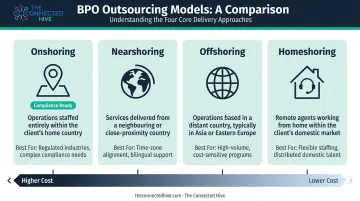
Choosing the right model requires evaluating more than just cost. Compliance requirements (particularly HIPAA and PCI-DSS) can restrict which geographic models are viable for healthcare or financial services programs.
This is where advisory expertise matters. The Connected Hive, founded by Tim Austrums, guides businesses through model selection using a structured needs assessment covering interaction volume, compliance mandates, cultural alignment, and scalability.
With a vetted network of 3,500+ domestic US contact centers and 8,000+ globally (including partners in Latin America, the Philippines, India, and Eastern Europe), the goal is matching the right model to each client's specific operational profile. The advisory service is typically provided at no cost to the buyer; the selected BPO partner funds the engagement.
RFPs, SLAs, and Compliance Terms
Once a model is selected, the next step is formalizing the vendor relationship — and the documents below define how that relationship performs.
Request for Proposal (RFP) — the formal document businesses issue to call center vendors requesting detailed proposals covering capabilities, staffing models, technology, pricing, and references. A well-structured RFP should explicitly address compliance requirements, technology integration expectations, and KPI benchmarks upfront. Businesses without expert guidance frequently underspecify these areas, leaving gaps that surface after signing.
Service Level Agreement (SLA) — the binding contract defining the performance standards a vendor must meet, including specific metrics, reporting requirements, and remedies for non-performance. SLA gaps (such as vague KPI definitions or missing penalty provisions) are among the most common sources of vendor disputes. Both documents require precise terminology fluency to evaluate and negotiate effectively.
HIPAA (Health Insurance Portability and Accountability Act) — federal regulation governing the privacy and security of protected health information. Any call center handling healthcare-related contacts (including subcontractors) falls within HIPAA's business associate framework. Covered entities and their BPO partners must execute Business Associate Agreements (BAAs) with required safeguards and flow-down obligations.
PCI-DSS (Payment Card Industry Data Security Standard) — the security standard required for any organization handling credit card transactions. Per the PCI Security Standards Council, spoken card data places contact center people, processes, call recordings, VoIP systems, and connected infrastructure in scope. Sensitive authentication data cannot be stored after authorization.
For businesses in healthcare, insurance, and financial services, compliance verification cannot be a late-stage checkbox.
Tim Austrums' experience working with Humana, Blue Cross/Blue Shield, Discover, and government agencies like FEMA has reinforced one consistent pattern: compliance gaps in vendor infrastructure show up after contracts are signed, not during selection. The Connected Hive's partner vetting process includes compliance verification at every stage — because fixing it post-signature costs far more than getting it right upfront.
Frequently Asked Questions
What are the 5 key performance indicators (KPIs) for a call center?
The most widely tracked KPIs are FCR, AHT, CSAT, ASA, and Service Level. The right ones to prioritize depend on program focus — efficiency-driven operations weight AHT and ASA heavily, while customer experience programs emphasize FCR and CSAT. ICMI's 2025 research also places abandonment rate and agent productivity in the top five measured metrics.
What is the 80/20 rule in a call center?
The 80/20 rule is a common service level benchmark: 80% of inbound calls answered within 20 seconds. It's a widely cited starting point, not a regulatory requirement — specific SLAs may target higher thresholds depending on industry, program type, and contract terms.
What is the difference between a call center and a contact center?
A call center handles voice calls exclusively. A contact center manages customer interactions across multiple channels — phone, email, live chat, social media, and SMS. Most modern operations are technically contact centers, even if they're still casually called call centers.
What is a synonym or "fancy" word for call center?
Common alternatives include contact center, customer engagement center, and customer experience center. "Contact center" is the most widely accepted industry term because it reflects multi-channel capabilities beyond voice.
What powerful words or phrases should be used in a call center?
High-impact agent language includes empathetic acknowledgment ("I understand how frustrating that must be"), ownership phrases ("I'll take care of that for you"), and resolution confirmation ("Is there anything else I can help you with today?"). Research consistently links this type of language to measurably higher customer satisfaction scores.
What does BPO stand for, and how is it different from outsourcing?
**BPO stands for Business Process Outsourcing**, where an entire business function (like customer service or back-office operations) is delegated to a third-party vendor. General outsourcing may supplement internal staff with contractors; BPO transfers ownership of the whole function.