Introduction
Most businesses handle both types of calls every day, yet surprisingly few have a clear strategy governing each. That gap costs money. It creates inconsistent customer experiences, misaligned staffing, and campaigns that underperform because the wrong model was applied to the wrong goal.
The distinction between inbound and outbound calls isn't just definitional. It determines how you hire agents, which technology you deploy, how you measure success, and whether compliance requirements apply before you make a single call.
What follows breaks down both models, identifies where each creates the most value by industry, and offers a practical framework for deciding which approach — or which combination — fits your goals.
Key Takeaways
- Inbound calls are customer-initiated and reactive, focused on support, resolution, and retention
- Outbound calls are business-initiated and proactive, focused on lead generation, sales, and research
- Each model requires distinct agent skills, technologies, and success metrics
- Most businesses benefit from a blended approach that combines both capabilities
- Choosing the wrong model or partner leads to wasted budget and poor customer experience
Inbound vs. Outbound Calls: Quick Comparison
Here's how the two call types stack up across the dimensions that matter most to operations and strategy:
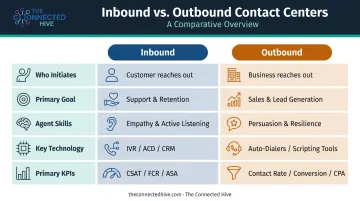
| Dimension | Inbound | Outbound |
|---|---|---|
| Who initiates | Customer calls the business | Business calls customers or prospects |
| Primary goal | Support, resolution, retention | Sales, lead generation, research |
| Agent skill focus | Empathy, active listening, problem-solving | Persuasion, resilience, rapport-building |
| Key technology | IVR, ACD systems, CRM | Auto-dialers, CRM, call scripting tools |
| Primary KPIs | CSAT, First Call Resolution, Average Speed of Answer | Contact Rate, Lead Conversion Rate, Cost per Acquisition |
Benchmark Reference Points
- FCR: ContactBabel's 2024 US Contact Center Decision-Makers' Guide measured a 75% mean First Call Resolution rate across 189 US contact center managers in 2023, with Average Speed of Answer at 79 seconds
- Outbound conversion: HubSpot's 2025 State of Cold Calling Report found 35% of regular cold callers hit conversion rates of 2–5%, while 10% exceeded 20%. Rates vary widely by list quality, offer type, and follow-up speed.
What Are Inbound Calls?
Inbound calls are initiated by customers or prospects reaching out to a business. They're reactive by nature — the caller has a need, a question, or a problem, and they're choosing to engage.
That reactive dynamic is what makes inbound operations central to customer retention. When someone calls with a billing issue or a coverage question, how that interaction goes determines whether they stay or leave.
Core Inbound Call Types
- Customer service and general inquiries — questions about products, services, policies, or accounts
- Technical support — troubleshooting issues, particularly common in SaaS and healthcare technology
- Billing and account management — payment questions, invoice disputes, plan changes
- Inbound sales — prospects calling after seeing an ad or visiting a website, often with higher purchase intent than outbound leads
- Appointment scheduling — especially prevalent in healthcare, where scheduling errors directly affect patient access
Why Voice Remains Essential
Phone preference isn't declining as fast as some predict. McKinsey's 2023 consumer survey found that 71% of Gen Z and 94% of Baby Boomers viewed live calls as the quickest and easiest way to reach customer care. For complex, high-stakes interactions — a denied insurance claim, a medication question, a disputed charge — voice remains the preferred channel.
That channel preference has a direct financial consequence: handling those calls well compounds quickly. SQM estimates that each 1-point improvement in First Call Resolution saves a typical midsize call center approximately $286,000 annually and raises interaction NPS by 1.4 points.
Inbound Challenges
Managing inbound volume is harder than it looks:
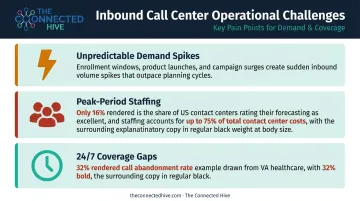
- Unpredictable demand spikes — open enrollment periods, product launches, and crises create sudden surges that overwhelm static staffing plans
- Peak-period staffing — ContactBabel found only 16% of US contact centers rated their long-term forecasting capability "excellent," while staffing represents up to 75% of operating costs
- 24/7 coverage gaps — a VA healthcare center handling 135,600 calls in a single quarter averaged 29 available staff against an estimated need of 53, producing 32% call abandonment in primary care and surgery queues
Use Cases by Industry
| Industry | Primary Inbound Functions |
|---|---|
| Healthcare | Member services, appointment scheduling, enrollment support, benefits inquiries (HIPAA compliance required) |
| Insurance | Claims inquiries, policy questions, coverage verification, renewal support |
| Financial services | Account management, transaction support, fraud inquiries (PCI DSS compliance applies to payment card calls) |
| Government | Citizen services, benefits eligibility, disaster response hotlines — FEMA and similar agencies require surge-ready capacity on short notice |
What Are Outbound Calls?
Outbound calls are placed by a business to reach current or prospective customers. They're proactive — the business has a specific objective, whether that's closing a sale, qualifying a lead, scheduling an appointment, or conducting a survey.
One distinction worth making early: cold calls go to contacts with no prior relationship, while warm calls follow up on existing engagement. Warm call performance tends to be significantly stronger. Research from InsideSales found that following up on a lead within five minutes produces conversion rates more than 8x higher than delayed outreach — a strong argument for building rapid-response outbound workflows around inbound lead activity.
Core Outbound Call Types
- Sell directly to prospective customers through telemarketing and telesales campaigns
- Identify and score prospects for the sales pipeline via lead generation and qualification
- Schedule meetings between prospects and sales or clinical staff through appointment setting
- Gather first-party data on preferences and satisfaction through market research and surveys
- Re-engage lapsed customers with follow-up calls, renewal reminders, and win-back outreach
Outbound Benefits
A structured outbound program can accelerate pipeline development faster than most inbound-only strategies. The proactive reach means you're not waiting for customers to discover you. For healthcare enrollment campaigns, insurance renewals, or financial services lead follow-up, outbound calling gives you direct access to decision-makers on your timeline.
That access matters most when timing is critical. Tim Austrums, founder of The Connected Hive, led outbound enrollment campaigns for Humana that required strategic agent training, HIPAA-compliant workflows, and the ability to adapt call approaches dynamically based on member segment and enrollment period pressure.
Outbound Challenges
- Compliance exposure — TCPA rules require prior express consent for automated or prerecorded calls; the FTC's National Do Not Call Registry held over 258 million active numbers in FY2025, with over 2.6 million DNC complaints filed that year
- Calling hour restrictions — FTC guidance limits covered outbound telemarketing to 8 a.m.–9 p.m. local time
- Agent resilience — rejection rates are high; outbound roles require specific hiring and coaching approaches
- List quality dependency — conversion rates vary enormously based on list accuracy, segmentation, and offer relevance
Use Cases by Industry
| Industry | Primary Outbound Functions |
|---|---|
| Healthcare | Medicare enrollment campaigns, member outreach, post-discharge follow-up (HIPAA required) |
| Insurance | Renewal reminders, win-back campaigns for cancellation-risk members, new product offers |
| Financial Services | Loan and product offers, payment reminders, portfolio review scheduling (PCI applies where payment data is handled) |
| Retail/Tech | Lead follow-up, cart abandonment outreach, customer satisfaction surveys |
Inbound vs. Outbound Calls: Which Is Better for Your Business?
Neither model is inherently superior. The right answer depends on your business stage, primary objective, and the customer relationship you're trying to build or maintain.
Situational Decision Guide
Choose inbound-first if:
- You have a large existing customer base with high support volume
- Your primary goal is retention, CSAT, or reducing churn
- You operate in a regulated industry (healthcare, insurance) where customer inquiries require specialized handling
Choose outbound-first if:
- You're expanding into new markets or targeting new customer segments
- Your primary goal is lead generation, enrollment growth, or revenue acquisition
- You have a clean, consented contact list and a clear offer
Choose a blended model if:
- You need both retention and growth capabilities
- Your call volumes fluctuate enough that rigid inbound-only staffing creates waste
- You want a unified customer view across support and sales interactions
Compliance and Operational Realities
This choice is as operational as it is strategic. Inbound centers require forecasting tools and flexible staffing for unpredictable demand. Outbound centers require compliance infrastructure: TCPA consent management, DNC suppression updated at least every 31 days, accurate caller ID transmission, and documented consent provenance.
For businesses in healthcare or financial services, HIPAA and PCI DSS requirements apply to both inbound and outbound call flows. Violations are costly — and compliance gaps often surface during vendor transitions. Tim Austrums and The Connected Hive have guided clients including Humana, Blue Cross/Blue Shield, Discover, and Ameriprise through exactly these requirements, which informs how the firm evaluates partner readiness for regulated programs.
Self-Assessment Checklist
Before committing to a model, answer these five questions:
- What percentage of our contacts are customer-initiated vs. business-initiated?
- Is our primary CX goal retention or acquisition?
- Do we have the staffing and infrastructure to handle peak volumes in-house?
- Are we operating in a regulated industry with HIPAA, TCPA, or PCI requirements?
- Do we have clear metrics defined to measure success for each call type?
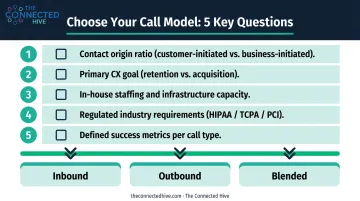
If any of these five are unclear, get answers before selecting a model or signing with a vendor. Gaps here are where costly mismatches happen.
The Case for a Blended Call Center
A blended call center handles both inbound and outbound calls, with intelligent routing software dynamically balancing load based on real-time demand. Agents aren't doing both simultaneously — the system shifts capacity so that idle inbound agents can work outbound queues during slow periods, and outbound campaigns pause when inbound volume spikes.
Why Blended Models Are Growing
ContactBabel's 2024 data shows that 24% of US contact centers already operate as mixed models. The operational case is straightforward:
- Reduced agent idle time — mean idle time across the surveyed sample was 8.6%; blended routing can compress that further
- Unified customer view — agents handling both call types develop a more complete picture of the customer relationship
- Flexible capacity — the same team can support a renewal campaign in the morning and field inbound service calls in the afternoon
What to Evaluate Before Going Blended
Blended operations add real complexity. Before committing, weigh:
- Agent training investment — agents need dual skill sets, which increases onboarding time and ongoing coaching requirements
- Technology complexity — blended operations require more sophisticated routing, reporting, and workforce management platforms
- Service level protection — outbound campaigns must be designed so they don't cannibalize inbound service levels during peak periods
For most mid-to-large businesses, those three factors make building blended infrastructure in-house a significant undertaking. Outsourcing to a vetted contact center partner is typically more cost-effective. The Connected Hive's no-cost-to-client consultancy covers full needs assessment, RFP development, and partner vetting across a network of 3,500+ domestic US contact centers, so businesses can evaluate blended options with expert guidance before making any commitment.
Frequently Asked Questions
What is the difference between inbound and outbound calls?
Inbound calls are initiated by customers reaching out to a business — reactive, typically driven by a need for support or information. Outbound calls are initiated by the business to contact customers or prospects proactively. Both serve distinct but equally important functions depending on your business goals.
Does an outbound call mean it was answered?
No. An outbound call simply means the business placed the call — it says nothing about whether it was answered. Contact rate (or answered rate) is a separate metric tracked to measure how effectively an outbound campaign is reaching its intended audience.
What types of businesses benefit most from inbound call centers?
Businesses with large existing customer bases and high support volume benefit most — healthcare providers, insurance companies, financial institutions, and retailers. For these organizations, managing customer inquiries, claims, and account support is central to retention and operational continuity.
Can one call center handle both inbound and outbound calls?
Yes. Blended call centers give agents the flexibility to shift between incoming calls and outbound contacts based on real-time demand. This model is increasingly common and often more cost-efficient for businesses that need both capabilities.
What skills do agents need for inbound vs. outbound calls?
Inbound agents lead with empathy, active listening, and calm problem-solving under pressure. Outbound agents rely on persuasion, resilience against rejection, and the ability to build rapport quickly — sometimes in under 60 seconds. Both roles require solid product knowledge, professionalism, and compliance awareness.
When should a business outsource its inbound or outbound call handling?
Outsourcing makes sense when call volumes exceed internal capacity, when compliance expertise (HIPAA, PCI, TCPA) is required, or when in-house costs outpace what a vetted partner would charge. The Connected Hive's clients — across healthcare, insurance, financial services, and government — typically see 20–30% cost savings compared to equivalent in-house operations.