

Introduction
Every business owner will eventually face a transition. The only real question is whether you'll be ready when it arrives.
The Exit Planning Institute's research shows that roughly 50% of owner exits are involuntary, triggered by what EPI calls the "5 D's": Death, Disability, Divorce, Disagreement, and Distress. Yet 87% of business owners have no formal exit plan, according to EPI's 2025 State of Owner Readiness report.
That gap carries serious financial consequences. For most owners, the business represents an average of 80% of their net worth — making an unplanned exit one of the most financially damaging events they can face.
This guide covers what business transition planning involves, when to start, which path fits your situation, and what a solid plan looks like in practice. Whether you're a decade out or starting to think seriously about your exit, this framework helps you move from uncertainty to a concrete, actionable plan.
Key Takeaways
- 87% of owners lack a formal exit plan — yet 50% of exits are involuntary, making preparation urgent
- Starting 3–5 years early opens significantly more options and improves financial outcomes
- Common transition paths — third-party sale, family succession, employee ownership, management buyout — each carry distinct trade-offs
- A complete plan integrates legal, financial, operational, and leadership considerations — not each in isolation
- No single advisor covers all the bases — a multi-disciplinary team is essential
What Is Business Transition Planning and Why Does It Matter?
Business transition planning is the structured process of preparing to transfer ownership and/or leadership — whether through a sale, family succession, employee ownership, or merger. Unlike day-to-day operations management, it focuses entirely on what happens to the business when you're no longer running it.
Transition Planning vs. Succession Planning
These two terms are often used interchangeably, but they address different questions:
- Transition planning asks: Who will own the company?
- Succession planning asks: Who will lead the company?
Both are essential, and they must be coordinated. A sale to a private equity firm, for example, solves the ownership question — but leadership continuity still needs to be addressed separately.
The Cost of Having No Plan
According to EPI's 2025 National State of Owner Readiness report, only 13% of US business owners have a formal exit plan. EPI also estimates that only 20–30% of businesses that go to market actually sell — a figure that drops further when owners haven't prepared.
For owners whose business represents 80% or more of their personal wealth, an absent exit plan isn't a minor gap — it's a direct financial risk.
What Proactive Planning Actually Delivers
Getting ahead of a transition provides four distinct advantages:
- Operations stay stable through the ownership change, protecting revenue and client relationships
- Reducing owner dependency raises enterprise value and makes the business more attractive to buyers
- Contingency planning limits the damage caused by forced exits (death, divorce, disability, disagreement, or distress)
- You control the terms of your exit — rather than having circumstances decide them for you
When Is the Right Time to Start Planning?
The short answer: earlier than you think. Most transitions take far longer than owners anticipate, and the gap between "thinking about it" and "executing it" is where value gets lost.
Realistic Transition Timelines
Different paths require different amounts of runway:
| Transition Type | Preparation Timeline | Engagement-to-Close |
|---|---|---|
| Third-party sale | 1–3 years to prepare | 6–9 months (IBBA Market Pulse Q2 2025) |
| Family succession | 5–10 years recommended | Varies significantly |
| ESOP (seller financing) | Years of feasibility work | Repayment typically 5–7 years |
| Management buyout | No universal benchmark | Depends on financing structure |
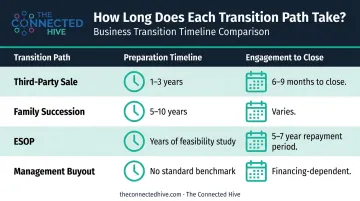
EPI's guidance is that a holistic transition strategy takes 3–5 years to execute properly. That window covers closing value gaps, reducing owner dependency, and building a business that can stand on its own — not just completing paperwork.
What Forced Timelines Actually Cost
When the 5 D's strike without a plan in place, the consequences are predictable:
- Fewer viable transition paths
- Compressed timelines that favor buyers, not sellers
- Reduced leverage in negotiations
- Inability to address operational or financial weaknesses before they're discovered
The most reliable approach is treating the business as transition-ready at all times. Clean financials, documented processes, diversified revenue, and a capable management team make the business attractive — and keep your exit options open no matter when a trigger arrives.
Types of Business Transitions: Choosing the Right Path
There is no universally "best" transition path. The right option depends on what you actually want: maximum financial return, legacy preservation, employee welfare, or continued involvement. Clarifying those priorities before evaluating options saves significant time and prevents costly false starts.
Selling to a Third Party
A third-party sale — to a strategic buyer or financial/institutional investor — typically offers the fastest route to maximum liquidity. According to IBBA's Q2 2025 Market Pulse, PE add-on buyers (33%), strategic buyers (29%), and PE platform buyers (17%) dominate the $5M–$50M transaction space.
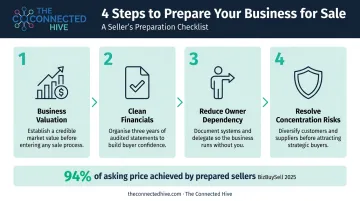
Key preparation steps before going to market:
- Obtain a current, credible business valuation
- Clean up financials and address any operational or tax issues
- Reduce owner dependency and document key processes
- Identify and resolve customer concentration risks
BizBuySell's 2025 data shows closed businesses sold at 94% of asking price — but only when sellers had done the work before listing.
Family Succession
Transferring to a family member preserves legacy and keeps the business in trusted hands. The financial trade-off is real: owners often don't receive full enterprise value, and the transaction typically becomes a hybrid of gift and sale depending on the owner's financial independence.
This path also requires honest conversations about successor readiness — capability, commitment, and family dynamics among members who may have conflicting expectations. FamilyBusiness.org recommends beginning the succession process 5–10 years in advance for this reason.
Employee or Management Buyout
Employee Stock Ownership Plans (ESOPs) and management buyouts (MBOs) both reward the people who built the business with you. The National Center for Employee Ownership reports 6,609 ESOPs covering 15.1 million participants — an established but specialized path that works best for businesses with sufficient size and enterprise value.
MBOs are more common in smaller businesses where a select management group can realistically absorb ownership. Both paths preserve culture and keep operations locally controlled — the main trade-off being more complex financing structures compared to a direct third-party sale.
Merger or Strategic Partnership
A merger combines two businesses to access capital, technology, or market reach. It's typically the most negotiation-intensive path and often the one that most significantly alters culture and leadership structure. For owners who prioritize operational continuity and legacy, mergers require careful due diligence. Post-close arrangements — who leads, what changes, what stays — need to be negotiated explicitly before signing.
Key Elements of a Successful Business Transition Plan
Start with Goal Clarity
Before any legal or financial steps, define what success actually looks like. Three questions worth answering first:
- How much liquidity do I need to fund my next chapter?
- Do I want any continued involvement post-transition?
- What happens to my employees and key relationships?
These answers shape everything that follows: the right transition path, the acceptable deal structure, and the timeline.
Get a Current Business Valuation
A professional valuation establishes a credible pricing benchmark, surfaces value gaps to close before transition, and grounds expectations in market reality rather than personal attachment. EPI recommends treating it as an annual readiness practice — not a one-time pre-sale event. Most owners are surprised by how much the market's number differs from their own estimate; getting there early gives you time to close that gap.
Legal and Financial Structuring
The structural decisions in a transition have significant tax and legal consequences. Core elements include:
- Buy-sell agreements — govern how ownership transfers in planned and unplanned scenarios
- Asset vs. equity sale structure — determines how gains are taxed at the transaction level
- Estate planning instruments — trusts, gifting strategies, and family limited partnerships
- Early tax planning — the earlier this begins, the more options exist to minimize the tax impact on net proceeds
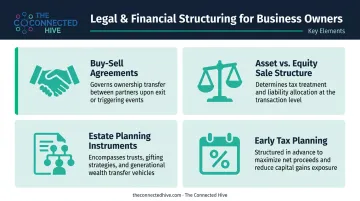
Tax planning left to the final stages of a transaction is one of the most common and costly mistakes owners make.
Operational Continuity Planning
A business that can't run without its owner is worth less to a buyer — and is harder to transition under any structure. Demonstrating operational independence requires:
- Documented processes that don't live only in the owner's head
- A capable management team with clear accountability
- Stable, consistent customer-facing operations
For businesses where customer service or contact center operations represent a meaningful share of revenue and client satisfaction, this is especially critical. Buyers scrutinize these functions closely. Working with a BPO and contact center consultant like The Connected Hive helps owners assess their customer experience infrastructure and close gaps before buyers discover them. Engagements range from single-day assessments to extended on-site advisory, depending on the scope of what needs attention.
Leadership Succession and Knowledge Transfer
Financial preparations move faster than leadership ones. Transferring institutional knowledge, key customer relationships, and decision-making authority takes time and deliberate structure. This process should begin well before the transition is finalized — not in the weeks before close.
How to Build Your Business Transition Advisory Team
No single advisor has the full range of expertise a business transition requires. A complete advisory team typically includes:
| Advisor | Core Contribution |
|---|---|
| CPA / Tax Advisor | Structures the transaction to minimize tax exposure |
| Estate Attorney | Handles legal documents, trusts, and ownership transfer instruments |
| Financial Planner | Aligns transition proceeds with personal financial goals |
| Business Valuation Specialist | Provides credible, independent valuation |
| Business Broker / Investment Banker | Markets the business and manages buyer negotiations |
The Case for Specialized Operational Advisors
For businesses where customer experience or contact center infrastructure is central to enterprise value, a specialized BPO and contact center consultant belongs on that team. The Connected Hive, for example, draws on 20+ years of executive BPO experience and a network of 3,500+ domestic and 8,000+ global contact centers to assess whether customer-facing operations add to your valuation or create risk. Because their fees are paid by the placed partner rather than the business owner, this type of specialized expertise typically costs nothing out of pocket.
When to Assemble Your Team
Once your core team is identified, timing becomes the next critical variable. Advisors add the most value early in the process — bringing them in after deal terms are already taking shape limits their ability to strengthen your position. Assembling the full team 2–3 years before your intended exit gives every advisor time to do their best work.
Common Business Transition Planning Mistakes to Avoid
Waiting Too Long to Plan
This is the most common and most damaging mistake. Owners who start late face narrower options, compressed timelines, and less negotiating leverage. The irony is that the businesses most in need of transition planning are often the ones whose owners are too busy running operations to focus on exit strategy.
Overestimating Business Value
Personal identity and business value often get conflated. Without an objective third-party valuation, many owners enter negotiations with expectations that don't match market reality — leading to failed deals, fractured relationships with advisors, and months of costly back-and-forth. Regular valuations serve as a reality check throughout the planning period.
Neglecting the Human Side
While valuation errors are costly, the non-financial dimensions of a transition can be just as damaging — and are even more frequently overlooked:
- Research from Harvard Business School suggests 75% of owners experience post-exit regret when their company has become central to their identity
- Employees facing job uncertainty create turnover risk at exactly the wrong moment in the transition
- Key accounts grow unstable when client relationships are tied to the owner rather than the organization
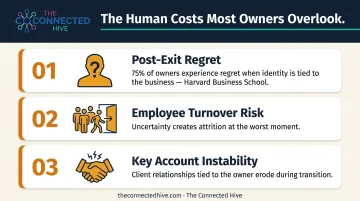
Transparent, phased communication protects morale. A gradual wind-down of owner involvement, rather than an abrupt departure, also protects business continuity through the transition.
Frequently Asked Questions
What is business transition planning?
Business transition planning is the strategic process of preparing a business for a change in ownership or leadership. It covers legal, financial, operational, and succession elements to ensure continuity and protect both personal and business goals throughout the transfer.
What are the key elements of a business transition plan?
A solid transition plan covers six core areas:
- Clarifying owner goals and exit timeline
- Obtaining a current business valuation
- Legal and financial structuring, including tax planning
- Operational continuity planning
- Leadership succession and knowledge transfer
- Building a multi-disciplinary advisory team
What is the difference between business transition planning and succession planning?
Transition planning addresses ownership — who will own the company after you leave. Succession planning addresses leadership — who will run the company. Both are necessary and must be coordinated, but they involve different decisions, advisors, and timelines.
When should I start planning my business transition?
Start 3–5 years before your intended exit. Most transitions take longer than expected, and early preparation significantly improves both your financial outcomes and the range of options available to you.
How long does a business transition typically take?
Timelines depend heavily on the exit path. Third-party sales typically require 1–3 years of preparation and 6–9 months from advisor engagement to close. Family succession works best over 5–10 years, while employee ownership transitions involve multi-year financing arrangements. Your chosen path sets the timeline.