Introduction
Every call center faces the same pressure: customers want faster resolutions, but agents need enough time to actually solve problems. Average Handle Time sits directly at the center of that conflict.
Get AHT too high and staffing costs spiral, queues back up, and frustrated customers abandon calls. Push it too low and agents start rushing, first-call resolution drops, and customers call back — costing more overall than the time you saved.
This guide covers everything operations and CX leaders need to know about AHT:
- What it actually measures and how to calculate it correctly
- What benchmark ranges look like across industries
- Why it matters operationally — and what drives it up
- How to improve it without trading quality for speed
Key Takeaways
- AHT = Talk Time + Hold Time + After-Call Work, divided by total interactions
- SQM benchmarks the general industry average at 7 minutes — not the often-cited 6
- An artificially low AHT can hurt First Call Resolution and raise total cost-to-serve
- Customers abandon calls during hold time faster than any other AHT component — making it the highest-stakes variable to control
- Partnering with a vetted outsourced contact center can close AHT performance gaps faster than internal process fixes alone
What Is Average Handle Time (AHT) in a Call Center?
AHT is the average total time required to complete a single customer interaction — from the moment an agent picks up to the moment all post-call tasks are finished. It is not simply how long an agent stays on the phone. It captures the full lifecycle of a customer transaction.
The Three Components of AHT
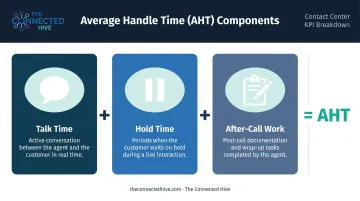
Every AHT calculation draws from three distinct time buckets:
- Talk Time — The live conversation: listening, gathering information, and navigating systems while the call is active. It's what most people picture, but it's only one part of the total.
- Hold Time — Any period the customer spends waiting on hold. Agents trigger holds to consult supervisors, research accounts, transfer calls, or wait on slow systems. From a customer experience standpoint, hold time tends to do the most damage.
- After-Call Work (ACW) — Everything that happens once the call ends: updating CRM records, logging case notes, sending follow-up emails, initiating escalations, or completing compliance documentation. It often gets overlooked, but it's a real and measurable slice of total handle time.
AHT vs. Related Metrics
AHT is frequently confused with adjacent KPIs. Here's how they differ:
| Metric | What It Measures |
|---|---|
| Average Talk Time | Active conversation only — excludes hold and ACW |
| Average Speed of Answer (ASA) | How fast a call is picked up — measures pre-answer queue delay, not handling |
| First Call Resolution (FCR) | Whether the issue was resolved without a repeat contact — measures outcome, not duration |
| AHT | Total agent workload per interaction: talk + hold + ACW |
Reading AHT in isolation is a common mistake. A center with a low AHT but poor FCR is almost certainly trading short calls for repeat contacts, and repeat contacts cost more than the time saved on the first call.
How to Calculate AHT in a Call Center
The Formula
AHT = (Total Talk Time + Total Hold Time + Total After-Call Work) ÷ Total Number of Interactions
Each variable represents cumulative time across all interactions in your measurement window — typically a defined day, week, or month.
Worked Example
Say your team handles 300 calls in a week with the following totals:
- Total Talk Time: 900 minutes
- Total Hold Time: 150 minutes
- Total After-Call Work: 150 minutes
AHT = (900 + 150 + 150) ÷ 300 = 1,200 ÷ 300 = 4 minutes
The math is simple. What makes or breaks the result is whether you're feeding the right inputs into it.
Common Calculation Mistakes
Three errors distort AHT more than any others:
- Omitting ACW entirely — many teams add talk time plus hold time and stop there, which understates true handle time and makes benchmarking unreliable.
- Excluding abandoned calls from the denominator — if agents engaged with a call before disconnect, that activity still counts. Leaving those interactions out inflates apparent AHT.
- Using too short a time window — a single day can reflect an unusual spike or lull. Measure across at least a full week, ideally a month, to get a reliable picture.
Calculate at Multiple Levels
Once your inputs are accurate, aggregate numbers still hide where inefficiencies live. Calculate AHT at three levels:
- Team-wide — for high-level capacity planning
- By call type or inquiry category — to distinguish complex calls from simple ones
- By individual agent — to target coaching accurately
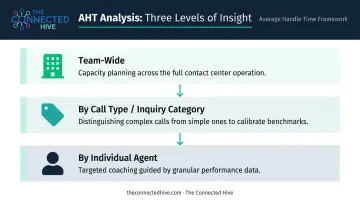
A team average of 6 minutes might look fine until you break it out and find that one inquiry type is running at 11 minutes while another sits at 3.
AHT Benchmarks: What Is a Good Average Handle Time?
What the Data Actually Shows
The number most commonly cited as a "standard" AHT benchmark is 6 minutes — but that figure lacks a primary source to back it up. SQM Group's research across 500+ North American contact centers puts the general industry benchmark at 7 minutes. Their 2024 participant data reported a mean of 697 seconds — up 18% year over year — reflecting the growing complexity of customer interactions.
Treat 7 minutes as a starting point for general benchmarking, not a universal target.
Why Industry and Call Type Matter More Than the Average
AHT varies significantly based on what's being handled:
- Simple transactional calls (account balance inquiries, order status, address changes) naturally carry shorter AHTs
- Complex inquiry types — claims processing, benefits enrollment, technical troubleshooting, billing disputes — require more time and should carry higher AHT expectations
- Healthcare and insurance programs like open enrollment or member claims involve multi-step verification and nuanced information that extend handle times structurally
Businesses evaluating outsourced contact center partners should ask vendors about their AHT benchmarks by call type, not just a single overall number. A provider who can speak to inquiry-specific handle times is demonstrating real operational visibility — a meaningful indicator of operational maturity.
That distinction between call types matters even more when you consider what happens when AHT is treated as a number to simply drive down.
The "Optimize, Don't Minimize" Principle
Chasing a lower AHT without understanding what's driving it is one of the most common mistakes in contact center management. A very low AHT often means:
- Agents are cutting calls short before issues are fully resolved
- First Call Resolution rates drop
- Customers call back — at full cost
- CSAT scores fall
The real goal is finding the right AHT for each inquiry type — one that allows genuine resolution within a reasonable timeframe.
Why AHT Matters: Impact on Operations and Customer Experience
The Staffing Math
AHT feeds directly into workforce management models. Scheduling teams use it to calculate how many agents are needed at any given interval. Even modest AHT changes move the needle on capacity.
The Swinton Group — a 450-agent contact center — reduced average AHT by 50 seconds through workflow automation. That translated to capacity savings equivalent to 40 full-time employees and 7,781 additional calls handled per month — without adding headcount.
ICMI notes that approximately 70% of contact center costs are personnel-related — which means AHT improvements compound quickly at scale.
The Customer Experience Dimension
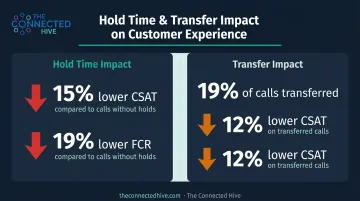
Hold time is the component of AHT most directly felt by customers — and the data on its impact is sharp. SQM research across 500+ North American contact centers found clear patterns across both hold time and transfers:
- Calls with hold time scored 15% lower CSAT and 19% lower FCR than calls without it
- 19% of customers were transferred during their call
- Transferred calls scored 12% lower CSAT than non-transferred calls
AHT as a Diagnostic Foundation
Those customer experience costs reinforce why AHT can't be treated as a pure efficiency metric. Beyond staffing and satisfaction scores, it informs:
- Agent scorecards and coaching priorities
- Call routing design decisions
- Technology investment cases (knowledge base, AI assist, CRM integration)
A contact center that can't explain what's driving its AHT — whether call complexity, training gaps, or routing inefficiency — has no clear path to improving it. Identifying the root cause is what makes targeted fixes possible.
What Causes High AHT in a Call Center?
Agent-Side Causes
- Insufficient training on products, processes, or compliance requirements
- Low confidence navigating knowledge resources, leading to extended searches during live calls
- Poor call-handling habits: excessive small talk, failure to set call expectations upfront, slow system navigation
Process and Technology Causes
- Inefficient call routing sending customers to agents without the right skills for their inquiry
- Fragmented desktop environments requiring agents to toggle between multiple systems mid-call — Salesforce research found 58% of agents at underperforming organizations toggled among multiple screens to find information, versus 36% at high performers
- No centralized knowledge base, leaving agents to search across disconnected sources
- Heavy manual data-entry requirements during or after calls
Call Complexity and Volume Causes
Not every AHT increase is fixable — some are structural.
A healthcare contact center during open enrollment, a financial services center during a product launch, or a government agency responding to a declared disaster will see AHT rise because the calls themselves are genuinely more complex and high-stakes.
Before launching an AHT-reduction initiative, distinguish between:
- Structural AHT — driven by inherent call complexity (requires different staffing models, not coaching)
- Fixable AHT — driven by process gaps, training deficiencies, or technology limitations (addressable through targeted intervention)
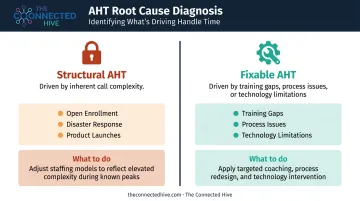
Running a coaching program against structurally complex call volume won't move the metric — it will frustrate agents and erode confidence instead.
How to Improve Average Handle Time Without Sacrificing Quality
Targeted Agent Coaching
Blanket AHT mandates — "everyone needs to get their time down" — consistently backfire. They pressure agents to rush without addressing why calls are running long.
Effective improvement requires:
- Identify which inquiry types are driving elevated AHT at the agent level
- Use call recordings and interaction analytics to find where conversations stall — not just who has the highest overall number
- Coach to specific gaps — a knowledge deficit needs different treatment than a call-structure habit
Build a Centralized Knowledge Base
Agents who can find accurate information in seconds don't need to put customers on hold. A knowledge base reduces both talk time and hold time simultaneously — making it one of the highest-leverage investments in the contact center stack.
What makes a knowledge base effective:
- Searchable with role-appropriate access
- Tiered by inquiry type and complexity
- Actively maintained as products, policies, and regulations change
- Accessible without leaving the agent's primary desktop environment
Optimize Call Routing
Skills-based routing matches callers to agents with the specific expertise for their inquiry type, reducing transfers, repeat contacts, and extended troubleshooting. The impact is most visible in complex inquiry categories, where the right match on first contact prevents escalations and repeat calls.
Key routing improvements that reduce AHT:
- Routes calls to agents with relevant expertise, not just available agents
- Reduces transfer rates that inflate handle time
- Minimizes repeat contacts caused by mismatched first assignments
A NICE case study in healthcare documented an 8% AHT improvement and 5% CSAT improvement from predictive AI routing — with both gains occurring together, not at each other's expense.
Streamline After-Call Work
ACW is the most overlooked AHT component — and often the most improvable. Strategies that work:
- Call summary automation: AI-generated wrap-up notes reduce the cognitive load and time required to document interactions. A telecom provider using NICE's AutoSummary tool reported a 25% reduction in ACW time.
- Standardized CRM templates: Structured entry fields are faster than free-text notes and produce cleaner data for reporting
- Post-call checklists: Reduce decision fatigue by giving agents a defined sequence to follow after each interaction type
Choose the Right Outsourced Partner
For businesses that outsource customer support, the contact center partner selection decision has more impact on AHT outcomes than almost any internal initiative. A well-run BPO with optimized routing, trained agents, and documented inquiry-type benchmarks gives clients a performance foundation that can take years to build from scratch.
The Connected Hive helps businesses skip that build phase. Tim Austrums and his team connect clients with vetted contact center partners — drawn from a network of 3,500+ domestic US centers — whose operations are already structured to deliver on both AHT and quality targets. The focus is on matching each client to partners with documented performance in their specific industry and call type mix, rather than leaving them to navigate hundreds of vendors independently.
Frequently Asked Questions
What does AHT mean in a call center?
AHT stands for Average Handle Time — the average total duration of a customer interaction including talk time, hold time, and after-call work. It is one of the core KPIs used to measure contact center efficiency and agent workload per interaction.
What is a good AHT for a call center?
SQM benchmarks the general industry average at around 7 minutes across 500+ North American centers. "Good" AHT depends heavily on industry, call type, and complexity. It should always be evaluated alongside FCR and CSAT rather than optimized in isolation.
How do you calculate AHT in a call center?
Use this formula: (Total Talk Time + Total Hold Time + Total After-Call Work) ÷ Total Number of Interactions. For reliable results, calculate across at least a week of interactions.
What causes high average handle time in a call center?
Three main drivers account for most AHT increases:
- Agent training gaps and limited product knowledge
- Inefficient technology — slow systems, poor routing, fragmented desktops, no knowledge base
- Complex call types that require more time to resolve regardless of agent skill
How does AHT affect customer satisfaction?
Hold time and excessive transfers — both components of AHT — are directly linked to lower CSAT. SQM data shows calls with hold time score 15% lower on CSAT. An artificially low AHT from rushed calls also harms satisfaction, as unresolved issues drive repeat contacts.
What is the difference between AHT and talk time?
Talk time covers only the active conversation between agent and customer. AHT is broader — it includes talk time plus hold time and after-call work, making it a more complete measure of the total effort required to handle an interaction end to end.