Business process optimization (BPO) is the discipline that fixes this. It's not a software purchase or a one-time project — it's a structured methodology for analyzing how work actually gets done, identifying what's broken, and redesigning processes to deliver measurable results.
This guide covers everything you need to know: what BPO is, how it differs from related concepts, key benefits backed by data, the main methodologies, a step-by-step implementation framework, and when it makes sense to bring in outside expertise.
Key Takeaways
- Business process optimization is proactive and data-driven, not a reaction to problems after they surface
- Deloitte research found 41% of daily work time produces no organizational value
- Use DMAIC for complex, measurable problems; use Lean or Kaizen when continuous day-to-day improvement is the goal
- Employee resistance — not flawed methodology — is what derails most process redesigns
- External consultants add the most value when internal teams lack the neutrality to assess their own processes objectively
What Is Business Process Optimization?
Business process optimization is the systematic practice of analyzing existing workflows, identifying inefficiencies, and redesigning those workflows to reduce costs, eliminate waste, and deliver consistent, measurable outcomes — without disrupting ongoing operations.
BPO is often conflated with two adjacent terms — each means something distinct:
- Business Process Management (BPM) — the broader strategic discipline of governing all organizational processes over time. BPO operates within BPM.
- Business Process Improvement (BPI) — typically reactive and incremental, addressing specific pain points as they surface. BPO is more proactive, data-driven, and comprehensive.
Which Processes Are Candidates for Optimization?
Not every workflow needs a redesign. Focus first on processes that:
- Repeat frequently across teams or departments
- Involve multiple manual handoffs between people or systems
- Consistently generate errors, complaints, or delays
- Cross departmental boundaries without clear ownership
- Consume disproportionate time relative to the value they produce
Business Process Optimization Examples
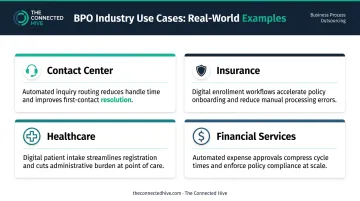
BPO applies across every major industry. Here are four real-world scenarios:
- Contact center inquiry routing — Automating how inbound contacts are categorized and assigned to the right agent reduces handle time and eliminates the manual triage that slows resolution.
- Insurance enrollment workflows — Digitizing member enrollment eliminates duplicate data entry and compresses the time from application to active coverage.
- Healthcare patient intake and onboarding — Replacing paper-based intake with digital workflows reduces administrative burden and speeds eligibility verification.
- Financial services expense approvals — Automating multi-step approval chains removes bottlenecks and cuts cycle times from days to hours — with a full auditable trail.
The methodology is the same regardless of industry. What changes is where the waste lives and which workflows carry the most risk if left unaddressed.
Key Benefits of Business Process Optimization
Cost Reduction and Capacity Recovery
Eliminating redundant steps and automating manual tasks directly lowers labor and operational costs. The scale of the opportunity is significant: Deloitte's 2025 research of 10,000 business and HR leaders found that 41% of daily work time is estimated to go toward tasks that create no organizational value — yet only 22% of organizations were highly effective at simplifying that work.
Two examples show what's achievable:
- A bank operating model redesign reduced overall costs by up to 35% (McKinsey)
- A global consumer-products company cut workloads by more than 15% in the first year (Deloitte)
Before investing in new technology or headcount, measure how much of your current capacity is consumed by work that shouldn't exist.
Faster Cycle Times
Streamlined processes reduce the time employees spend on repetitive, low-value tasks and return that capacity to revenue-generating or customer-facing work.
Public-sector Lean cases from McKinsey illustrate the gains:
- A US regulatory agency made decisions 35% faster and cut backlog by more than 70%
- The Swedish Migration Board reduced average processing time by more than 50% while lowering direct processing costs by 12%
Fewer Errors and Better Quality
Standardized, well-documented processes reduce variation and human error, which matters most in regulated industries where accuracy isn't optional.
The compliance stakes are concrete. CMS's FY2024 improper payments data shows $85.45 billion in combined improper payments across Medicare and Medicaid programs, with 79.11% of Medicaid improper payments attributed to insufficient documentation. That's a documentation and process control problem, not a fraud problem.
Enhanced Customer Experience
Optimized processes translate directly to faster response times, more accurate information, and fewer friction points. Accenture found that 87% of consumers are likely to avoid a company after a single bad experience.
In contact center environments, streamlined workflows reduce average handle time and improve first-call resolution. Both metrics have outsized effects on satisfaction scores, and the cost of getting them wrong compounds quickly after that first bad experience.
Employee Engagement
When employees are freed from tedious manual work and given clear, efficient processes, morale improves. Two foundational Lean cases illustrate the effect: FHA's Office of Multifamily Housing Programs saw a 15% engagement improvement alongside a 50% increase in monthly output, and Direct Line Group reported a 10% engagement lift during its Lean transformation.
Common Business Process Optimization Methodologies
DMAIC (Six Sigma)
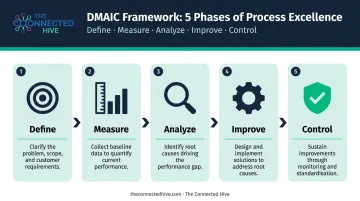
DMAIC is a structured five-phase framework for improving existing processes that fall short of performance standards:
- Define: Scope the problem, identify stakeholders, set customer requirements
- Measure: Quantify current performance with baseline data
- Analyze: Identify root causes of defects and delays
- Improve: Redesign the process to eliminate root causes
- Control: Put mechanisms in place to sustain the gains
Results from ASQ-documented hospital cases illustrate the methodology's precision: one nursing shift-report process improved from 0.7 sigma to 3.3 sigma capability; a combined Lean Six Sigma and Theory of Constraints case reduced outpatient waiting time from 120 minutes to 45 minutes.
Use DMAIC when you have a measurable defect, a defined customer requirement, and the data infrastructure to track improvement rigorously.
Lean and Kaizen
Lean focuses on eliminating any step that doesn't deliver value to the customer — queues, redundant approvals, rework, unnecessary handoffs. Kaizen is the philosophy of continuous, frontline-driven improvement that sustains those gains over time. Each approach has a distinct emphasis:
- Lean targets structural waste — steps, handoffs, and delays that add no customer value
- Kaizen targets culture — building frontline ownership so improvements stick after the project ends
- Together, they address both redesign and adoption
McKinsey's public-sector Lean cases found that 75% of employees preferred the new operating model, confirming that how people experience the change matters as much as the design itself.
Lean/Kaizen fits best when the goal is improving end-to-end flow across a service or operation, rather than isolating a single defect.
Choosing the Right Methodology
| Scenario | Best Fit |
|---|---|
| Complex process with measurable defects and clear CTQ metrics | DMAIC |
| End-to-end service flow with queues, rework, and handoff waste | Lean/Kaizen |
| Ongoing operational culture and frontline ownership | Kaizen |
| Combination of variation and end-to-end waste | Hybrid approach |
In practice, most organizations combine elements from multiple frameworks. Start by defining what you're actually trying to fix — the right methodology tends to become clear once the problem is specific enough.
How to Implement Business Process Optimization: A Step-by-Step Guide
Step 1: Identify and Prioritize
Not every process needs immediate attention. Score candidates on impact vs. effort: prioritize workflows causing the most delays, errors, customer complaints, or cost overruns that are also feasible to redesign given available resources.
Avoid the temptation to optimize everything simultaneously. Two well-executed improvements outperform six incomplete ones.
Step 2: Map the Current Process
Before making any changes, document exactly how work flows today — including every step, stakeholder, input, output, and handoff point. Common tools include:
- Process flow diagrams for linear workflows
- Swimlane maps for cross-functional handoffs
- SIPOC charts (Suppliers, Inputs, Process, Outputs, Customers) for scoping
Map what actually happens, not what the procedure manual says should happen. The gap between the two is usually where inefficiency lives.
Step 3: Analyze for Root Causes
With the current state mapped, look for bottlenecks, redundant steps, unclear ownership, and manual handoffs prone to error. Use structured analysis techniques:
- 5 Whys — Ask "why" repeatedly to move from symptom to root cause
- Pareto analysis — Identify the 20% of causes responsible for 80% of problems
Distinguish symptoms from causes. Slow processing times are a symptom; unclear ownership over a specific approval step is a cause.
Step 4: Redesign and Pilot
Map the desired future state based on your analysis. Changes may include automation of specific steps, role reassignments, elimination of redundant approvals, or restructured handoffs.
Before full rollout, pilot the redesigned process with a small team. Pilots surface implementation issues that look fine on a diagram but break down in practice.
Step 5: Implement, Monitor, and Continuously Improve
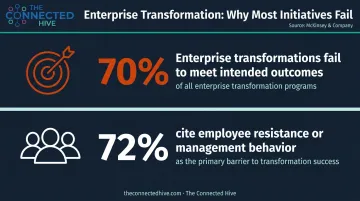
Rollout must include employee training and clear communication of why the process is changing. McKinsey research found that approximately 70% of enterprise transformations fail to meet intended outcomes, with 72% of failed programs citing employee resistance or management behavior as the primary barrier.
After implementation:
- Establish KPIs and dashboards to monitor performance against baseline
- Schedule regular process reviews — quarterly at minimum
- Build optimization into regular operations rather than treating it as a one-time project
One practical note: optimizing a single process without understanding how it connects to adjacent workflows often creates new bottlenecks elsewhere. A holistic organizational assessment before redesign prevents that problem.
When to Bring in a Business Process Optimization Consultant
Signs You Need External Expertise
Internal teams often struggle to diagnose processes they work inside every day. Familiarity bias is real: when you've operated within a broken workflow for two years, the broken parts start to feel normal.
Consider bringing in outside expertise when:
- Internal teams lack the skills to perform structured process analysis or root cause work
- Workflows are highly complex or span multiple departments without a neutral owner
- Previous improvement attempts haven't held — gains decayed within months
- Organizational politics prevent honest assessment of where problems originate
- Regulatory requirements demand independent challenge of existing controls
What a Good Consultant Does Differently
An experienced consultant brings what internal teams typically can't: objectivity, a structured methodology, and industry-specific benchmarks. In specialized domains like contact center operations and BPO partnerships, industry depth matters more than general consulting credentials.
Tim Austrums, founder of The Connected Hive, brings over 20 years of executive experience in contact center strategy, with client engagements spanning Humana, Blue Cross/Blue Shield, Discover, Ameriprise, FEMA, and state government health benefits programs.

That experience shapes how assessments are structured — evaluating goals, culture, technology, and workflows as a connected system rather than isolated problems. Common gaps that surface include underutilized contact center technology, compliance blind spots in HIPAA and PCI environments, vendor misalignment, and agent workflow breakdowns that internal teams have long since stopped questioning.
From there, vendor matching becomes a natural next step. With access to over 3,500 domestic and 8,000 global contact center partners, Tim's team identifies what needs to change and who can execute it — then negotiates the partner relationships to make it happen.
How to Evaluate a Consultant
When assessing any process optimization consultant, look for:
- Relevant industry experience (not just general operations background)
- A structured methodology with documented phases and deliverables
- Transparent communication and clear definition of expected ROI
- Verifiable references from comparable organizations
- Willingness to establish baseline metrics before the engagement begins
Frequently Asked Questions
What are the 5 stages of business process optimization?
The five stages are: Identify (select processes with the highest improvement potential), Map (document current workflows in detail), Analyze (find root causes of inefficiency), Redesign (build the optimized future-state process), and Monitor (track performance and continuously improve against established KPIs).
What are examples of business process optimization?
Common examples include automating customer inquiry routing in contact centers to reduce handle time, digitizing insurance enrollment to eliminate duplicate data entry, restructuring employee onboarding across HR systems, and replacing manual approval chains in finance departments with automated routing and audit trails.
Which BPM tool is best for business process optimization?
There's no single best tool — selection depends on process complexity, organizational size, and goals. Mid-complexity workflows suit platforms like Kissflow, Formstack, or Nintex, while large-scale operations often require enterprise suites like Appian. Process mapping and mining should typically come before any automation investment.
What is the difference between business process optimization and business process improvement?
Business process improvement (BPI) is typically reactive — it addresses specific pain points as they arise. Business process optimization is more proactive and strategic, using data and structured methodologies to redesign processes for long-term efficiency gains rather than incremental fixes.
When should a business hire a process optimization consultant?
Consider hiring a consultant when internal teams lack bandwidth for complex, cross-functional analysis, or when previous improvement efforts haven't stuck. An outside perspective often surfaces inefficiencies that familiarity has made invisible to internal staff.
How does business process optimization benefit customer experience?
Optimized processes reduce errors and create more consistent service delivery. In contact center environments, this means shorter wait times and faster issue resolution — Gartner research consistently links first-contact resolution to higher customer satisfaction and lower customer effort.