That's the pressure driving more businesses toward back office outsourcing. The global BPO market is valued at $328.4 billion in 2025 and projected to reach $695.8 billion by 2033, according to Grand View Research — a trajectory that reflects how seriously organizations are treating operational efficiency as a competitive factor.
This article goes beyond defining outsourcing. It breaks down which back office functions deliver measurable impact when delegated, what the real advantages look like in practice, and what separates successful outsourcing decisions from costly ones.
Key Takeaways
- Back office outsourcing means delegating non-customer-facing operational functions to a specialized third-party provider
- The highest-impact functions to outsource include data entry, accounting, payroll, claims processing, and HR administration
- Core advantages are cost efficiency, on-demand scalability, and access to compliance-ready expertise
- 88% of organizations met their cost-reduction goals through outsourcing, per Deloitte's Global Shared Services survey
- Poor provider selection — not outsourcing itself — is the primary cause of failed engagements
What Is Back Office Outsourcing?
Back office outsourcing is the practice of delegating administrative and operational support functions to a third-party provider, freeing internal teams to focus on revenue-generating work.
The distinction matters. Front office functions are customer-facing:
- Sales calls and outbound prospecting
- Inbound customer support
- Account management and renewals
Back office functions operate behind the scenes — data processing, payroll runs, compliance reporting, claims adjudication. Both are essential, but back office is where inefficiency accumulates, often unnoticed until it becomes a constraint on growth.
Most businesses don't feel the strain of back office overhead during early stages. They feel it when they try to scale — and discover that administrative capacity doesn't expand as smoothly as sales or product delivery.
That's where outsourcing changes the equation. The cost savings are real — typically 20–30% compared to in-house equivalents — but the more consequential benefit is operational continuity: the ability to scale without administrative drag limiting what's possible.
Key Back Office Services Worth Outsourcing
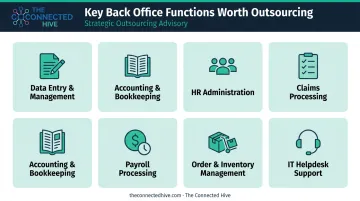
The functions most commonly delegated to BPO providers include:
- Data entry and management — high-volume, repetitive, and error-prone when handled by overburdened internal staff
- Accounting and bookkeeping — accounts payable, accounts receivable, reconciliation, and financial reporting
- Payroll processing — one of the most universally outsourced functions; according to Deloitte's Global Business Services survey, 80% of organizations had implemented payroll through a shared services or outsourcing model
- HR administration — onboarding, benefits administration, compliance documentation, and employee records
- Claims processing — especially critical in healthcare and insurance, where volume spikes and compliance requirements strain internal teams simultaneously
- Order processing and inventory management — relevant for e-commerce and retail businesses managing seasonal demand
- IT helpdesk support — tier-1 and tier-2 support that can be scaled independently of core technical teams
Which functions make sense to outsource depends on where internal capacity is most constrained. For regulated industries — healthcare, insurance, financial services — any outsourcing partner handling sensitive data must demonstrate compliance with HIPAA, PCI DSS, or SOC 2 requirements. Cost savings matter, but a vendor that can't document compliance exposes your organization to regulatory risk that no pricing advantage offsets.
Key Advantages of Back Office Outsourcing
The advantages below are tied to concrete operational outcomes : cost structure, processing capacity, compliance risk, and speed. Each becomes most valuable when applied consistently, with the right provider and clear performance expectations.
Cost Efficiency That Compounds Over Time
Back office outsourcing reduces costs across multiple expense lines simultaneously: salaries, benefits, training, infrastructure, and management overhead for non-core roles.
Unlike a simple headcount reduction, outsourcing converts fixed operational costs into variable ones aligned to actual business need. The provider absorbs hiring, onboarding, and skills maintenance costs. The client pays for output or capacity, not for idle time between demand peaks.
Deloitte's 2021 Global Shared Services and Outsourcing Survey found that 88% of approximately 600 respondent organizations achieved their cost-reduction objectives through shared services and outsourcing arrangements. That's an outcome-attainment rate across nearly 600 organizations, not a projected estimate.
The compounding effect is most pronounced for high-volume, repetitive functions:
- Payroll processing costs scale with headcount internally, but outsourced capacity can flex with the business
- Data entry and accounts payable require specialist accuracy, not full-time permanent hires at lower volumes
- Freed administrative budget can be reallocated toward product development, sales capacity, or customer experience improvements
KPIs most affected: cost per transaction, overhead as a percentage of revenue, cost-per-hire for support functions, budget predictability across quarters.
Scalability Without Operational Disruption
Back office outsourcing lets businesses adjust support capacity in response to demand, without the lag time and expense of traditional hiring cycles.
Consider what that means in practice:
- A healthcare company managing open enrollment surges needs temporary claims and data processing capacity for a defined window
- A retail business absorbing holiday order volumes requires additional order processing and customer support bandwidth for weeks, not months
- An insurance provider facing claims spikes after a weather event must scale immediately, not after a 60-day hiring and onboarding cycle
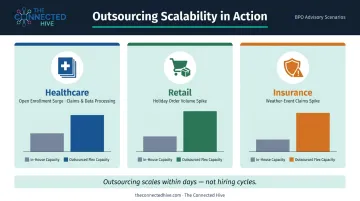
The alternative — maintaining a fully staffed in-house team sized for peak demand — means paying for excess capacity during normal operating periods. That structural inefficiency compounds across every month of the year.
KPIs most affected: time-to-capacity during demand surges, workforce utilization rate, error rates during peak periods, and customer satisfaction scores tied to processing speed.
For companies in active growth phases, this flexibility is particularly critical: administrative functions often need to expand faster than core hiring can support, and outsourcing fills that gap without the structural overhead.
Access to Specialized Expertise and Compliance-Ready Operations
Outsourcing back office functions gives businesses immediate access to professionals who specialize in exactly those functions. A specialized BPO provider maintains updated compliance protocols, industry-specific workflows, and current technology integrations as part of their core service model.
The client inherits that expertise rather than building it from scratch. In regulated industries, this matters more than in most: compliance failures carry direct financial consequences.
- The HHS Office for Civil Rights has settled or imposed civil money penalties in 152 HIPAA enforcement cases totaling $144.9 million as of November 2024
- The average cost of a data breach in financial services reached $6.08 million in 2024, per IBM's breach cost analysis
When financial reporting, claims adjudication, or HR compliance are handled by specialists who stay current with regulatory changes, the outputs are more accurate, audit-ready, and operationally reliable. Fewer errors upstream means less rework downstream, and in compliance-sensitive functions, rework has a dollar cost attached to every incident.
KPIs most affected: error and rework rates, compliance audit outcomes, time-to-resolution on administrative tasks, data accuracy rates.
What Happens When Back Office Outsourcing Is Ignored or Mismanaged
Keeping all administrative burden in-house at scale isn't neutral — it's a choice with a compounding cost.
As the business grows, tasks that were manageable at 30 employees become bottlenecks at 150. Error rates rise. Processing slows. Internal talent gets pulled from strategic work into operational firefighting.
The result is a leadership team spending time on payroll exceptions and data corrections rather than on decisions that move the business forward.
Mismanaged outsourcing creates a different set of problems. Deloitte's 2024 Global Outsourcing Survey found:
- 70% of organizations had selectively insourced scope previously delivered by a third party in the prior five years
- A separate 70% reported their vendor-management-office function was not fully mature
- Among organizations considering backshoring operations, 53% cited low service quality as the primary reason, followed by the need for greater control (49%) and unrealized savings (32%)
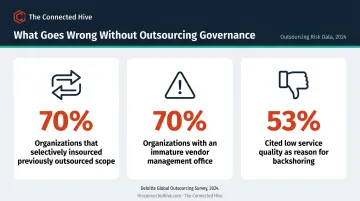
These figures don't argue against outsourcing. They argue against outsourcing without governance. Selecting a provider based on cost alone — without evaluating compliance capability, industry experience, or operational fit — produces exactly the outcomes in those statistics.
Timing matters just as much as vendor selection. Businesses that wait until operational strain is acute before outsourcing typically manage the transition under pressure, which compresses due diligence, shortens evaluation timelines, and increases the risk of a poor fit. The businesses that get the most from outsourcing treat it as a strategic decision made before the pain becomes urgent.
How to Get the Most Value from Back Office Outsourcing
Back office outsourcing delivers its highest value when provider selection is treated as a strategic decision — not a procurement transaction.
That means evaluating on criteria beyond price:
- Industry experience — has the provider handled this function in your specific sector?
- Compliance credentials — are they HIPAA-compliant, PCI DSS-certified, or SOC 2-audited where your operations require it?
- Technology compatibility — can their systems integrate with your existing CRM, ERP, or workflow platforms?
- Scalability — can they expand capacity within days, not months?
- References — what do current clients say about quality consistency and communication?
Choosing the right provider is only half the equation. Once a partner is in place, define KPIs at the outset — turnaround time, error rate, compliance adherence — conduct regular performance reviews, and keep direct communication channels open so issues get addressed before they compound.
For businesses navigating multiple potential providers, particularly in regulated industries, working with a consulting partner can significantly reduce selection risk. The Connected Hive specializes in matching businesses with vetted, compliance-aware contact center and BPO providers across healthcare, insurance, financial services, and other sectors. Before any provider recommendation is made, their process covers operational requirements, technology compatibility, compliance needs, and cultural fit — and the matching service comes at no cost to the client.
Conclusion
The value of back office outsourcing compounds over time. Cost efficiency, flexibility, and specialized expertise don't deliver their full impact in month one — they build as the partnership matures, the provider learns your operations, and the core team stops spending cycles on work that doesn't move the business forward.
The businesses that get the most from outsourcing don't treat it as a one-time fix. They treat it as an ongoing operational practice: one that starts with clear strategic intent, requires regular performance check-ins, and depends on a provider relationship grounded in mutual accountability.
When those conditions are in place, the operational gains are real and durable — lower overhead, faster turnaround on administrative work, and a leadership team with more bandwidth to focus on growth.
Frequently Asked Questions
What is back office outsourcing?
Back office outsourcing means delegating internal administrative and support functions like data entry, payroll, HR, and accounting to a specialized third-party provider. This frees internal resources to focus on customer-facing and revenue-generating work instead of operational maintenance.
What are back office services examples?
Common examples include:
- Data entry and records management
- Accounting, bookkeeping, and payroll processing
- HR administration and benefits management
- Claims and order processing
- IT helpdesk support and customer support operations
What is the difference between front office and back office outsourcing?
Front office functions are customer-facing: sales, inbound support, and account management. Back office functions operate internally, covering administrative, financial, and data-driven tasks. Outsourcing back office operations targets that internal layer, not direct customer interaction.
How much does back office outsourcing typically cost?
Costs vary widely based on the scope of services, transaction volume, industry complexity, and provider location. Rather than relying on a fixed average, evaluate total cost of ownership (quality, compliance capability, and scalability) alongside price when comparing proposals from multiple providers.
Which industries benefit most from back office outsourcing?
Healthcare, insurance, financial services, e-commerce, and government agencies see consistently high impact because these sectors combine high-volume administrative workloads with strict compliance requirements that are costly and risk-prone to manage entirely in-house.
How do I choose the right back office outsourcing provider?
Evaluate providers on industry experience, compliance credentials (HIPAA, PCI DSS, SOC 2 as applicable), technology capabilities, scalability, and client references. For regulated industries or complex engagements, working with a BPO consulting firm can reduce evaluation risk and shorten the time to finding a qualified match.